Marks Jenifer L, Gong Yixuan, Chitale Dhananjay, Golas Ben, McLellan Michael D, Kasai Yumi, Ding Li, Mardis Elaine R, Wilson Richard K, Solit David, Levine Ross, Michel Kathrin, Thomas Roman K, Rusch Valerie W, Ladanyi Marc, Pao William
Human Oncology and Pathogenesis Program, Memorial Sloan-Kettering Cancer Center, New York, NY 10065, USA.
Cancer Res. 2008 Jul 15;68(14):5524-8. doi: 10.1158/0008-5472.CAN-08-0099.
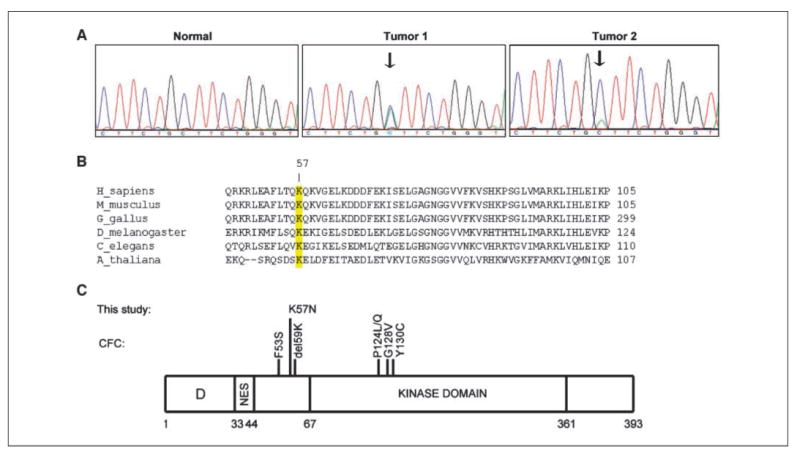
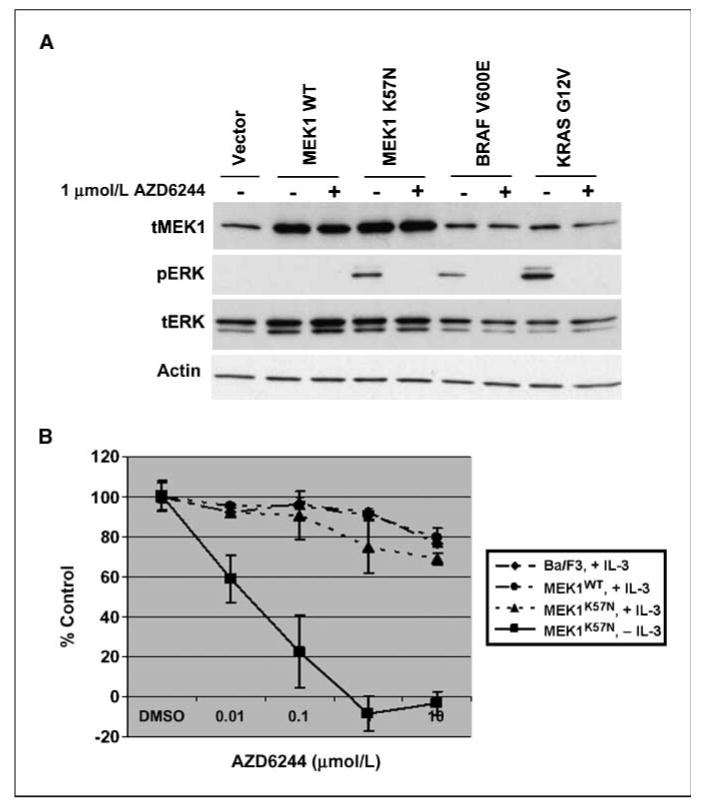
Genetic lesions affecting a number of kinases and other elements within the epidermal growth factor receptor (EGFR) signaling pathway have been implicated in the pathogenesis of human non-small-cell lung cancer (NSCLC). We performed mutational profiling of a large cohort of lung adenocarcinomas to uncover other potential somatic mutations in genes of this pathway that could contribute to lung tumorigenesis. We have identified in 2 of 207 primary lung tumors a somatic activating mutation in exon 2 of MEK1 (i.e., mitogen-activated protein kinase kinase 1 or MAP2K1) that substitutes asparagine for lysine at amino acid 57 (K57N) in the nonkinase portion of the kinase. Neither of these two tumors harbored known mutations in other genes encoding components of the EGFR signaling pathway (i.e., EGFR, HER2, KRAS, PIK3CA, and BRAF). Expression of mutant, but not wild-type, MEK1 leads to constitutive activity of extracellular signal-regulated kinase (ERK)-1/2 in human 293T cells and to growth factor-independent proliferation of murine Ba/F3 cells. A selective MEK inhibitor, AZD6244, inhibits mutant-induced ERK activity in 293T cells and growth of mutant-bearing Ba/F3 cells. We also screened 85 NSCLC cell lines for MEK1 exon 2 mutations; one line (NCI-H1437) harbors a Q56P substitution, a known transformation-competent allele of MEK1 originally identified in rat fibroblasts, and is sensitive to treatment with AZD6244. MEK1 mutants have not previously been reported in lung cancer and may provide a target for effective therapy in a small subset of patients with lung adenocarcinoma.
影响表皮生长因子受体(EGFR)信号通路中多种激酶和其他元件的基因损伤与人类非小细胞肺癌(NSCLC)的发病机制有关。我们对一大群肺腺癌进行了突变分析,以发现该通路基因中其他可能导致肺肿瘤发生的潜在体细胞突变。我们在207例原发性肺肿瘤中的2例中,发现MEK1(即丝裂原活化蛋白激酶激酶1或MAP2K1)外显子2存在体细胞激活突变,该突变在激酶的非激酶部分将氨基酸57位的赖氨酸替换为天冬酰胺(K57N)。这两个肿瘤均未在编码EGFR信号通路其他组分的基因(即EGFR、HER2、KRAS、PIK3CA和BRAF)中出现已知突变。在人293T细胞中,突变型而非野生型MEK1的表达导致细胞外信号调节激酶(ERK)-1/2的组成型活性,并使鼠Ba/F3细胞在无生长因子的情况下增殖。选择性MEK抑制剂AZD6244可抑制293T细胞中突变诱导的ERK活性以及携带突变的Ba/F3细胞的生长。我们还对85株NSCLC细胞系进行了MEK1外显子2突变筛查;一株细胞系(NCI-H1437)存在Q56P替换,这是最初在大鼠成纤维细胞中鉴定出的已知具有转化能力的MEK1等位基因,并且对AZD6244治疗敏感。此前尚未在肺癌中报道过MEK1突变体,其可能为一小部分肺腺癌患者提供有效治疗靶点。