Mitui M, Nahas S A, Du L T, Yang Z, Lai C H, Nakamura K, Arroyo S, Scott S, Purayidom A, Concannon P, Lavin M, Gatti R A
Department of Pathology and Laboratory Medicine, The David Geffen School of Medicine at the University of California, Los Angeles (UCLA), Los Angeles, California 90095-1732, USA.
Hum Mutat. 2009 Jan;30(1):12-21. doi: 10.1002/humu.20805.
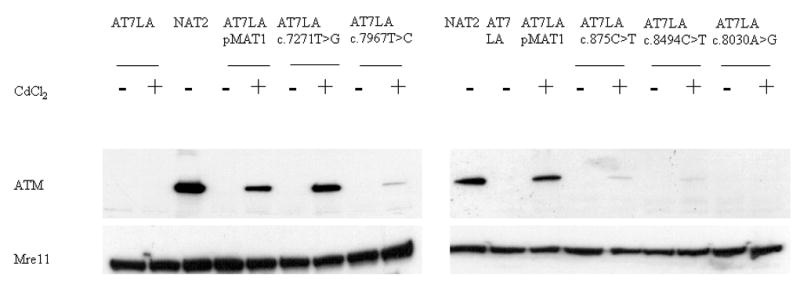
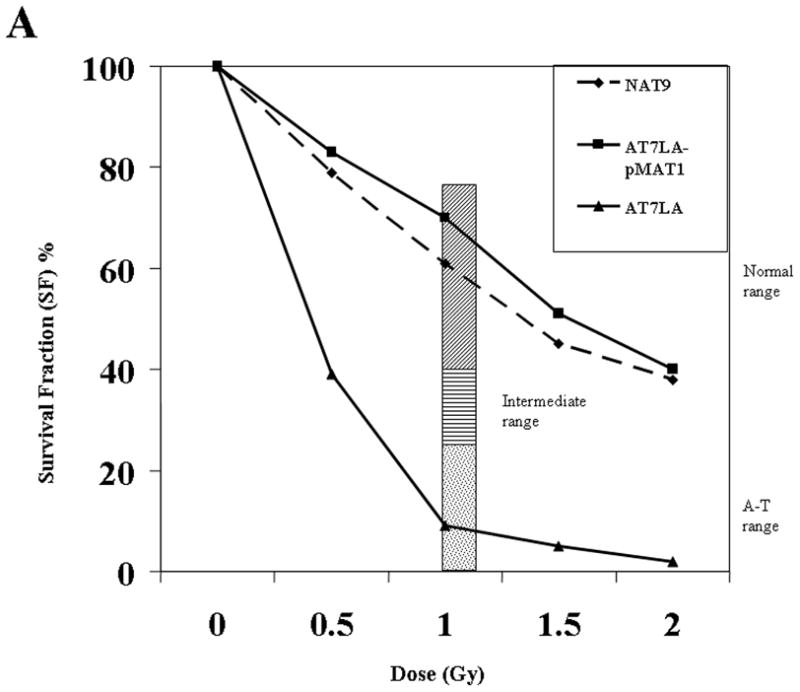
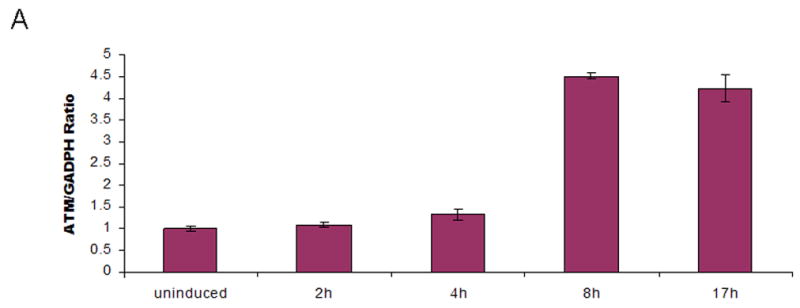
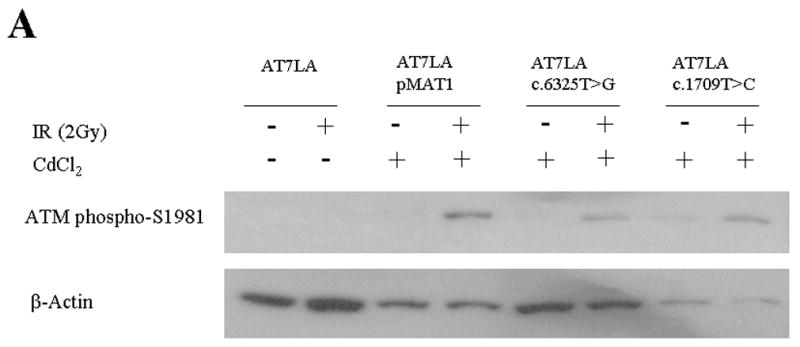
The functional consequences of missense variants are often difficult to predict. This becomes especially relevant when DNA sequence changes are used to determine a diagnosis or prognosis. To analyze the consequences of 12 missense variants in patients with mild forms of ataxia-telangiectasia (A-T), we employed site-directed mutagenesis of ataxia-telangiectasia mutated (ATM) cDNA followed by stable transfections into a single A-T cell line to isolate the effects of each allele on the cellular phenotype. After induction of the transfected cells with CdCl2, we monitored for successful ATM transcription and subsequently assessed: 1) intracellular ATM protein levels; 2) ionizing radiation (IR)-induced ATM kinase activity; and 3) cellular radiosensitivity. We then calculated SIFT and PolyPhen scores for the missense changes. Nine variants produced little or no correction of the A-T cellular phenotype and were interpreted to be ATM mutations; SIFT/PolyPhen scores supported this. Three variants corrected the cellular phenotype, suggesting that they represented benign variants or polymorphisms. SIFT and PolyPhen scores supported the functional analyses for one of these variants (c.1709T>C); the other two were predicted to be "not tolerated" (c.6188G>A and c.6325T>G) and were classified as "operationally neutral." Genotype/phenotype relationships were compared: three deleterious missense variants were associated with an increased risk of cancer (c.6679C>T, c.7271T>G, and c.8494C>T). In situ mutagenesis represents an effective experimental approach for distinguishing deleterious missense mutations from benign or operationally neutral missense variants.
错义变体的功能后果往往难以预测。当利用DNA序列变化来确定诊断或预后时,这一点就显得尤为重要。为了分析12个错义变体对轻度共济失调毛细血管扩张症(A-T)患者的影响,我们对共济失调毛细血管扩张症突变(ATM)cDNA进行了定点诱变,随后将其稳定转染到单一的A-T细胞系中,以分离每个等位基因对细胞表型的影响。在用CdCl2诱导转染细胞后,我们监测ATM转录是否成功,随后评估:1)细胞内ATM蛋白水平;2)电离辐射(IR)诱导的ATM激酶活性;3)细胞放射敏感性。然后,我们计算了错义变化的SIFT和PolyPhen评分。九个变体对A-T细胞表型几乎没有或没有产生校正作用,被解释为ATM突变;SIFT/PolyPhen评分支持这一结论。三个变体校正了细胞表型,表明它们代表良性变体或多态性。SIFT和PolyPhen评分支持了其中一个变体(c.1709T>C)的功能分析;另外两个变体预计为“不耐受”(c.6188G>A和c.6325T>G),并被归类为“操作上中性”。比较了基因型/表型关系:三个有害的错义变体与癌症风险增加相关(c.6679C>T、c.7271T>G和c.8494C>T)。原位诱变是一种有效的实验方法,可用于区分有害的错义突变与良性或操作上中性的错义变体。