Lovelock Paul K, Spurdle Amanda B, Mok Myth T S, Farrugia Daniel J, Lakhani Sunil R, Healey Sue, Arnold Stephen, Buchanan Daniel, Couch Fergus J, Henderson Beric R, Goldgar David E, Tavtigian Sean V, Chenevix-Trench Georgia, Brown Melissa A
Queensland Institute of Medical Research, PO Royal Brisbane Hospital, Herston Road, Queensland 4029, Australia.
Breast Cancer Res. 2007;9(6):R82. doi: 10.1186/bcr1826.
Many of the DNA sequence variants identified in the breast cancer susceptibility gene BRCA1 remain unclassified in terms of their potential pathogenicity. Both multifactorial likelihood analysis and functional approaches have been proposed as a means to elucidate likely clinical significance of such variants, but analysis of the comparative value of these methods for classifying all sequence variants has been limited.
We have compared the results from multifactorial likelihood analysis with those from several functional analyses for the four BRCA1 sequence variants A1708E, G1738R, R1699Q, and A1708V.
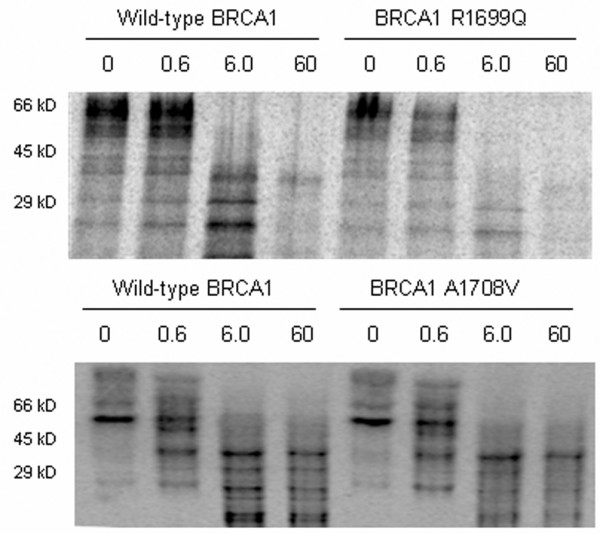
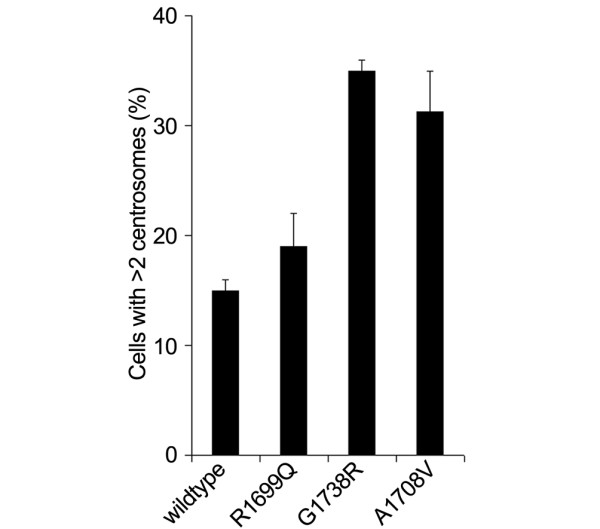
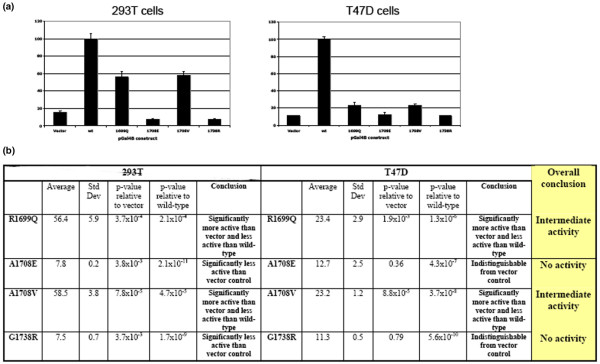
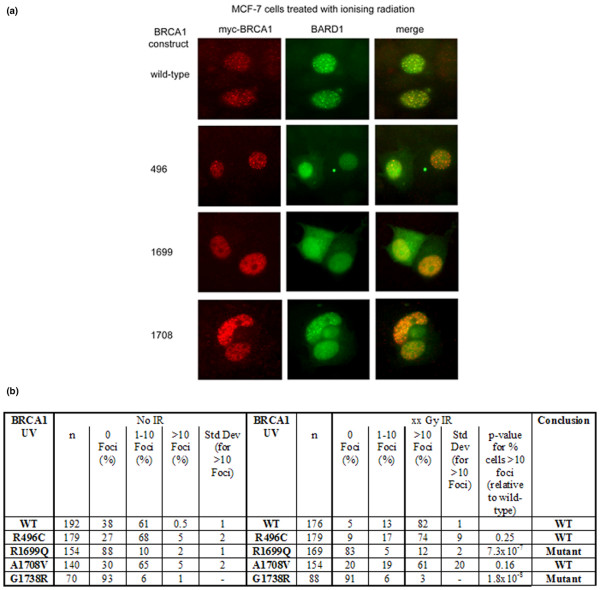
Our results show that multifactorial likelihood analysis, which incorporates sequence conservation, co-inheritance, segregation, and tumour immunohistochemical analysis, may improve classification of variants. For A1708E, previously shown to be functionally compromised, analysis of oestrogen receptor, cytokeratin 5/6, and cytokeratin 14 tumour expression data significantly strengthened the prediction of pathogenicity, giving a posterior probability of pathogenicity of 99%. For G1738R, shown to be functionally defective in this study, immunohistochemistry analysis confirmed previous findings of inconsistent 'BRCA1-like' phenotypes for the two tumours studied, and the posterior probability for this variant was 96%. The posterior probabilities of R1699Q and A1708V were 54% and 69%, respectively, only moderately suggestive of increased risk. Interestingly, results from functional analyses suggest that both of these variants have only partial functional activity. R1699Q was defective in foci formation in response to DNA damage and displayed intermediate transcriptional transactivation activity but showed no evidence for centrosome amplification. In contrast, A1708V displayed an intermediate transcriptional transactivation activity and a normal foci formation response in response to DNA damage but induced centrosome amplification.
These data highlight the need for a range of functional studies to be performed in order to identify variants with partially compromised function. The results also raise the possibility that A1708V and R1699Q may be associated with a low or moderate risk of cancer. While data pooling strategies may provide more information for multifactorial analysis to improve the interpretation of the clinical significance of these variants, it is likely that the development of current multifactorial likelihood approaches and the consideration of alternative statistical approaches will be needed to determine whether these individually rare variants do confer a low or moderate risk of breast cancer.
在乳腺癌易感基因BRCA1中鉴定出的许多DNA序列变异,就其潜在致病性而言仍未分类。多因素似然分析和功能分析方法都已被提出,作为阐明此类变异可能的临床意义的手段,但对这些方法在分类所有序列变异方面的比较价值的分析有限。
我们比较了多因素似然分析与针对BRCA1的四个序列变异A1708E、G1738R、R1699Q和A1708V的几种功能分析的结果。
我们的结果表明,结合序列保守性、共遗传、分离和肿瘤免疫组织化学分析的多因素似然分析,可能会改善变异的分类。对于先前显示功能受损的A1708E,对雌激素受体、细胞角蛋白5/6和细胞角蛋白14肿瘤表达数据的分析显著加强了致病性预测,致病性的后验概率为99%。对于在本研究中显示功能缺陷的G1738R,免疫组织化学分析证实了先前对所研究的两种肿瘤不一致的“BRCA1样”表型的发现,该变异的后验概率为96%。R1699Q和A1708V的后验概率分别为54%和69%,仅适度提示风险增加。有趣的是,功能分析结果表明这两种变异都只有部分功能活性。R1699Q在对DNA损伤的焦点形成方面有缺陷,显示出中等程度的转录反式激活活性,但没有中心体扩增的证据。相比之下,A1708V显示出中等程度的转录反式激活活性,对DNA损伤有正常的焦点形成反应,但诱导了中心体扩增。
这些数据突出了进行一系列功能研究以鉴定功能部分受损的变异的必要性。结果还提出了A1708V和R1699Q可能与低或中度癌症风险相关的可能性。虽然数据汇总策略可能为多因素分析提供更多信息,以改善对这些变异临床意义的解释,但可能需要开发当前的多因素似然方法并考虑替代统计方法,以确定这些个体罕见变异是否确实赋予低或中度乳腺癌风险。