Eglen Stephen J, Lofgreen Dan D, Raven Mary A, Reese Benjamin E
Cambridge Computational Biology Institute, Department of Applied Mathematics and Theoretical Physics, University of Cambridge, Cambridge, CB3 0WA, UK.
BMC Neurosci. 2008 Jul 21;9:68. doi: 10.1186/1471-2202-9-68.
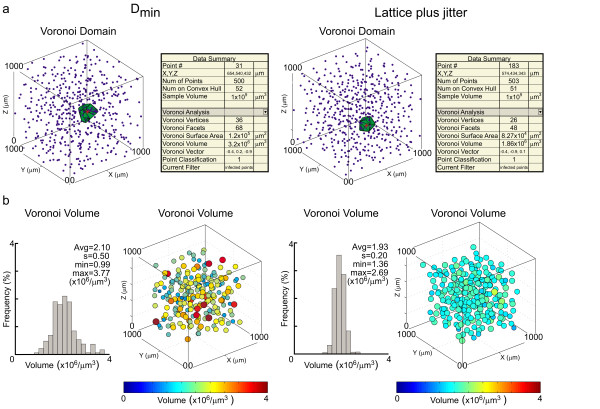
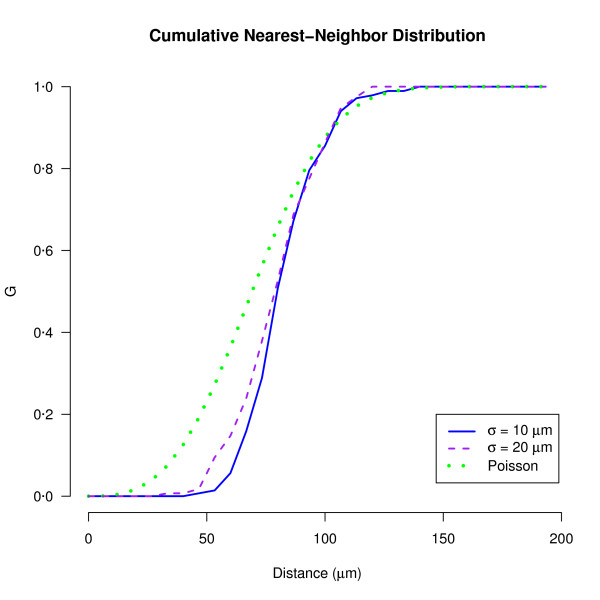
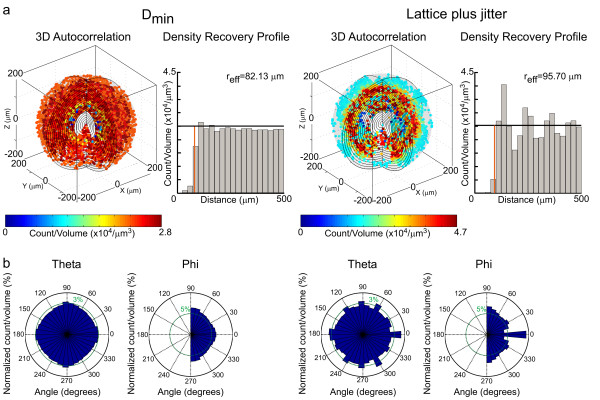
Multiple technologies have been brought to bear on understanding the three-dimensional morphology of individual neurons and glia within the brain, but little progress has been made on understanding the rules controlling cellular patterning. We describe new matlab-based software tools, now available to the scientific community, permitting the calculation of spatial statistics associated with 3D point patterns. The analyses are largely derived from the Delaunay tessellation of the field, including the nearest neighbor and Voronoi domain analyses, and from the spatial autocorrelogram.
Our tools enable the analysis of the spatial relationship between neurons within the central nervous system in 3D, and permit the modeling of these fields based on lattice-like simulations, and on simulations of minimal-distance spacing rules. Here we demonstrate the utility of our analysis methods to discriminate between two different simulated neuronal populations.
Together, these tools can be used to reveal the presence of nerve cell patterning and to model its foundation, in turn informing on the potential developmental mechanisms that govern its establishment. Furthermore, in conjunction with analyses of dendritic morphology, they can be used to determine the degree of dendritic coverage within a volume of tissue exhibited by mature nerve cells.
多种技术已被用于理解大脑中单个神经元和神经胶质细胞的三维形态,但在理解控制细胞模式形成的规则方面进展甚微。我们描述了一种基于Matlab的新软件工具,现已向科学界提供,它可以计算与三维点模式相关的空间统计量。这些分析主要源于该区域的德劳内三角剖分,包括最近邻分析和沃罗诺伊域分析,以及空间自相关图。
我们的工具能够对中枢神经系统中神经元之间的空间关系进行三维分析,并允许基于类似晶格的模拟以及最小距离间隔规则的模拟对这些区域进行建模。在此,我们展示了我们的分析方法在区分两种不同模拟神经元群体方面的效用。
总之,这些工具可用于揭示神经细胞模式的存在并对其基础进行建模,进而为控制其形成的潜在发育机制提供信息。此外,结合树突形态分析,它们可用于确定成熟神经细胞在一定体积组织内的树突覆盖程度。