Di Cello Francescopaolo, Hillion Joelle, Kowalski Jeanne, Ronnett Brigitte M, Aderinto Abimbola, Huso David L, Resar Linda M S
Hematology Division, The Johns Hopkins University School of Medicine, Baltimore, MD 21205, USA.
Mol Cancer Ther. 2008 Jul;7(7):2090-5. doi: 10.1158/1535-7163.MCT-07-2282.
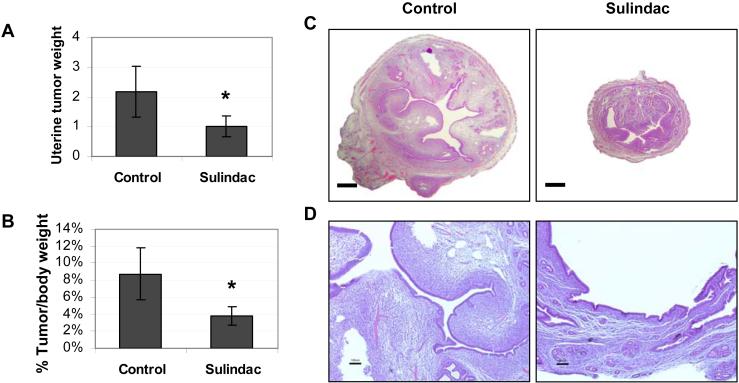
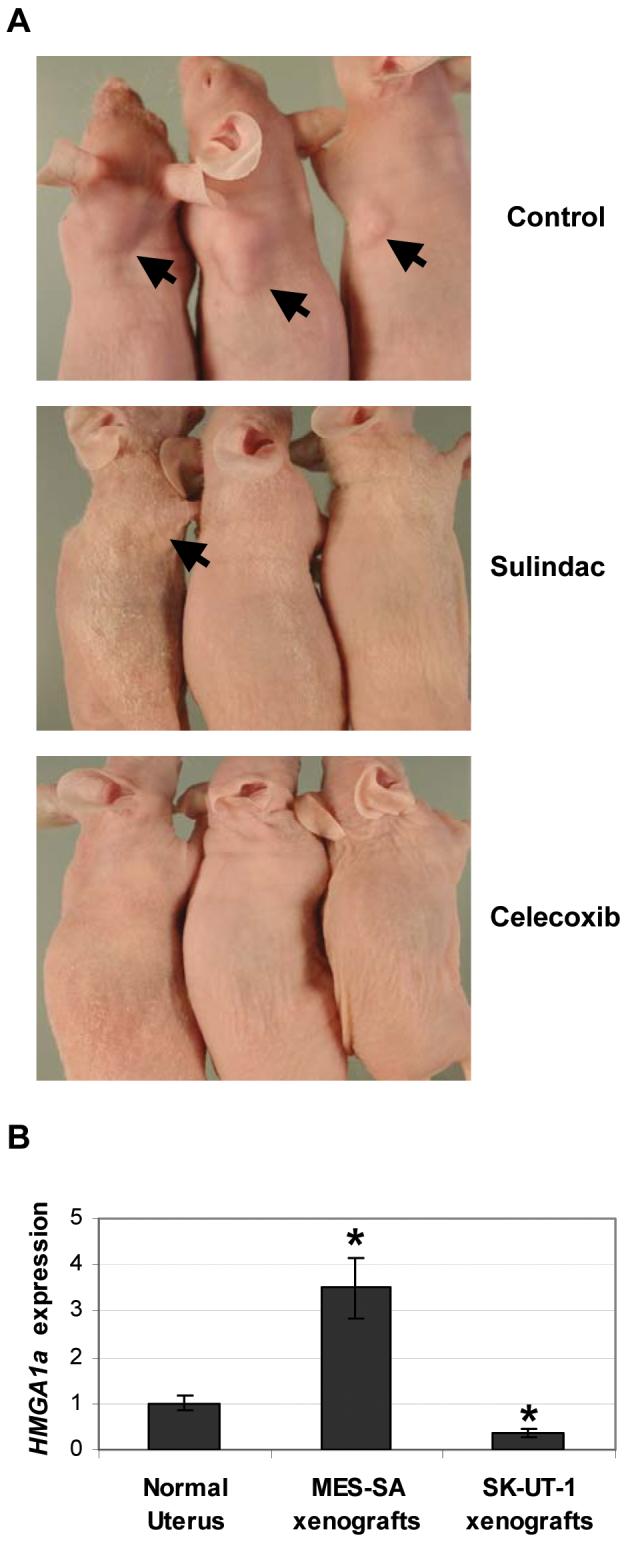
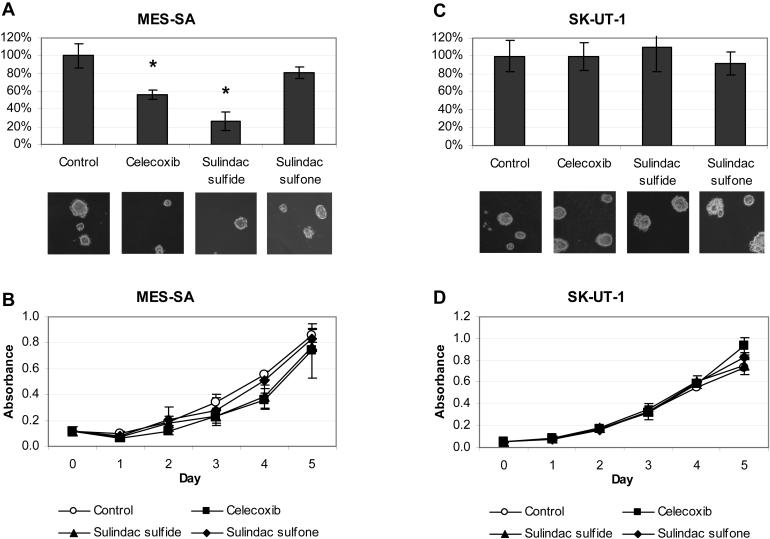
Uterine cancer is a common cause for cancer death in women and there is no effective therapy for metastatic disease. Thus, research is urgently needed to identify new therapeutic agents. We showed previously that all female HMGA1a transgenic mice develop malignant uterine tumors, indicating that HMGA1a causes uterine cancer in vivo. We also demonstrated that HMGA1a up-regulates cyclooxygenase-2 (COX-2) during tumorigenesis in this model. Similarly, we found that HMGA1a and COX-2 are overexpressed in human leiomyosarcomas, a highly malignant uterine cancer. Although epidemiologic studies indicate that individuals who take COX inhibitors have a lower incidence of some tumors, these inhibitors have not been evaluated in uterine cancer. Here, we show that HMGA1a mice on sulindac (a COX-1/COX-2 inhibitor) have significantly smaller uterine tumors than controls. To determine if COX inhibitors are active in human uterine cancers that overexpress HMGA1a, we treated cultured cells with sulindac sulfide or celecoxib (a specific COX-2 inhibitor). Both drugs block anchorage-independent growth in high-grade human uterine cancer cells that overexpress HMGA1a (MES-SA cells). In contrast, neither inhibitor blocked transformation in cells that do not overexpress HMGA1a. Moreover, xenograft tumors from MES-SA cells were significantly inhibited in mice on sulindac. More strikingly, no tumors formed in mice on celecoxib. These preclinical studies suggest that COX inhibitors could play a role in preventing tumor onset or progression in uterine cancers with dysregulation of the HMGA1a-COX-2 pathway. Importantly, these drugs have lower toxicity than chemotherapeutic agents used to treat advanced-stage uterine cancers.
子宫癌是女性癌症死亡的常见原因,对于转移性疾病尚无有效的治疗方法。因此,迫切需要开展研究以确定新的治疗药物。我们之前表明,所有雌性HMGA1a转基因小鼠都会发生恶性子宫肿瘤,这表明HMGA1a在体内会引发子宫癌。我们还证明,在该模型的肿瘤发生过程中,HMGA1a会上调环氧化酶-2(COX-2)。同样,我们发现HMGA1a和COX-2在人平滑肌肉瘤(一种高度恶性的子宫癌)中过度表达。尽管流行病学研究表明,服用COX抑制剂的个体某些肿瘤的发病率较低,但这些抑制剂尚未在子宫癌中进行评估。在此,我们表明,服用舒林酸(一种COX-1/COX-2抑制剂)的HMGA1a小鼠的子宫肿瘤明显小于对照组。为了确定COX抑制剂在过度表达HMGA1a的人子宫癌中是否有活性,我们用舒林酸硫化物或塞来昔布(一种特异性COX-2抑制剂)处理培养的细胞。两种药物都能阻断过度表达HMGA1a的高级别人子宫癌细胞(MES-SA细胞)的非锚定依赖性生长。相比之下,这两种抑制剂都不能阻断未过度表达HMGA1a的细胞的转化。此外,在服用舒林酸的小鼠中,MES-SA细胞的异种移植肿瘤受到显著抑制。更引人注目的是,服用塞来昔布的小鼠没有形成肿瘤。这些临床前研究表明,COX抑制剂可能在预防HMGA1a-COX-2途径失调的子宫癌的肿瘤发生或进展中发挥作用。重要的是,这些药物的毒性低于用于治疗晚期子宫癌的化疗药物。