Alkema L, Raftery A E, Brown T
University of Washington, Center for Statistics and the Social Sciences, Seattle, Washington, USA.
Sex Transm Infect. 2008 Aug;84 Suppl 1(Suppl_1):i11-i16. doi: 10.1136/sti.2008.029991.
To construct confidence intervals for HIV prevalence in countries with generalised epidemics.
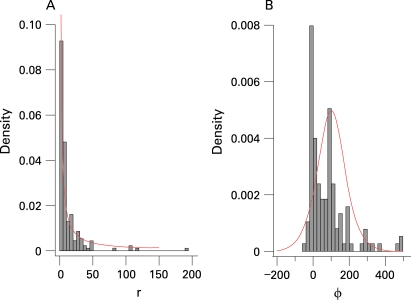
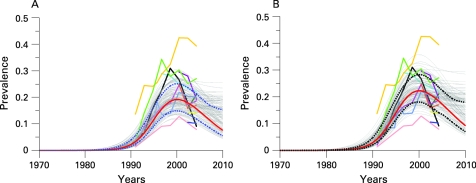
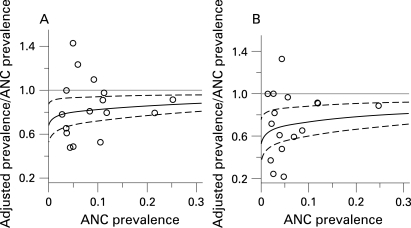
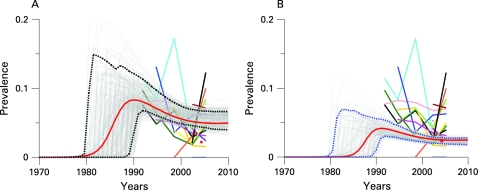
In the Bayesian melding approach, a sample of country-specific epidemic curves describing HIV prevalence over time is derived based on time series of antenatal clinic prevalence data and general information on the parameters that describe the HIV epidemic. The prevalence trends at antenatal clinics are calibrated to population-based HIV prevalence estimates from national surveys. For countries without population based estimates, a general calibration method is developed. Based on the sample of calibrated epidemic curves, we derive annual 95% confidence intervals for HIV prevalence. The curve that best represents the data at antenatal clinics and population-based surveys, as well as general information about the epidemic, is chosen to represent the best estimates and predictions.
We present results for urban areas in Haiti and Namibia to illustrate the estimates and confidence intervals that are derived with the methodology.
为广泛流行艾滋病的国家构建艾滋病病毒流行率的置信区间。
在贝叶斯融合方法中,基于产前诊所流行率数据的时间序列以及描述艾滋病病毒流行情况的参数的一般信息,得出描述各国艾滋病病毒流行率随时间变化的特定国家流行曲线样本。将产前诊所的流行趋势校准为基于全国调查的人群艾滋病病毒流行率估计值。对于没有基于人群估计值的国家,开发了一种通用校准方法。基于校准后的流行曲线样本,我们得出艾滋病病毒流行率的年度95%置信区间。选择最能代表产前诊所数据、基于人群的调查以及有关该流行情况的一般信息的曲线,以代表最佳估计值和预测结果。
我们展示了海地和纳米比亚城市地区的结果,以说明通过该方法得出的估计值和置信区间。