Brown T, Salomon J A, Alkema L, Raftery A E, Gouws E
Population and Health Studies, East-West Center, Honolulu, HI, USA.
Sex Transm Infect. 2008 Aug;84 Suppl 1(Suppl_1):i5-i10. doi: 10.1136/sti.2008.030437.
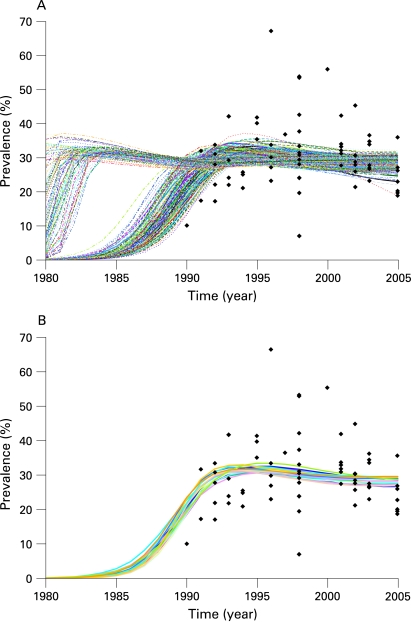
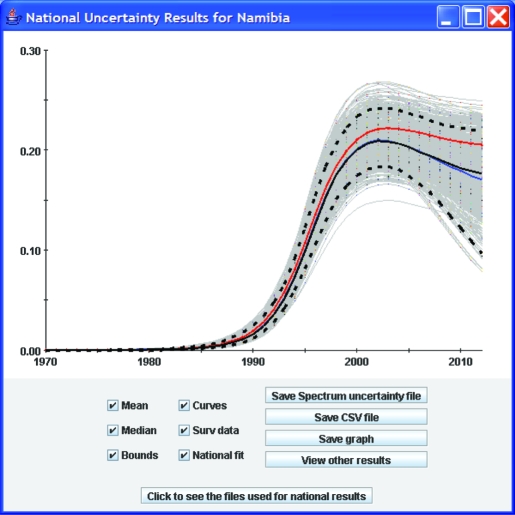
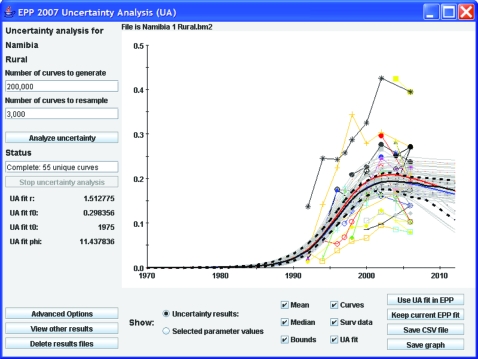
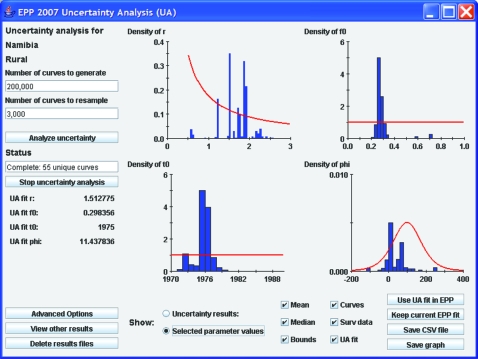
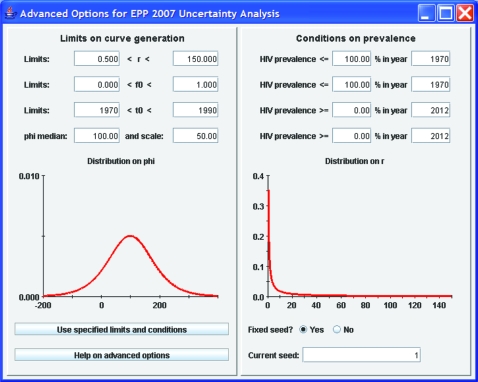
The UNAIDS Estimation and Projection Package (EPP) was developed to aid in country-level estimation and short-term projection of HIV/AIDS epidemics. This paper describes advances reflected in the most recent update of this tool (EPP 2007), and identifies key issues that remain to be addressed in future versions. The major change to EPP 2007 is the addition of uncertainty estimation for generalised epidemics using the technique of Bayesian melding, but many additional changes have been made to improve the user interface and efficiency of the package. This paper describes the interface for uncertainty analysis, changes to the user interface for calibration procedures and other user interface changes to improve EPP's utility in different settings. While formal uncertainty assessment remains an unresolved challenge in low-level and concentrated epidemics, the Bayesian melding approach has been applied to provide analysts in these settings with a visual depiction of the range of models that may be consistent with their data. In fitting the model to countries with longer-running epidemics in sub-Saharan Africa, a number of limitations have been identified in the current model with respect to accommodating behaviour change and accurately replicating certain observed epidemic patterns. This paper discusses these issues along with their implications for future changes to EPP and to the underlying UNAIDS Reference Group model.
联合国艾滋病规划署估计与预测软件包(EPP)的开发旨在协助各国对艾滋病毒/艾滋病疫情进行国家级估计和短期预测。本文介绍了该工具最新版本(EPP 2007)所体现的进展,并确定了未来版本中仍有待解决的关键问题。EPP 2007的主要变化是采用贝叶斯融合技术增加了对广泛流行疫情的不确定性估计,但还进行了许多其他更改以改善软件包的用户界面和效率。本文描述了不确定性分析的界面、校准程序用户界面的更改以及其他用户界面更改,以提高EPP在不同环境中的实用性。虽然在低水平和集中流行疫情中,正式的不确定性评估仍是一个未解决的挑战,但贝叶斯融合方法已被应用,以便为这些环境中的分析人员提供可能与其数据一致的一系列模型的直观描述。在将该模型应用于撒哈拉以南非洲地区流行时间较长的国家时,发现当前模型在适应行为变化和准确复制某些观察到的流行模式方面存在一些局限性。本文讨论了这些问题以及它们对EPP未来更改和联合国艾滋病规划署参考小组基础模型的影响。