Bartlett Megan R, Fink Ruth B, Schwartz Myrna F, Linebarger Marcia
Moss Rehabilitation Research Institute, Albert Einstein Healthcare Network, Philadelphia, PA, USA.
Aphasiology. 2007;21(5):475-498. doi: 10.1080/02687030601154167.
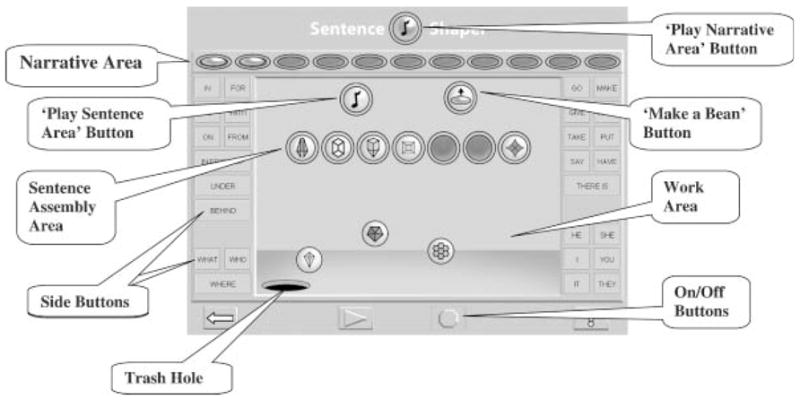
SentenceShaper() (SSR) is a computer program that supports spoken language production in aphasia by recording and storing the fragments that the user speaks into the microphone, making them available for playback and allowing them to be combined and integrated into larger structures (i.e., sentences and narratives). A prior study that measured utterance length and grammatical complexity in story-plot narratives produced with and without the aid of SentenceShaper demonstrated an "aided effect" in some speakers with aphasia, meaning an advantage for the narratives that were produced with the support of this communication aid (Linebarger, Schwartz, Romania, Kohn, & Stephens, 2000). The present study deviated from Linebarger et al.'s methods in key respects and again showed aided effects of SentenceShaper in persons with aphasia. AIMS: Aims were (1) to demonstrate aided effects in "functional narratives" conveying hypothetical real-life situations from a first person perspective; (2) for the first time, to submit aided and spontaneous speech samples to listener judgements of informativeness; and (3) to produce preliminary evidence on topic-specific carryover from SentenceShaper, i.e., carryover from an aided production to a subsequent unaided production on the same topic. METHODS #ENTITYSTARTX00026; PROCEDURES: Five individuals with chronic aphasia created narratives on two topics, under three conditions: Unaided (U), Aided (SSR), and Post-SSR Unaided (Post-U). The 30 samples (5 participants, 2 topics, 3 conditions) were randomised and judged for informativeness by graduate students in speech-language pathology. The method for rating was Direct Magnitude Estimation (DME). OUTCOMES #ENTITYSTARTX00026; RESULTS: Repeated measures ANOVAs were performed on DME ratings for each participant on each topic. A main effect of Condition was present for four of the five participants, on one or both topics. Planned contrasts revealed that the aided effect (SSR >U) was significant in each of these cases. For two participants, there was also topic-specific carryover (Post-U >U). CONCLUSIONS: Listeners judged functional narratives generated on SentenceShaper to be more informative than comparable narratives spoken spontaneously. This extends the evidence for aided effects of SentenceShaper. There was also evidence, albeit weaker, for topic-specific carryover, suggesting that the program might be used effectively to practise for upcoming face-to-face interactions.
SentenceShaper(SSR)是一款计算机程序,它通过记录并存储用户对着麦克风说出的片段,来支持失语症患者的口语表达,使这些片段可供回放,并能将它们组合并整合为更大的结构(即句子和叙述)。之前一项研究比较了在有无SentenceShaper辅助下生成的故事情节叙述中的话语长度和语法复杂性,结果显示该程序对一些失语症患者有“辅助效果”,即在这种交流辅助工具的支持下生成的叙述具有优势(Linebarger、Schwartz、Romania、Kohn和Stephens,2000年)。本研究在关键方面与Linebarger等人的方法不同,再次显示了SentenceShaper对失语症患者的辅助效果。
本研究的目的是:(1)在从第一人称视角传达假设的现实生活情境的“功能性叙述”中证明辅助效果;(2)首次将有辅助和自发的语音样本提交给听众进行信息性判断;(3)提供关于SentenceShaper特定主题延续性的初步证据,即从有辅助的表达延续到关于同一主题的后续无辅助表达。
方法#实体开始X00026;程序:五名慢性失语症患者在三种条件下就两个主题创作叙述:无辅助(U)、有辅助(SSR)和SSR后无辅助(Post-U)。这30个样本(5名参与者,2个主题,3种条件)被随机排列,并由言语语言病理学专业的研究生对其信息性进行判断。评分方法为直接数量估计(DME)。
结果#实体开始X00026;结果:对每个参与者每个主题的DME评分进行重复测量方差分析。五名参与者中有四名在一个或两个主题上出现了条件的主效应。计划对比显示,在每种情况下,辅助效果(SSR>U)都很显著。对于两名参与者,还存在特定主题的延续性(Post-U>U)。
听众认为在SentenceShaper上生成的功能性叙述比自发说出的类似叙述更具信息性。这扩展了SentenceShaper辅助效果的证据。也有证据表明存在特定主题的延续性,尽管较弱,这表明该程序可能有效地用于为即将到来的面对面交流进行练习。