Toupet Karine, Compan Valérie, Crozet Carole, Mourton-Gilles Chantal, Mestre-Francés Nadine, Ibos Françoise, Corbeau Pierre, Verdier Jean-Michel, Perrier Véronique
Univ Montpellier 2, Montpellier, France.
PLoS One. 2008 Jul 23;3(7):e2773. doi: 10.1371/journal.pone.0002773.
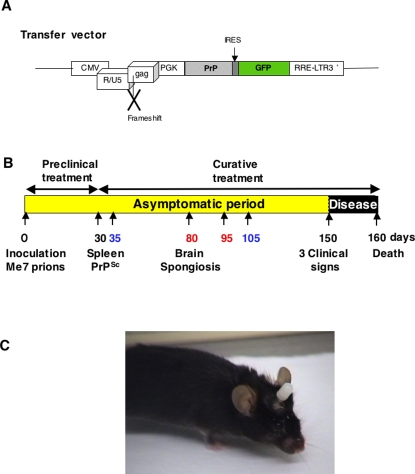
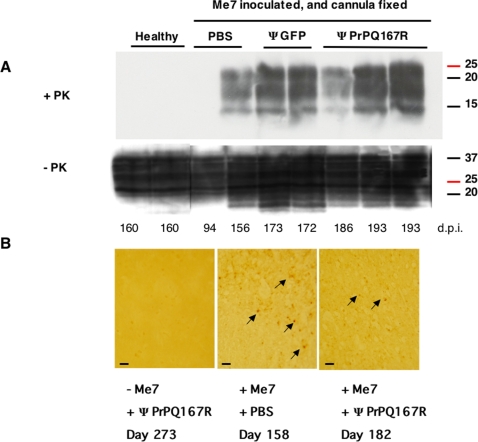
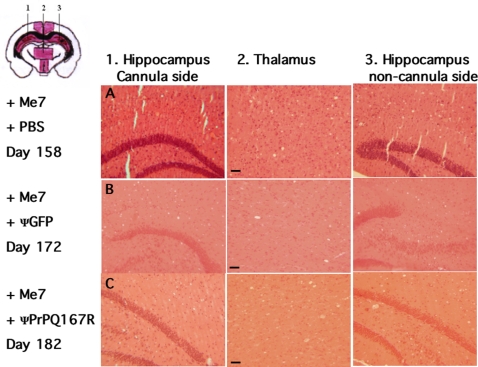
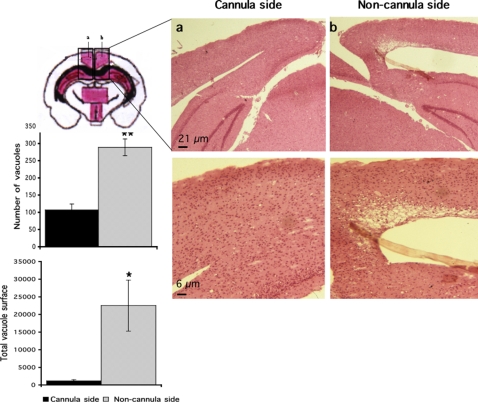
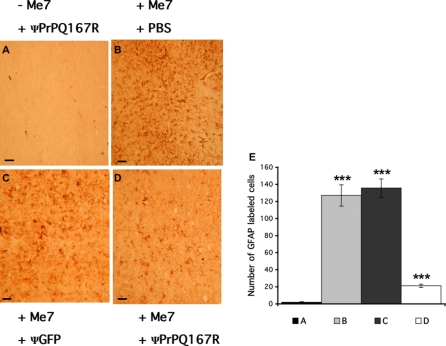
Classical drug therapies against prion diseases have encountered serious difficulties. It has become urgent to develop radically different therapeutic strategies. Previously, we showed that VSV-G pseudotyped FIV derived vectors carrying dominant negative mutants of the PrP gene are efficient to inhibit prion replication in chronically prion-infected cells. Besides, they can transduce neurons and cells of the lymphoreticular system, highlighting their potential use in gene therapy approaches. Here, we used lentiviral gene transfer to deliver PrPQ167R virions possessing anti-prion properties to analyse their efficiency in vivo. Since treatment for prion diseases is initiated belatedly in human patients, we focused on the development of a curative therapeutic protocol targeting the late stage of the disease, either at 35 or 105 days post-infection (d.p.i.) with prions. We observed a prolongation in the lifespan of the treated mice that prompted us to develop a system of cannula implantation into the brain of prion-infected mice. Chronic injections of PrPQ167R virions were done at 80 and 95 d.p.i. After only two injections, survival of the treated mice was extended by 30 days (20%), accompanied by substantial improvement in behaviour. This delay was correlated with: (i) a strong reduction of spongiosis in the ipsilateral side of the brain by comparison with the contralateral side; and (ii) a remarkable decrease in astrocytic gliosis in the whole brain. These results suggest that chronic injections of dominant negative lentiviral vectors into the brain, may be a promising approach for a curative treatment of prion diseases.
针对朊病毒疾病的传统药物疗法遇到了严重困难。开发截然不同的治疗策略已变得刻不容缓。此前,我们表明携带PrP基因显性负性突变体的VSV - G假型化FIV衍生载体能够有效抑制慢性朊病毒感染细胞中的朊病毒复制。此外,它们可以转导神经元和淋巴网状系统的细胞,突出了其在基因治疗方法中的潜在用途。在此,我们使用慢病毒基因转移来递送具有抗朊病毒特性的PrPQ167R病毒粒子,以分析其在体内的效率。由于人类患者针对朊病毒疾病的治疗开始得较晚,我们专注于开发一种针对疾病晚期的治愈性治疗方案,即在感染朊病毒后的35天或105天进行治疗。我们观察到治疗小鼠的寿命延长,这促使我们开发一种将套管植入朊病毒感染小鼠大脑的系统。在感染后80天和95天对小鼠进行PrPQ167R病毒粒子的慢性注射。仅经过两次注射,治疗小鼠的存活期延长了30天(20%),同时行为有显著改善。这种延迟与以下因素相关:(i)与对侧相比,大脑同侧的海绵状病变明显减少;(ii)全脑星形细胞胶质增生显著减少。这些结果表明,向大脑慢性注射显性负性慢病毒载体可能是一种有前景的治愈朊病毒疾病的治疗方法。