Deweese Joseph E, Burgin Alex B, Osheroff Neil
Department of Biochemistry, Vanderbilt University School of Medicine, Nashville, TN 37232-0146, USA.
Nucleic Acids Res. 2008 Sep;36(15):4883-93. doi: 10.1093/nar/gkn466. Epub 2008 Jul 24.
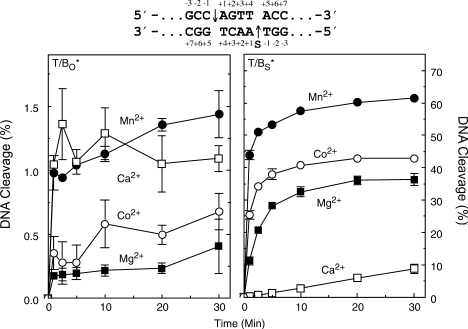
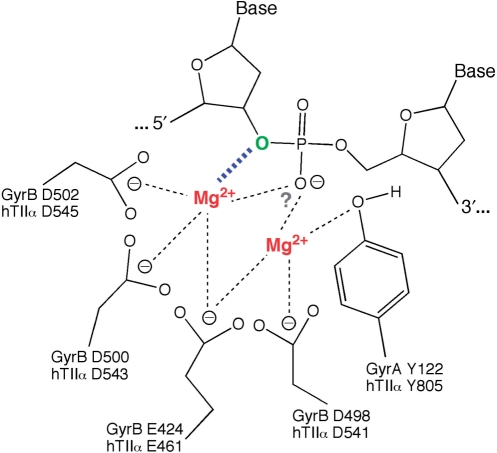
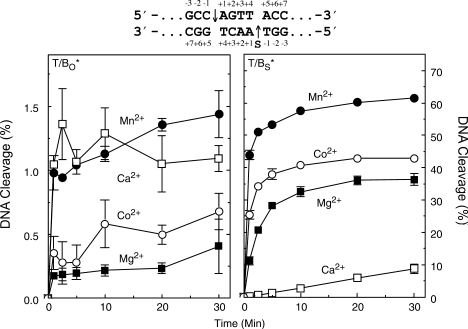
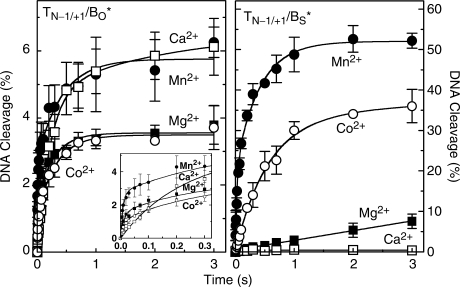
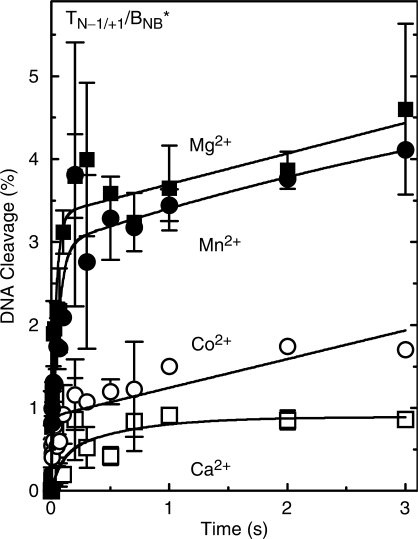
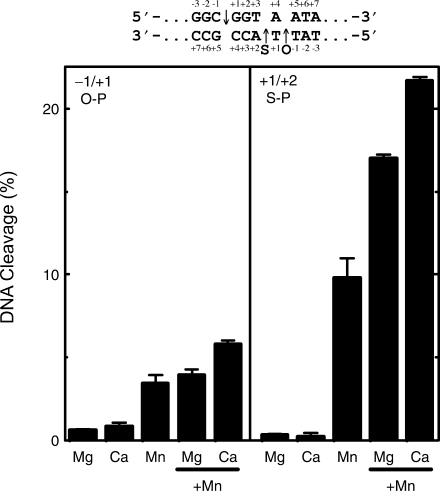
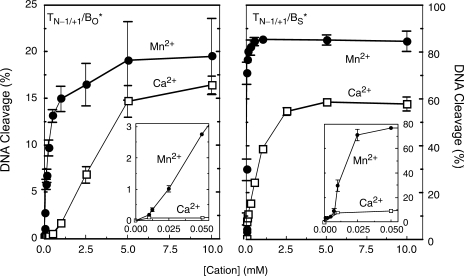
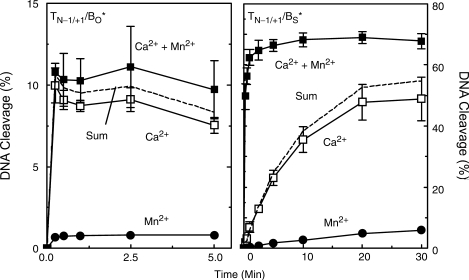
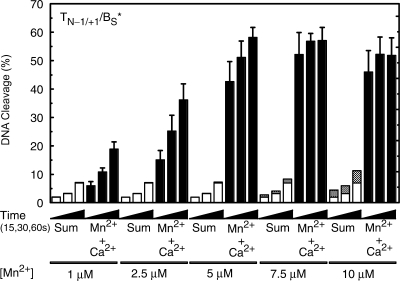
The DNA cleavage reaction of human topoisomerase IIalpha is critical to all of the physiological and pharmacological functions of the protein. While it has long been known that the type II enzyme requires a divalent metal ion in order to cleave DNA, the role of the cation in this process is not known. To resolve this fundamental issue, the present study utilized a series of divalent metal ions with varying thiophilicities in conjunction with DNA cleavage substrates that replaced the 3'-bridging oxygen of the scissile bond with a sulfur atom (i.e. 3'-bridging phosphorothiolates). Rates and levels of DNA scission were greatly enhanced when thiophilic metal ions were included in reactions that utilized sulfur-containing substrates. Based on these results and those of reactions that employed divalent cation mixtures, we propose that topoisomerase IIalpha mediates DNA cleavage via a two-metal-ion mechanism. In this model, one of the metal ions makes a critical interaction with the 3'-bridging atom of the scissile phosphate. This interaction greatly accelerates rates of enzyme-mediated DNA cleavage, and most likely is needed to stabilize the leaving 3'-oxygen.
人类拓扑异构酶IIα的DNA切割反应对于该蛋白的所有生理和药理功能都至关重要。虽然早就知道II型酶切割DNA需要二价金属离子,但其在这一过程中的作用尚不清楚。为了解决这一基本问题,本研究使用了一系列具有不同亲硫性的二价金属离子,并结合了用硫原子取代可裂键3'-桥连氧的DNA切割底物(即3'-桥连硫代磷酸酯)。当在使用含硫底物的反应中加入亲硫金属离子时,DNA断裂的速率和程度大大提高。基于这些结果以及使用二价阳离子混合物的反应结果,我们提出拓扑异构酶IIα通过双金属离子机制介导DNA切割。在这个模型中,其中一个金属离子与可裂磷酸酯的3'-桥连原子发生关键相互作用。这种相互作用极大地加速了酶介导的DNA切割速率,并且很可能是稳定离去的3'-氧所必需的。