Guo Xuefeng, Gorodetsky Alon A, Hone James, Barton Jacqueline K, Nuckolls Colin
Department of Chemistry, Columbia University, New York 10027, USA.
Nat Nanotechnol. 2008 Mar;3(3):163-7. doi: 10.1038/nnano.2008.4. Epub 2008 Feb 10.
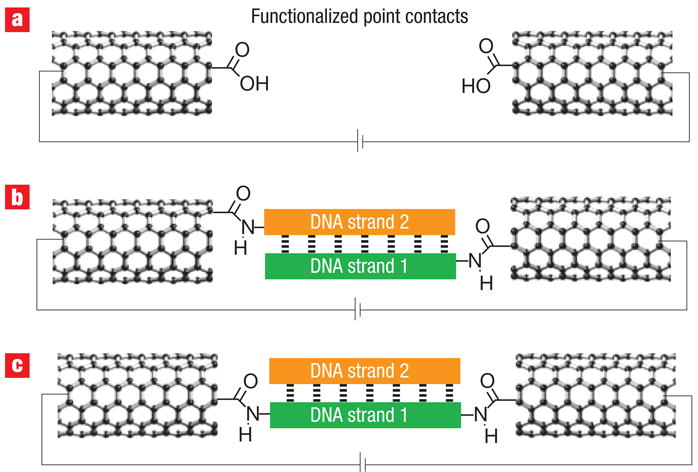
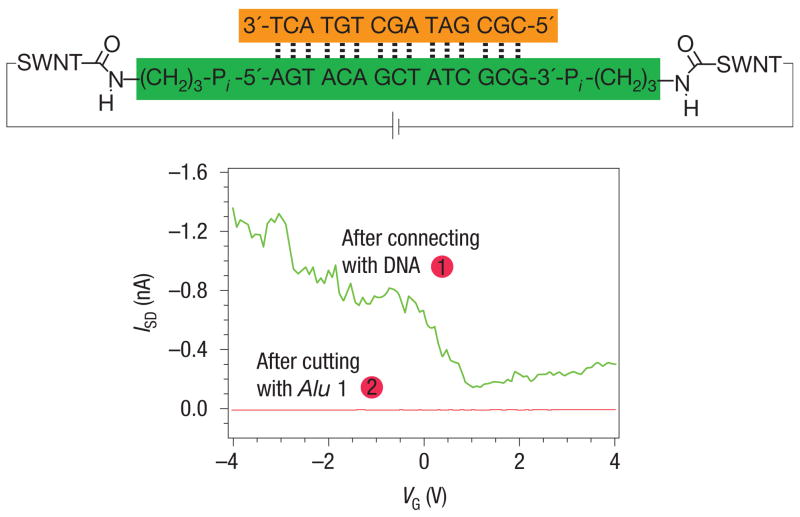
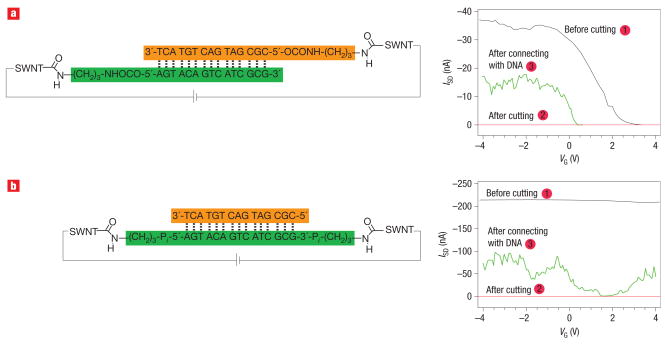
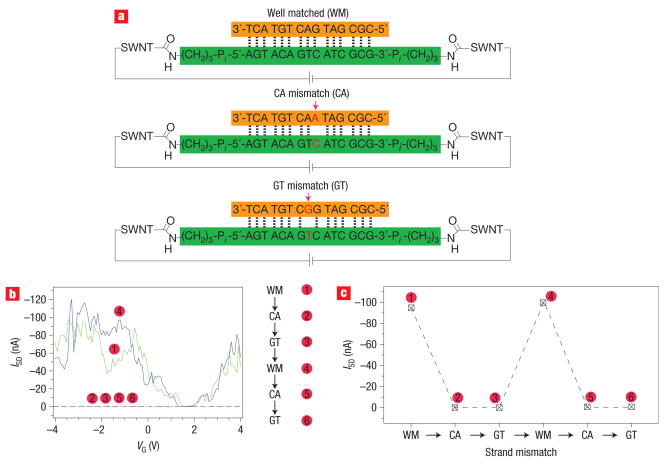
We describe a general method to integrate DNA strands between single-walled carbon nanotube electrodes and to measure their electrical properties. We modified DNA sequences with amines on either the 5' terminus or both the 3' and 5' termini and coupled these to the single-walled carbon nanotube electrodes through amide linkages, enabling the electrical properties of complementary and mismatched strands to be measured. Well-matched duplex DNA in the gap between the electrodes exhibits a resistance on the order of 1 M(Omega). A single GT or CA mismatch in a DNA 15-mer increases the resistance of the duplex approximately 300-fold relative to a well-matched one. Certain DNA sequences oriented within this gap are substrates for Alu I, a blunt end restriction enzyme. This enzyme cuts the DNA and eliminates the conductive path, supporting the supposition that the DNA is in its native conformation when bridging the ends of the single-walled carbon nanotubes.
我们描述了一种将DNA链整合到单壁碳纳米管电极之间并测量其电学性质的通用方法。我们在DNA序列的5'末端或3'和5'末端都用胺进行了修饰,并通过酰胺键将这些序列连接到单壁碳纳米管电极上,从而能够测量互补链和错配链的电学性质。电极之间间隙中匹配良好的双链DNA表现出约1 MΩ的电阻。在15聚体DNA中单个GT或CA错配会使双链体的电阻相对于匹配良好的双链体增加约300倍。在此间隙内定向的某些DNA序列是平端限制酶Alu I的底物。这种酶切割DNA并消除导电路径,支持了DNA在桥接单壁碳纳米管末端时处于天然构象的假设。