Saad Jamil S, Ablan Sherimay D, Ghanam Ruba H, Kim Andrew, Andrews Kalola, Nagashima Kunio, Soheilian Ferri, Freed Eric O, Summers Michael F
Howard Hughes Medical Institute, Department of Chemistry and Biochemistry, University of Maryland Baltimore County, 1000 Hilltop Circle, Baltimore, MD 21250, USA.
J Mol Biol. 2008 Oct 3;382(2):434-47. doi: 10.1016/j.jmb.2008.07.027. Epub 2008 Jul 16.
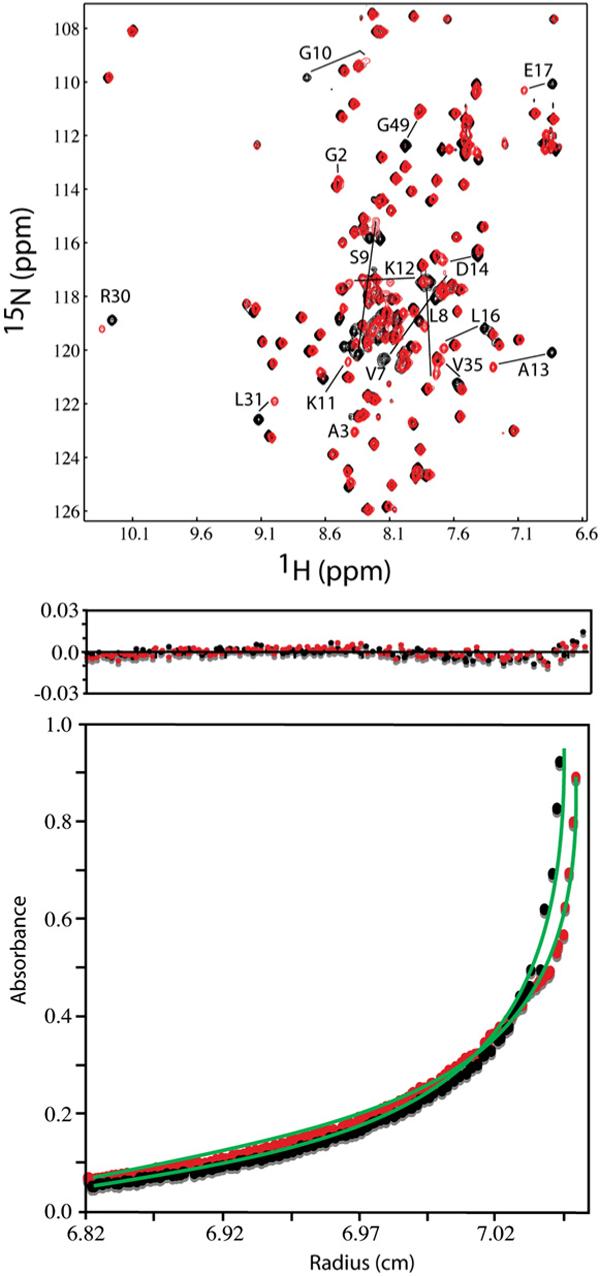
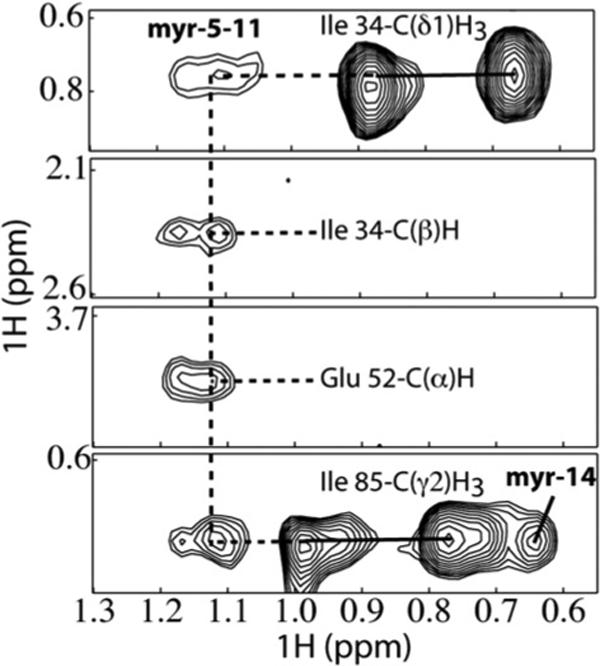
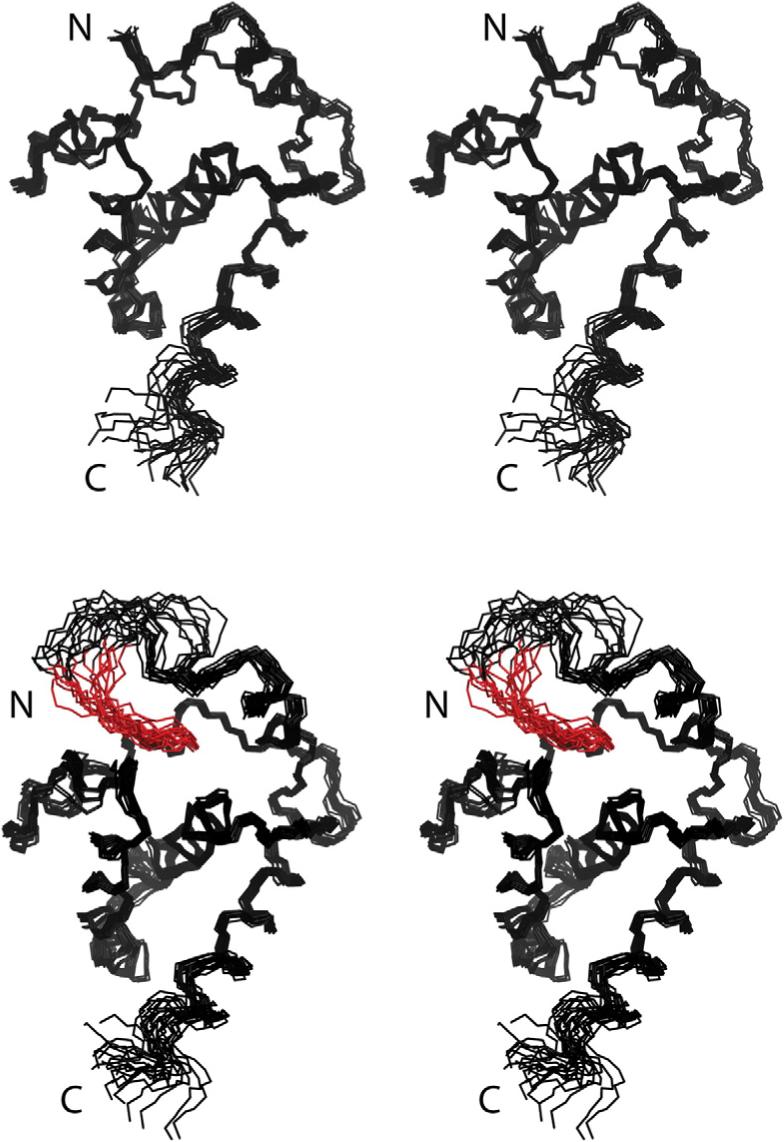
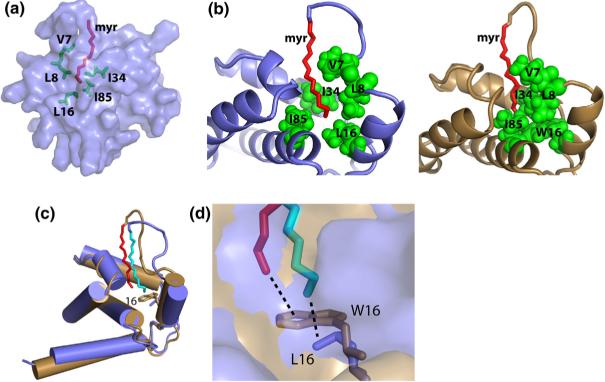
During the late phase of retroviral replication, newly synthesized Gag proteins are targeted to the plasma membrane (PM), where they assemble and bud to form immature virus particles. Membrane targeting by human immunodeficiency virus type 1 (HIV-1) Gag is mediated by the PM marker molecule phosphatidylinositol-(4,5)-bisphosphate [PI(4,5)P(2)], which is capable of binding to the matrix (MA) domain of Gag in an extended lipid conformation and of triggering myristate exposure. Here, we show that, as observed previously for HIV-1 MA, the myristyl group of HIV-2 MA is partially sequestered within a narrow hydrophobic tunnel formed by side chains of helices 1, 2, 3, and 5. However, the myristate of HIV-2 MA is more tightly sequestered than that of the HIV-1 protein and does not exhibit concentration-dependent exposure. Soluble PI(4,5)P(2) analogs containing truncated acyl chains bind HIV-2 MA and induce minor long-range structural changes but do not trigger myristate exposure. Despite these differences, the site of HIV-2 assembly in vivo can be manipulated by enzymes that regulate PI(4,5)P(2) localization. Our findings indicate that HIV-1 and HIV-2 are both targeted to the PM for assembly via a PI(4,5)P(2)-dependent mechanism, despite differences in the sensitivity of the MA myristyl switch, and suggest a potential mechanism that may contribute to the poor replication kinetics of HIV-2.
在逆转录病毒复制的后期,新合成的Gag蛋白被靶向运输到质膜(PM),在那里它们组装并出芽形成未成熟的病毒颗粒。1型人类免疫缺陷病毒(HIV-1)Gag的膜靶向作用由质膜标记分子磷脂酰肌醇-(4,5)-二磷酸[PI(4,5)P₂]介导,该分子能够以延伸的脂质构象与Gag的基质(MA)结构域结合,并触发肉豆蔻酸暴露。在此,我们表明,正如先前对HIV-1 MA所观察到的那样,HIV-2 MA的肉豆蔻酰基部分被隔离在由螺旋1、2、3和5的侧链形成的狭窄疏水通道内。然而,HIV-2 MA的肉豆蔻酸比HIV-1蛋白的肉豆蔻酸隔离得更紧密,并且不表现出浓度依赖性暴露。含有截短酰基链的可溶性PI(4,5)P₂类似物与HIV-2 MA结合并诱导微小的长程结构变化,但不会触发肉豆蔻酸暴露。尽管存在这些差异,但HIV-2在体内的组装位点可通过调节PI(4,5)P₂定位的酶来操纵。我们的研究结果表明,尽管MA肉豆蔻酰开关的敏感性存在差异,但HIV-1和HIV-2都是通过PI(4,5)P₂依赖性机制靶向运输到质膜进行组装的,并提示了一种可能导致HIV-2复制动力学较差的潜在机制。