Mäntylä Elina, Alessio Giorgio A, Blande James D, Heijari Juha, Holopainen Jarmo K, Laaksonen Toni, Piirtola Panu, Klemola Tero
Section of Ecology, Department of Biology, University of Turku, Turku, Finland.
PLoS One. 2008 Jul 30;3(7):e2832. doi: 10.1371/journal.pone.0002832.
An understanding of the evolution of potential signals from plants to the predators of their herbivores may provide exciting examples of co-evolution among multiple trophic levels. Understanding the mechanism behind the attraction of predators to plants is crucial to conclusions about co-evolution. For example, insectivorous birds are attracted to herbivore-damaged trees without seeing the herbivores or the defoliated parts, but it is not known whether birds use cues from herbivore-damaged plants with a specific adaptation of plants for this purpose.
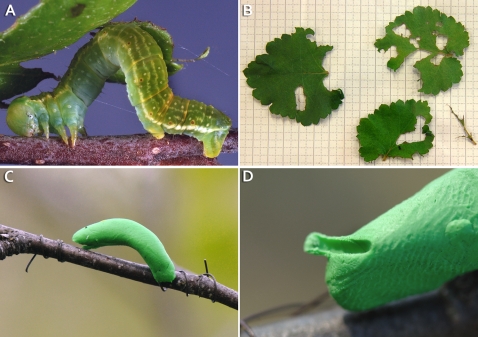
We examined whether signals from damaged trees attract avian predators in the wild and whether birds could use volatile organic compound (VOC) emissions or net photosynthesis of leaves as cues to detect herbivore-rich trees. We conducted a field experiment with mountain birches (Betula pubescens ssp. czerepanovii), their main herbivore (Epirrita autumnata) and insectivorous birds. Half of the trees had herbivore larvae defoliating trees hidden inside branch bags and half had empty bags as controls. We measured predation rate of birds towards artificial larvae on tree branches, and VOC emissions and net photosynthesis of leaves.
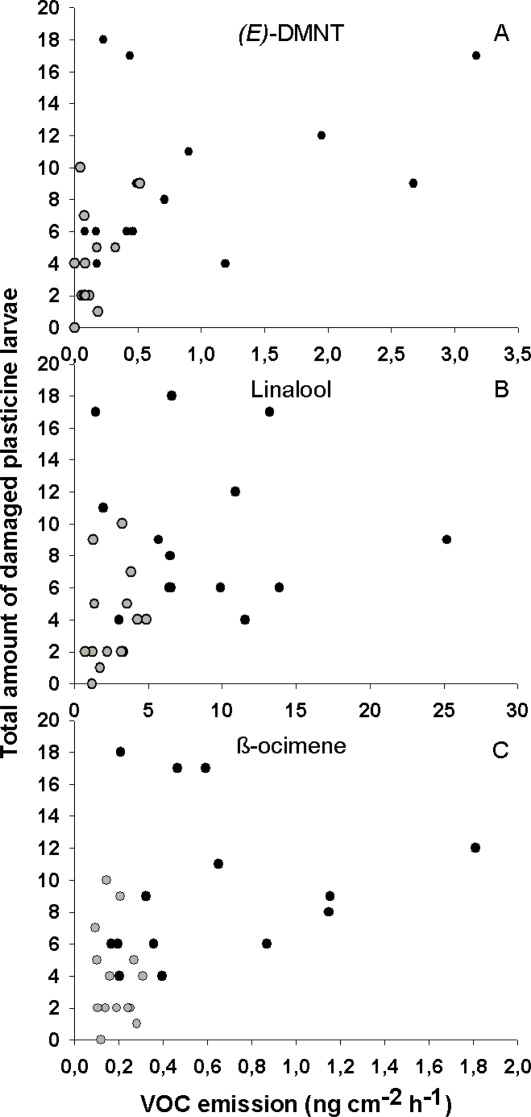
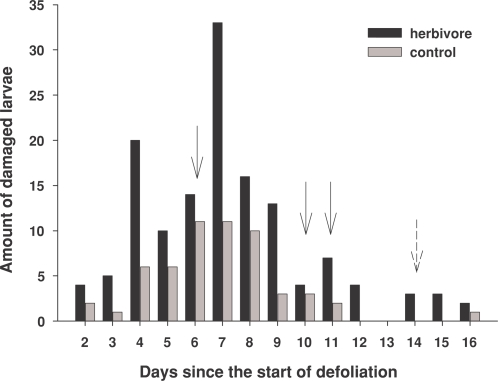
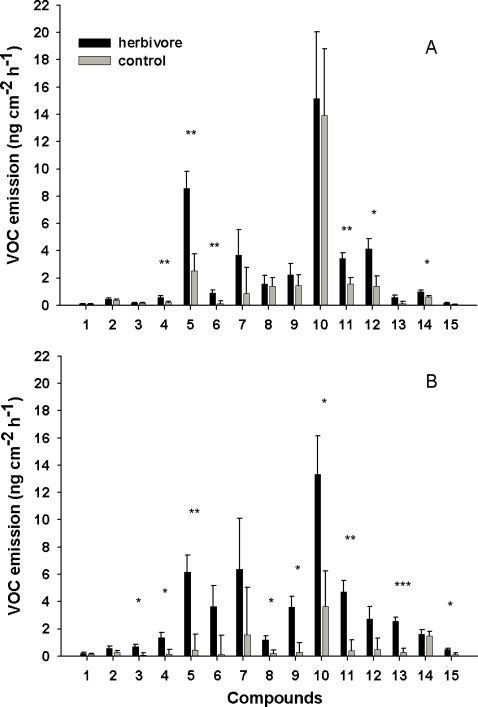
The predation rate was higher in the herbivore trees than in the control trees. This confirms that birds use cues from trees to locate insect-rich trees in the wild. The herbivore trees had decreased photosynthesis and elevated emissions of many VOCs, which suggests that birds could use either one, or both, as cues. There was, however, large variation in how the VOC emission correlated with predation rate. Emissions of (E)-DMNT [(E)-4,8-dimethyl-1,3,7-nonatriene], beta-ocimene and linalool were positively correlated with predation rate, while those of highly inducible green leaf volatiles were not. These three VOCs are also involved in the attraction of insect parasitoids and predatory mites to herbivore-damaged plants, which suggests that plants may not have specific adaptations to signal only to birds.
了解植物向食草动物的捕食者发出潜在信号的演变过程,可能会揭示多个营养级之间协同进化的有趣实例。理解捕食者被植物吸引背后的机制对于得出协同进化的结论至关重要。例如,食虫鸟类会被遭受食草动物破坏的树木吸引,即便它们没有看到食草动物或被啃食的部分,但尚不清楚鸟类是否利用了遭受食草动物破坏的植物所发出的信号,以及植物是否为此有特定的适应性。
我们研究了受损树木发出的信号在野外是否会吸引鸟类捕食者,以及鸟类是否能够利用挥发性有机化合物(VOC)排放或叶片的净光合作用作为线索来探测富含食草动物的树木。我们以山地桦树(Betula pubescens ssp. czerepanovii)、其主要食草动物(Epirrita autumnata)和食虫鸟类进行了一项野外实验。一半的树木中有隐藏在树枝袋内使树木落叶的食草动物幼虫,另一半则有作为对照的空袋子。我们测量了鸟类对树枝上人工幼虫的捕食率,以及叶片的VOC排放和净光合作用。
食草动物侵害的树木上的捕食率高于对照树木。这证实了鸟类利用树木发出的线索在野外定位富含昆虫的树木。食草动物侵害的树木光合作用降低,多种VOC排放增加,这表明鸟类可能将其中之一或两者都用作线索。然而,VOC排放与捕食率之间的关联存在很大差异。(E)-DMNT [(E)-4,8-二甲基-1,3,7-壬三烯]、β-罗勒烯和芳樟醇的排放与捕食率呈正相关,而高诱导性绿叶挥发物的排放则不然。这三种VOC也参与了昆虫寄生蜂和捕食螨对遭受食草动物破坏的植物的吸引,这表明植物可能没有仅向鸟类发出信号的特定适应性。