Anisowicz Anthony, Huang Hui, Braunschweiger Karen I, Liu Ziying, Giese Heidi, Wang Huajun, Mamaev Sergey, Olejnik Jerzy, Massion Pierre P, Del Mastro Richard G
Molecular Therapeutics Division, AmberGen Incorporated, Waltham, Massachusetts, USA.
BMC Cancer. 2008 Aug 3;8:222. doi: 10.1186/1471-2407-8-222.
Genome-wide changes in DNA methylation are an epigenetic phenomenon that can lead to the development of disease. The study of global DNA methylation utilizes technology that requires both expensive equipment and highly specialized skill sets.
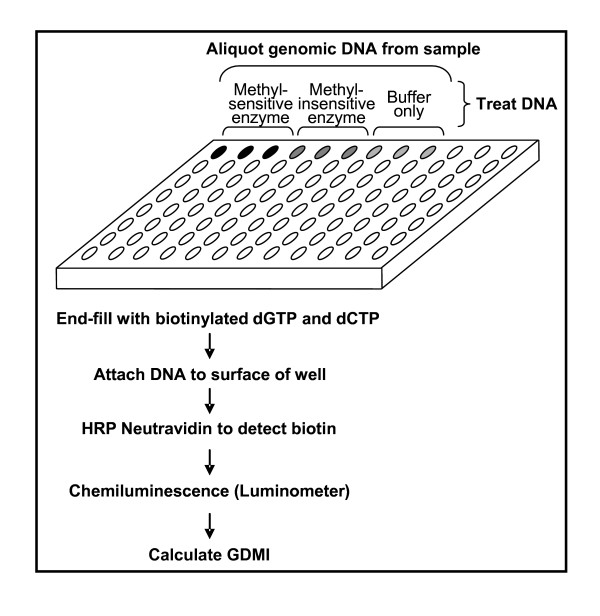
We have designed and developed an assay, CpGlobal, which is easy-to-use, does not utilize PCR, radioactivity and expensive equipment. CpGlobal utilizes methyl-sensitive restriction enzymes, HRP Neutravidin to detect the biotinylated nucleotides incorporated in an end-fill reaction and a luminometer to measure the chemiluminescence. The assay shows high accuracy and reproducibility in measuring global DNA methylation. Furthermore, CpGlobal correlates significantly with High Performance Capillary Electrophoresis (HPCE), a gold standard technology. We have applied the technology to understand the role of global DNA methylation in the natural history of lung cancer. World-wide, it is the leading cause of death attributed to any cancer. The survival rate is 15% over 5 years due to the lack of any clinical symptoms until the disease has progressed to a stage where cure is limited.
Through the use of cell lines and paired normal/tumor samples from patients with non-small cell lung cancer (NSCLC) we show that global DNA hypomethylation is highly associated with the progression of the tumor. In addition, the results provide the first indication that the normal part of the lung from a cancer patient has already experienced a loss of methylation compared to a normal individual.
By detecting these changes in global DNA methylation, CpGlobal may have a role as a barometer for the onset and development of lung cancer.
DNA甲基化的全基因组变化是一种表观遗传现象,可导致疾病的发生。全球DNA甲基化的研究利用的技术既需要昂贵的设备,又需要高度专业化的技能。
我们设计并开发了一种检测方法CpGlobal,它易于使用,不使用PCR、放射性物质和昂贵设备。CpGlobal利用甲基敏感限制酶、HRP抗生物素蛋白检测掺入末端填充反应中的生物素化核苷酸,并使用发光计测量化学发光。该检测方法在测量全球DNA甲基化方面显示出高准确性和可重复性。此外,CpGlobal与高性能毛细管电泳(HPCE)(一种金标准技术)显著相关。我们已应用该技术来了解全球DNA甲基化在肺癌自然史中的作用。在全球范围内,肺癌是导致死亡的主要癌症原因。由于直到疾病发展到难以治愈的阶段才出现任何临床症状,其5年生存率为15%。
通过使用细胞系以及来自非小细胞肺癌(NSCLC)患者的配对正常/肿瘤样本,我们表明全球DNA低甲基化与肿瘤进展高度相关。此外,结果首次表明,与正常个体相比,癌症患者肺部的正常部分已经经历了甲基化缺失。
通过检测全球DNA甲基化的这些变化,CpGlobal可能作为肺癌发生和发展的一种指标。