Komuro Akihiko, Bamming Darja, Horvath Curt M
Department of Medicine, Northwestern University, Evanston, IL 60208, USA.
Cytokine. 2008 Sep;43(3):350-8. doi: 10.1016/j.cyto.2008.07.011. Epub 2008 Aug 13.
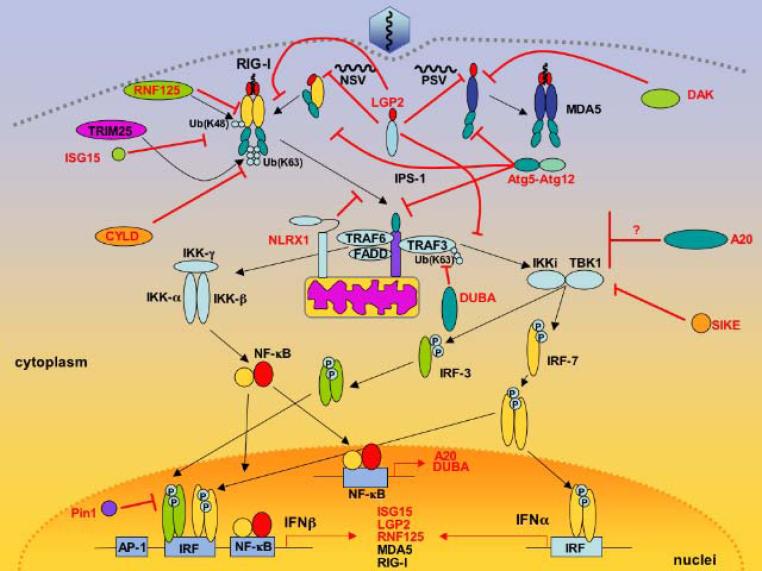
The recent, rapid progress in our understanding of cytoplasmic RNA-mediated antiviral innate immune signaling was initiated by the discovery of retinoic acid-inducible gene I (RIG-I) as a sensor of viral RNA. It is now widely recognized that RIG-I and related RNA helicases, melanoma differentiation-associated gene-5 (MDA5) and laboratory of genetics and physiology-2 (LGP2), can initiate and/or regulate RNA and virus-mediated type I IFN production and antiviral responses. As with other cytokine systems, production of type I IFN is a transient process, and can be hazardous to the host if unregulated, resulting in chronic cellular toxicity or inflammatory and autoimmune diseases. In addition, the RIG-I-like receptor (RLR) system is a fundamental target for virus-encoded immune suppression, with many indirect and direct examples of interference described. In this article, we review the current understanding of endogenous negative regulation in RLR signaling and explore direct inhibition of RLR signaling by viruses as a host immune evasion strategy.
我们对细胞质RNA介导的抗病毒天然免疫信号转导的理解最近取得了迅速进展,这是由视黄酸诱导基因I(RIG-I)作为病毒RNA传感器的发现所引发的。现在人们普遍认识到,RIG-I和相关的RNA解旋酶,黑色素瘤分化相关基因5(MDA5)和遗传学与生理学实验室2(LGP2),可以启动和/或调节RNA和病毒介导的I型干扰素产生及抗病毒反应。与其他细胞因子系统一样,I型干扰素的产生是一个短暂的过程,如果不受调控,可能对宿主有害,导致慢性细胞毒性或炎症及自身免疫性疾病。此外,RIG-I样受体(RLR)系统是病毒编码的免疫抑制的基本靶点,有许多间接和直接的干扰例子。在本文中,我们综述了目前对RLR信号转导中内源性负调控的理解,并探讨病毒对RLR信号转导的直接抑制作为一种宿主免疫逃避策略。