Racinais S, Gaoua N, Grantham J
ASPETAR, Qatar Orthopaedic and Sports Medicine Hospital, Exercise and Sports Science Department, Doha, Qatar.
J Physiol. 2008 Oct 1;586(19):4751-62. doi: 10.1113/jphysiol.2008.157420. Epub 2008 Aug 14.
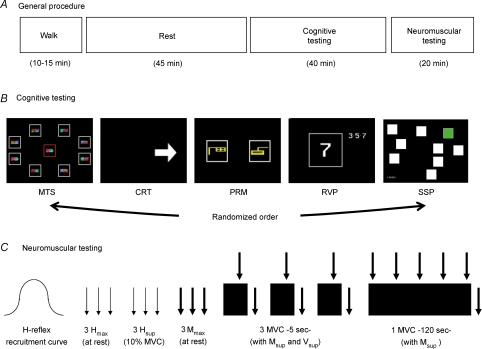
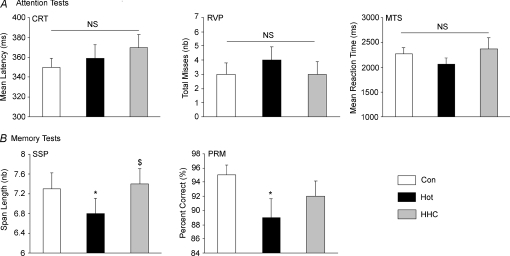
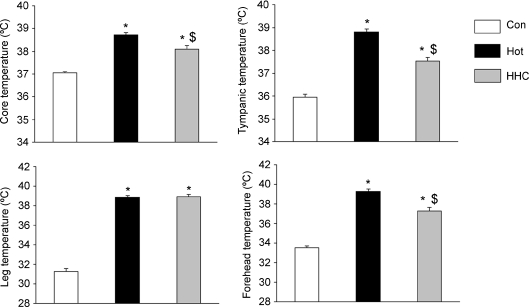
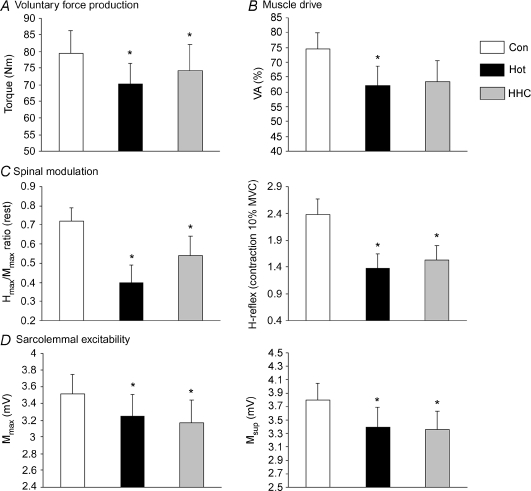
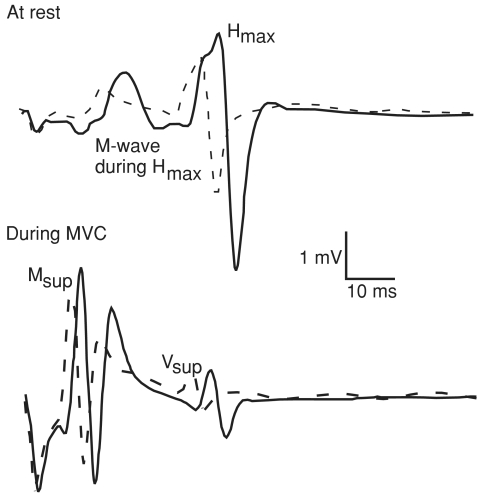
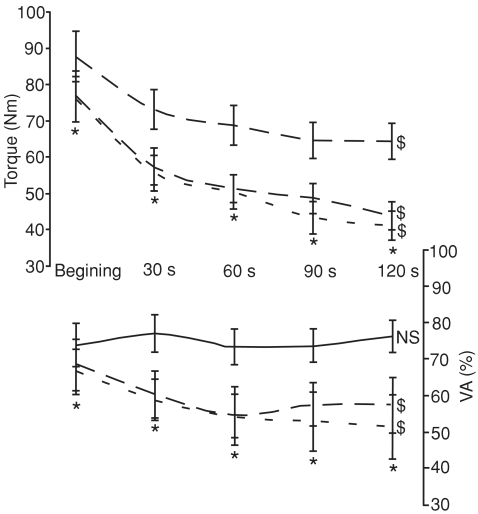
The aims of this study were to determine (i) the effect of passive hyperthermia on motor drive and cognitive function, and (ii) whether head cooling can limit the hyperthermia-induced alterations. Sixteen subjects were randomly exposed for 2 h to three different conditions: control (Con, 20 degrees C), hot (Hot, 50 degrees C) and hot head cool (HHC--where cold packs were applied to the head under Hot conditions). Three cognitive tests measuring attention and two measuring memory were performed. Neuromuscular testing included electrically evoked muscle action potentials (M-waves) and reflex waves (H-reflex) at rest and during brief (4-5 s) and sustained (120 s) maximal voluntary contractions (MVC) of the plantar flexors. All the tests were performed in the environmental room. During brief MVC, torque was significantly lower in both Hot and HHC as compared to Con (P < 0.05). The decrease in muscle activation was significant in Hot (P < 0.05) but not in HBC (P = 0.07). This was accompanied by peripheral failures in the transmission of the neural drive at both spinal (significant decrements in H-reflexes and V-waves, P < 0.05) and neuromuscular junction (significant decrements in M-waves, P < 0.05) levels. During sustained MVC, muscle activation was further depressed (P < 0.05) without any concomitant failures in M-waves, suggesting neural activation adjustments occurring probably at the supraspinal level. Cerebral perturbations were confirmed by significant decrements in both memory tests in Hot as compared with Con (P < 0.05) but not in simple tests (attention tests) that were not affected by hyperthermia. The decrement in memory capacity suggested the existence of frontal lobe activity impairments. Thus, HHC preserved memory capacity but not the visual memory.
(i)被动热疗对运动驱动和认知功能的影响;(ii)头部降温是否可以限制热疗引起的改变。16名受试者被随机暴露于三种不同条件下2小时:对照组(Con,20摄氏度)、热疗组(Hot,50摄氏度)和热疗头部冷却组(HHC,即在热疗条件下将冷敷袋敷于头部)。进行了三项测量注意力的认知测试和两项测量记忆力的认知测试。神经肌肉测试包括在静息状态下以及在足底屈肌进行短暂(4 - 5秒)和持续(120秒)最大自主收缩(MVC)期间的电诱发肌肉动作电位(M波)和反射波(H反射)。所有测试均在环境舱内进行。在短暂MVC期间,与Con组相比,Hot组和HHC组的扭矩均显著降低(P < 0.05)。肌肉激活的降低在Hot组显著(P < 0.05),而在HBC组不显著(P = 0.07)。这伴随着神经驱动在脊髓(H反射和V波显著降低,P < 0.05)和神经肌肉接头(M波显著降低,P < 0.05)水平的外周传递失败。在持续MVC期间,肌肉激活进一步降低(P < 0.05),而M波没有任何伴随的下降,这表明神经激活调整可能发生在脊髓以上水平。与Con组相比,Hot组的两项记忆测试均显著下降(P < 0.05),从而证实了大脑功能紊乱,但简单测试(注意力测试)不受热疗影响。记忆能力的下降表明存在额叶活动受损。因此,HHC保留了记忆能力,但没有保留视觉记忆。