Wolff Mary S, Engel Stephanie M, Berkowitz Gertrud S, Ye Xiaoyun, Silva Manori J, Zhu Chenbo, Wetmur James, Calafat Antonia M
Department of Community and Preventive Medicine, Mount Sinai School of Medicine, New York, New York 10029, USA.
Environ Health Perspect. 2008 Aug;116(8):1092-7. doi: 10.1289/ehp.11007.
Many phthalates and phenols are hormonally active and are suspected to alter the course of development.
We investigated prenatal exposures to phthalate and phenol metabolites and their associations with body size measures of the infants at birth.
We measured 5 phenol and 10 phthalate urinary metabolites in a multiethnic cohort of 404 women in New York City during their third trimester of pregnancy and recorded size of infants at birth.
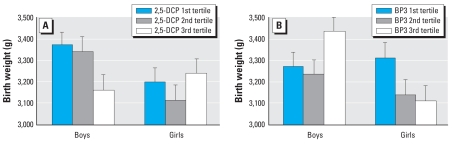
Median urinary concentrations were > 10 microg/L for 2 of 5 phenols and 6 of 10 phthalate monoester metabolites. Concentrations of low-molecular-weight phthalate monoesters (low-MWP) were approximately 5-fold greater than those of high-molecular-weight metabolites. Low-MWP metabolites had a positive association with gestational age [0.97 day gestational age per ln-biomarker; 95% confidence interval (CI), 0.07-1.9 days, multivariate adjusted] and with head circumference. Higher prenatal exposures to 2,5-dichlorophenol (2,5-DCP) predicted lower birth weight in boys (-210 g average birth weight difference between the third tertile and first tertile of 2,5-DCP; 95% CI, 71-348 g). Higher maternal benzophenone-3 (BP3) concentrations were associated with a similar decrease in birth weight among girls but with greater birth weight in boys.
We observed a range of phthalate and phenol exposures during pregnancy in our population, but few were associated with birth size. The association of 2,5-DCP and BP3 with reduced or increased birth weight could be important in very early or small-size births. In addition, positive associations of urinary metabolites with some outcomes may be attributable partly to unresolved confounding with maternal anthropometric factors.
许多邻苯二甲酸盐和酚类具有激素活性,被怀疑会改变发育进程。
我们调查了孕期邻苯二甲酸盐和酚类代谢物的暴露情况及其与婴儿出生时身体尺寸指标的关联。
我们在纽约市404名多民族孕妇队列的孕晚期测量了5种酚类和10种邻苯二甲酸盐的尿液代谢物,并记录了婴儿出生时的尺寸。
5种酚类中的2种以及10种邻苯二甲酸单酯代谢物中的6种尿液浓度中位数>10μg/L。低分子量邻苯二甲酸单酯(low-MWP)的浓度约为高分子量代谢物的5倍。低MWP代谢物与孕周呈正相关[每自然对数生物标志物对应的孕周增加0.97天;95%置信区间(CI),0.07 - 1.9天,多变量调整后],与头围也呈正相关。孕期较高暴露于2,5 - 二氯酚(2,5 - DCP)预示男孩出生体重较低(2,5 - DCP第三分位数与第一分位数之间平均出生体重差异为 - 210g;95%CI,71 - 348g)。母体二苯甲酮 - 3(BP3)浓度较高与女孩出生体重类似下降相关,但与男孩出生体重增加相关。
我们观察到我们研究人群孕期邻苯二甲酸盐和酚类暴露情况各异,但很少与出生尺寸相关。2,5 - DCP和BP3与出生体重降低或增加的关联在极早产或低体重出生中可能很重要。此外,尿液代谢物与某些结果的正相关可能部分归因于与母体人体测量因素未解决的混杂。