Balakrishnan Brinda, Dooley John, Kopia Gregory, Edelman Elazer R
Harvard-MIT Division of Health Sciences and Technology, Massachusetts Institute of Technology, Cambridge, MA 02139, USA.
J Control Release. 2008 Nov 12;131(3):173-80. doi: 10.1016/j.jconrel.2008.07.027. Epub 2008 Jul 25.
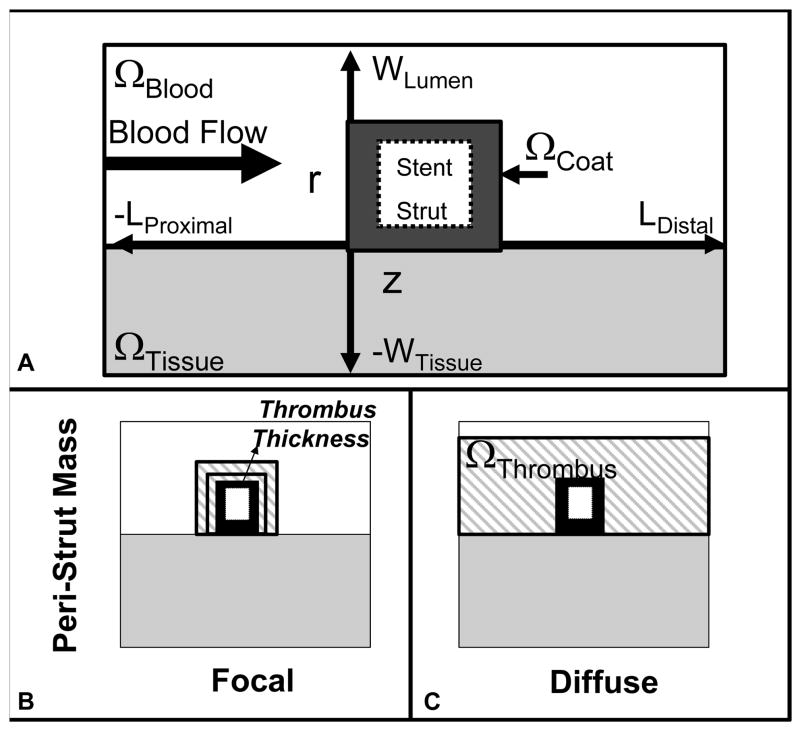
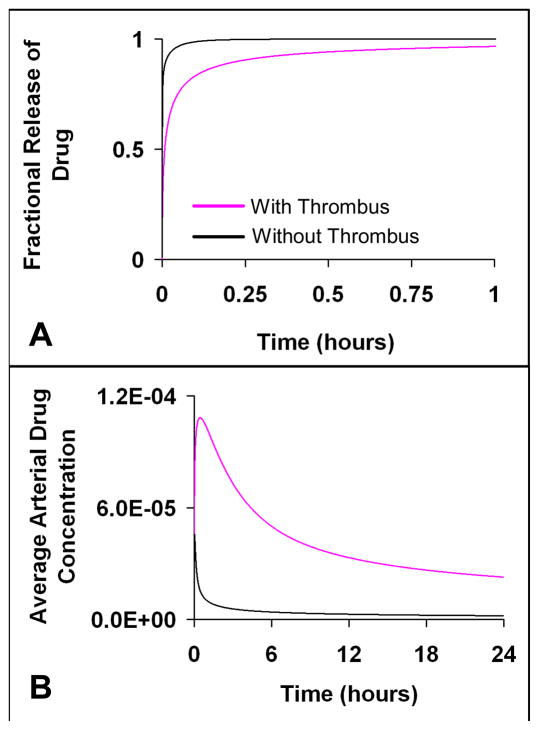
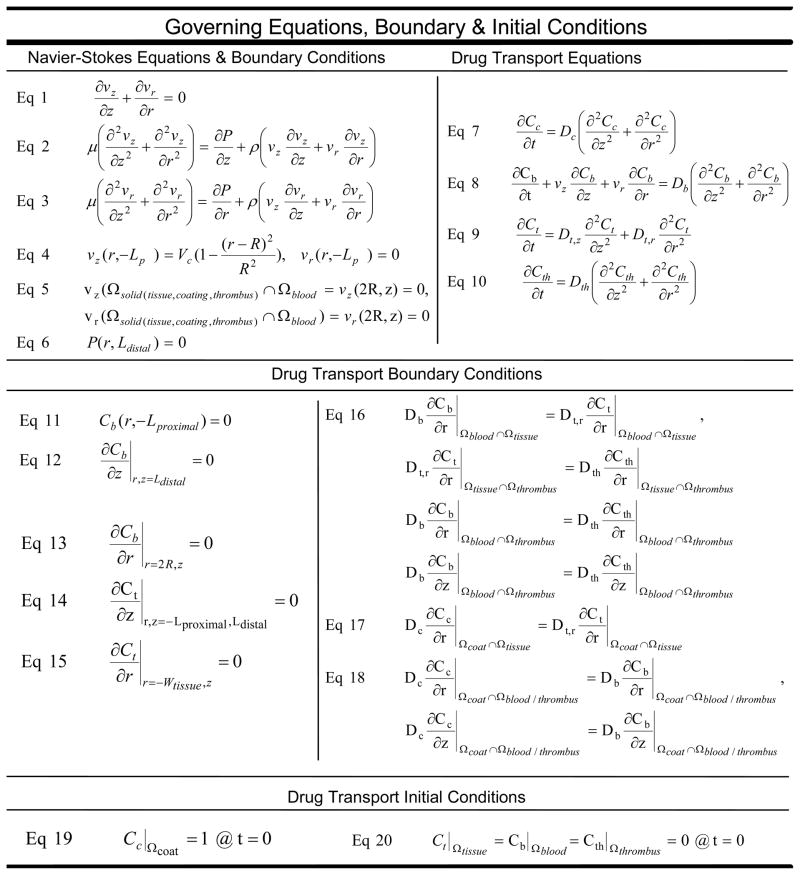
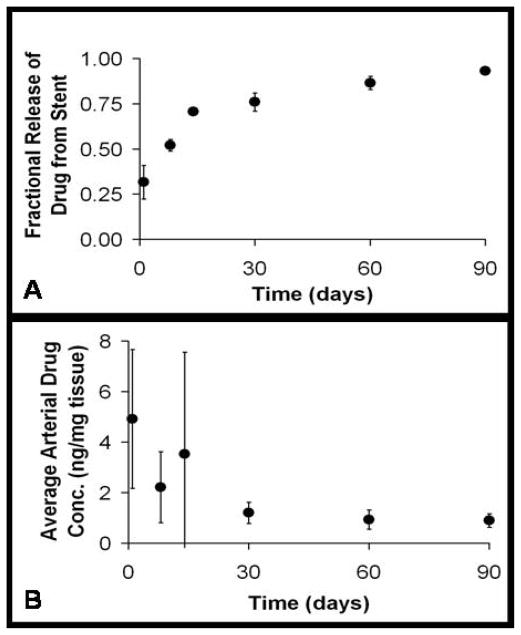
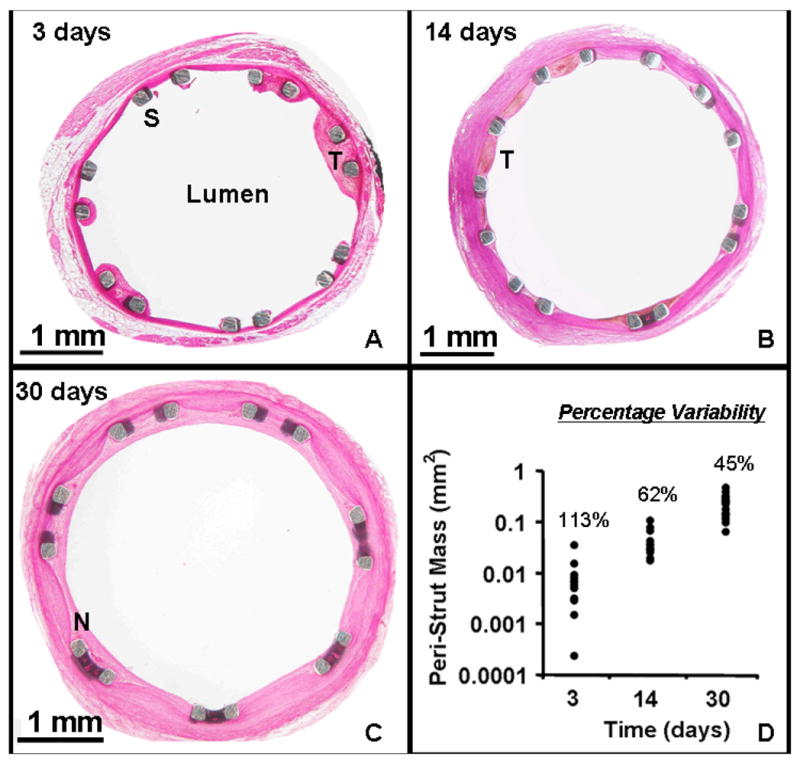
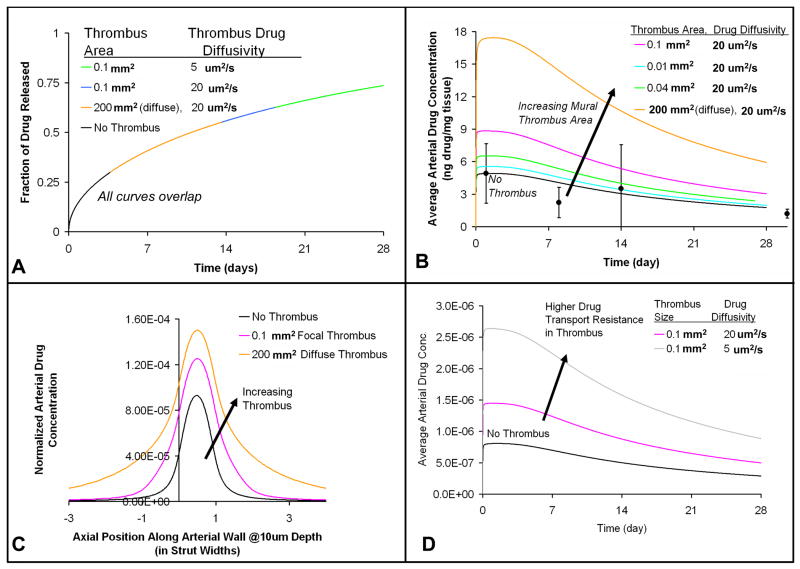
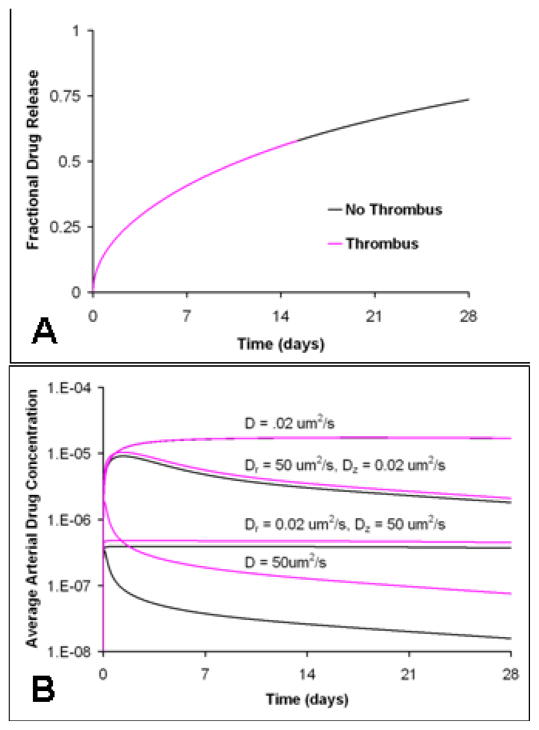
Arterial drug concentrations determine local toxicity. As such the emergent safety concerns surrounding drug-eluting stents mandate an investigation of the factors contributing to fluctuations in arterial drug uptake. Drug-eluting stents were implanted into porcine coronary arteries, arterial drug uptake was followed and modeled using 2-dimensional computational drug transport. Arterial drug uptake in vivo occurred faster than predicted by free drug diffusion, thus an alternate, mechanism for rapid transport has been proposed involving carrier-mediated transport. Though there was minimal variation in vivo in release kinetics from stent to stent, arterial drug deposition varied by up to 114% two weeks after stent implantation. The extent of adherent mural thrombus also fluctuated by 113% within 3 days after implantation. The computational drug transport model predicted that focal and diffuse thrombi elevate arterial drug deposition in proportion to the thrombus size by reducing drug washout subsequently increasing local drug availability. Fluctuations in arterial drug uptake are commonly reported. We now explain that variable peristrut thrombus can explain such observations even in the face of a narrow range of drug release from the stent. The mural thrombus effects on arterial drug deposition may be circumvented by forcing slow, rate limiting arterial transport that cannot be further hindered by mural thrombus.
动脉药物浓度决定局部毒性。因此,围绕药物洗脱支架出现的安全问题要求对导致动脉药物摄取波动的因素进行调查。将药物洗脱支架植入猪冠状动脉,跟踪动脉药物摄取情况,并使用二维计算药物传输模型进行模拟。体内动脉药物摄取比游离药物扩散预测的要快,因此有人提出了一种涉及载体介导运输的快速运输替代机制。虽然从一个支架到另一个支架,体内释放动力学的变化很小,但在支架植入两周后,动脉药物沉积的差异高达114%。植入后3天内,附着的壁血栓程度也波动了113%。计算药物传输模型预测,局灶性和弥漫性血栓通过减少药物洗脱,随后增加局部药物可用性,按血栓大小成比例提高动脉药物沉积。动脉药物摄取的波动经常被报道。我们现在解释,即使在支架药物释放范围狭窄的情况下,可变的支架周围血栓也可以解释这些观察结果。壁血栓对动脉药物沉积的影响可以通过迫使缓慢的、限速的动脉运输来规避,而这种运输不会被壁血栓进一步阻碍。