Tinder Teresa L, Subramani Durai B, Basu Gargi D, Bradley Judy M, Schettini Jorge, Million Arefayene, Skaar Todd, Mukherjee Pinku
Department of Immunology, Mayo Clinic, AZ 85259, USA.
J Immunol. 2008 Sep 1;181(5):3116-25. doi: 10.4049/jimmunol.181.5.3116.
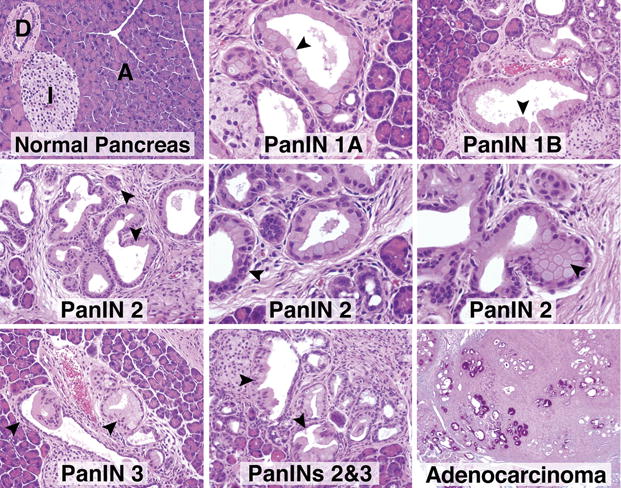
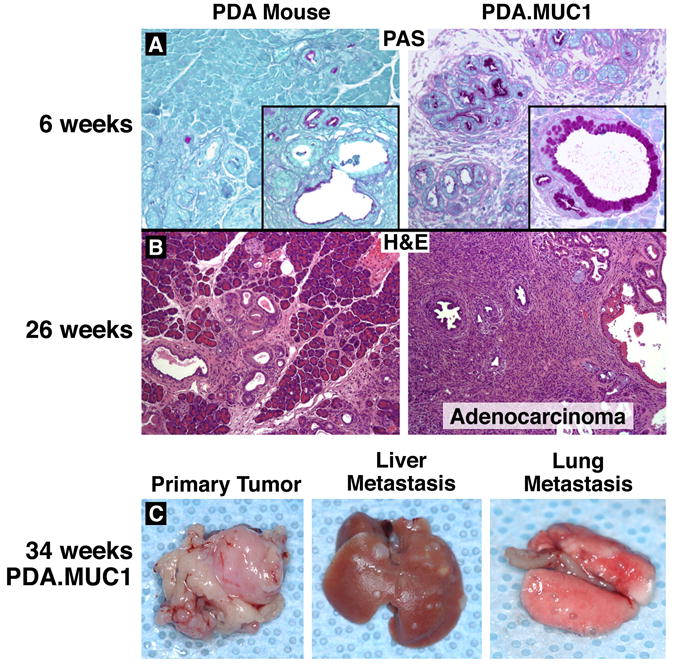
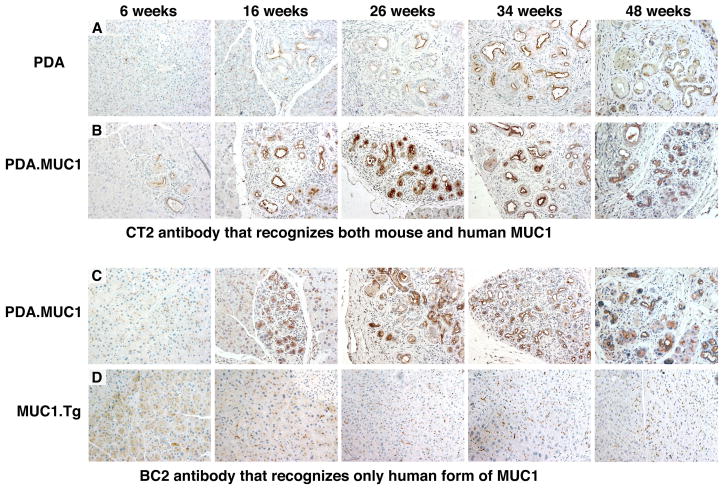
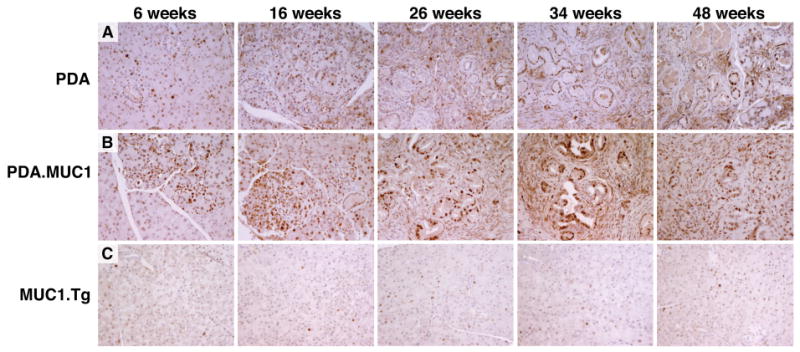
MUC1, a membrane tethered mucin glycoprotein, is overexpressed and aberrantly glycosylated in >80% of human ductal pancreatic adenocarcinoma. However, the role of MUC1 in pancreatic cancer has been elusive, partly due to the lack of an appropriate model. We report the characterization of a novel mouse model that expresses human MUC1 as a self molecule (PDA.MUC1 mice). Pancreatic tumors arise in an appropriate MUC1-tolerant background within an immune-competent host. Significant enhancement in the development of pancreatic intraepithelial preneoplastic lesions and progression to adenocarcinoma is observed in PDA.MUC1 mice, possibly due to increased proliferation. Tumors from PDA.MUC1 mice express higher levels of cyclooxygenase-2 and IDO compared with PDA mice lacking MUC1, especially during early stages of tumor development. The increased proinflammatory milieu correlates with an increased percentage of regulatory T cells and myeloid suppressor cells in the pancreatic tumor and tumor draining lymph nodes. Data shows that during pancreatic cancer progression, MUC1-mediated mechanisms enhance the onset and progression of the disease, which in turn regulate the immune responses. Thus, the mouse model is ideally suited for testing novel chemopreventive and therapeutic strategies against pancreatic cancer.
MUC1是一种膜锚定黏蛋白糖蛋白,在80%以上的人类导管胰腺腺癌中过度表达且糖基化异常。然而,MUC1在胰腺癌中的作用一直难以捉摸,部分原因是缺乏合适的模型。我们报告了一种新型小鼠模型(PDA.MUC1小鼠)的特征,该模型将人MUC1表达为自身分子。胰腺肿瘤在免疫健全宿主的合适MUC1耐受背景中出现。在PDA.MUC1小鼠中观察到胰腺上皮内瘤前病变的发展显著增强并进展为腺癌,这可能是由于增殖增加所致。与缺乏MUC1的PDA小鼠相比,PDA.MUC1小鼠的肿瘤表达更高水平的环氧化酶-2和吲哚胺2,3-双加氧酶,尤其是在肿瘤发展的早期阶段。促炎环境的增加与胰腺肿瘤和肿瘤引流淋巴结中调节性T细胞和髓系抑制细胞百分比的增加相关。数据表明,在胰腺癌进展过程中,MUC1介导的机制增强了疾病的发生和进展,进而调节免疫反应。因此,该小鼠模型非常适合测试针对胰腺癌的新型化学预防和治疗策略。