• 文献检索
  • 文档翻译
  • 深度研究
  • 学术资讯
  • Suppr Zotero 插件Zotero 插件
  • 邀请有礼
  • 套餐&价格
  • 历史记录
应用&插件
Suppr Zotero 插件Zotero 插件浏览器插件Mac 客户端Windows 客户端微信小程序
定价
高级版会员购买积分包购买API积分包
服务
文献检索文档翻译深度研究API 文档MCP 服务
关于我们
关于 Suppr公司介绍联系我们用户协议隐私条款
关注我们

Suppr 超能文献

核心技术专利:CN118964589B侵权必究
粤ICP备2023148730 号-1Suppr @ 2026

文献检索

告别复杂PubMed语法,用中文像聊天一样搜索,搜遍4000万医学文献。AI智能推荐,让科研检索更轻松。

立即免费搜索

文件翻译

保留排版,准确专业,支持PDF/Word/PPT等文件格式,支持 12+语言互译。

免费翻译文档

深度研究

AI帮你快速写综述,25分钟生成高质量综述,智能提取关键信息,辅助科研写作。

立即免费体验

母乳在极低出生体重儿坏死性小肠结肠炎或死亡风险中的作用。

Role of human milk in extremely low birth weight infants' risk of necrotizing enterocolitis or death.

作者信息

Meinzen-Derr J, Poindexter B, Wrage L, Morrow A L, Stoll B, Donovan E F

机构信息

Division of Neonatology, Department of Pediatrics, Center for Epidemiology and Biostatistics, Cincinnati Children's Hospital Medical Center, University of Cincinnati College of Medicine, Cincinnati, OH 45229-3039, USA.

出版信息

J Perinatol. 2009 Jan;29(1):57-62. doi: 10.1038/jp.2008.117. Epub 2008 Aug 21.

DOI:10.1038/jp.2008.117
PMID:18716628
原文链接:https://pmc.ncbi.nlm.nih.gov/articles/PMC2801431/
Abstract

OBJECTIVE

To determine the association between human milk (HM) intake and risk of necrotizing enterocolitis (NEC) or death among infants 401 to 1000 g birth weight.

STUDY DESIGN

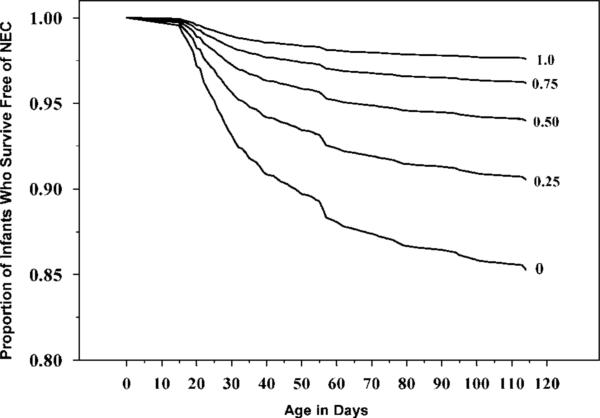
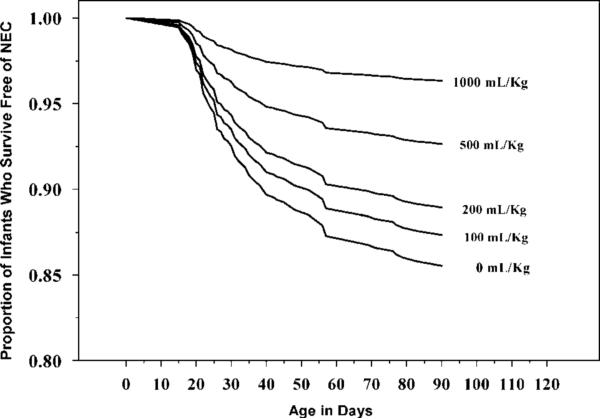
Analysis of 1272 infants in the National Institute of Child Health and Human Development Neonatal Network Glutamine Trial was performed to determine if increasing HM intake was associated with decreased risk of NEC or death. HM intake was defined as the proportion of HM to total intake, to enteral intake and total volume over the first 14 days. Known NEC risk factors were included as covariates in Cox proportional hazard analyses for duration of survival time free of NEC.

RESULT

Among study infants, 13.6% died or developed NEC after 14 days. The likelihood of NEC or death after 14 days was decreased by a factor of 0.83 (95% confidence interval, CI 0.72, 0.96) for each 10% increase in the proportion of total intake as HM. Each 100 ml kg(-1) increase in HM intake during the first 14 days was associated with decreased risk of NEC or death (hazard ratio, HR 0.87 (95% CI 0.77, 0.97)). There appeared to be a trend towards a decreased risk of NEC or death among infants who received 100% HM as a proportion to total enteral intake (HM plus formula), although this finding was not statistically significant (HR 0.85 (95% CI 0.60, 1.19)).

CONCLUSION

These data suggest a dose-related association of HM feeding with a reduction of risk of NEC or death after the first 2 weeks of life among extremely low birth weight infants.

摘要

目的

确定出生体重在401至1000克的婴儿中,母乳摄入量与坏死性小肠结肠炎(NEC)风险或死亡之间的关联。

研究设计

对美国国立儿童健康与人类发展研究所新生儿网络谷氨酰胺试验中的1272名婴儿进行分析,以确定母乳摄入量增加是否与NEC风险或死亡风险降低相关。母乳摄入量定义为出生后头14天内母乳占总摄入量、肠内摄入量和总体积的比例。已知的NEC风险因素作为协变量纳入Cox比例风险分析,以计算无NEC生存时间的持续时间。

结果

在研究婴儿中,13.6%在14天后死亡或发生NEC。总摄入量中母乳比例每增加10%,14天后发生NEC或死亡的可能性降低0.83倍(95%置信区间,CI 0.72,0.96)。出生后头14天内母乳摄入量每增加100 ml·kg⁻¹,与NEC或死亡风险降低相关(风险比,HR 0.87(95%CI 0.77,0.97))。作为肠内总摄入量(母乳加配方奶)的比例,接受100%母乳的婴儿发生NEC或死亡的风险似乎有降低趋势,尽管这一发现无统计学意义(HR 0.85(95%CI 0.60,1.19))。

结论

这些数据表明,在极低出生体重儿出生后的前两周,母乳喂养与NEC或死亡风险降低之间存在剂量相关关联。
https://cdn.ncbi.nlm.nih.gov/pmc/blobs/33fc/2801431/6300718dbeab/nihms-164921-f0002.jpg
https://cdn.ncbi.nlm.nih.gov/pmc/blobs/33fc/2801431/bc1cd7798730/nihms-164921-f0001.jpg
https://cdn.ncbi.nlm.nih.gov/pmc/blobs/33fc/2801431/6300718dbeab/nihms-164921-f0002.jpg
https://cdn.ncbi.nlm.nih.gov/pmc/blobs/33fc/2801431/bc1cd7798730/nihms-164921-f0001.jpg
https://cdn.ncbi.nlm.nih.gov/pmc/blobs/33fc/2801431/6300718dbeab/nihms-164921-f0002.jpg

相似文献

1
Role of human milk in extremely low birth weight infants' risk of necrotizing enterocolitis or death.母乳在极低出生体重儿坏死性小肠结肠炎或死亡风险中的作用。
J Perinatol. 2009 Jan;29(1):57-62. doi: 10.1038/jp.2008.117. Epub 2008 Aug 21.
2
Early human milk feeding is associated with a lower risk of necrotizing enterocolitis in very low birth weight infants.早期母乳喂养与极低出生体重儿坏死性小肠结肠炎风险较低相关。
J Perinatol. 2007 Jul;27(7):428-33. doi: 10.1038/sj.jp.7211758. Epub 2007 Apr 19.
3
The Association of Human Milk Proportion with the Clinical Outcomes of Necrotizing Enterocolitis in Preterm Infants: A Retrospective Study.人乳比例与早产儿坏死性小肠结肠炎临床结局的关联:一项回顾性研究。
Nutrients. 2023 Aug 30;15(17):3796. doi: 10.3390/nu15173796.
4
Practice of enteral nutrition in very low birth weight and extremely low birth weight infants.极低出生体重和超低出生体重婴儿的肠内营养实践
World Rev Nutr Diet. 2014;110:201-14. doi: 10.1159/000358468. Epub 2014 Apr 11.
5
Intake of own mother's milk during the first days of life is associated with decreased morbidity and mortality in very low birth weight infants during the first 60 days of life.生命最初几天摄入自身母亲的母乳与极低出生体重儿生命最初 60 天内的发病率和死亡率降低有关。
Neonatology. 2012;102(4):276-81. doi: 10.1159/000341335. Epub 2012 Aug 24.
6
Delayed introduction of progressive enteral feeds to prevent necrotising enterocolitis in very low birth weight infants.延迟引入渐进性肠内喂养以预防极低出生体重儿坏死性小肠结肠炎
Cochrane Database Syst Rev. 2014;2014(12):CD001970. doi: 10.1002/14651858.CD001970.pub5. Epub 2014 Dec 1.
7
Delayed introduction of progressive enteral feeds to prevent necrotising enterocolitis in very low birth weight infants.延迟引入渐进性肠内喂养以预防极低出生体重儿坏死性小肠结肠炎。
Cochrane Database Syst Rev. 2013 May 31(5):CD001970. doi: 10.1002/14651858.CD001970.pub4.
8
Cost savings of human milk as a strategy to reduce the incidence of necrotizing enterocolitis in very low birth weight infants.将母乳作为降低极低出生体重儿坏死性小肠结肠炎发病率的一种策略所带来的成本节约。
Neonatology. 2015;107(4):271-6. doi: 10.1159/000370058. Epub 2015 Mar 3.
9
Mixed Feedings and Necrotizing Enterocolitis: The Proportion of Human Milk Matters.混合喂养与坏死性小肠结肠炎:人乳比例很重要。
Breastfeed Med. 2023 Jun;18(6):469-474. doi: 10.1089/bfm.2022.0268. Epub 2023 May 12.
10
A Systematic Review and Meta-Analysis of Human Milk Feeding and Morbidity in Very Low Birth Weight Infants.人乳喂养与极低出生体重儿发病率的系统评价与荟萃分析。
Nutrients. 2018 May 31;10(6):707. doi: 10.3390/nu10060707.

引用本文的文献

1
[Impact of donor human milk bank on clinical outcomes in infants with very/extremely low birth weight].[捐赠人乳库对极低/超低出生体重儿临床结局的影响]
Beijing Da Xue Xue Bao Yi Xue Ban. 2025 Aug 18;57(4):759-763. doi: 10.19723/j.issn.1671-167X.2025.04.021.
2
Development and validation of a nomogram model for predicting the occurrence of necrotizing enterocolitis in premature infants with late-onset sepsis.预测晚发性败血症早产儿坏死性小肠结肠炎发生的列线图模型的开发与验证
Eur J Med Res. 2025 Jul 8;30(1):595. doi: 10.1186/s40001-025-02857-0.
3
Short outcomes of donor milk and mother's own milk for preterm infants.

本文引用的文献

1
Human milk intake and retinopathy of prematurity in extremely low birth weight infants.极低出生体重儿的母乳摄入量与早产儿视网膜病变
Pediatrics. 2007 Jul;120(1):1-9. doi: 10.1542/peds.2006-1465.
2
Early human milk feeding is associated with a lower risk of necrotizing enterocolitis in very low birth weight infants.早期母乳喂养与极低出生体重儿坏死性小肠结肠炎风险较低相关。
J Perinatol. 2007 Jul;27(7):428-33. doi: 10.1038/sj.jp.7211758. Epub 2007 Apr 19.
3
Necrotising enterocolitis.坏死性小肠结肠炎
早产婴儿使用捐赠母乳和母亲自身母乳的短期结局
Pediatr Res. 2025 Jun 17. doi: 10.1038/s41390-025-04208-5.
4
Racial and Ethnic Disparities in Mother's Milk Provision Among Mothers of Preterm Infants.早产婴儿母亲母乳供应中的种族和族裔差异。
JAMA Netw Open. 2025 May 1;8(5):e2510781. doi: 10.1001/jamanetworkopen.2025.10781.
5
CuddleCard: Protocol for a randomized controlled trial evaluating the effect of providing financial support to low-income mothers of preterm infants on parental caregiving in the neonatal intensive care unit (NICU).抱抱卡:一项随机对照试验的方案,评估为早产低收入母亲提供经济支持对新生儿重症监护病房(NICU)中父母照料的影响。
BMC Pediatr. 2025 May 15;25(1):383. doi: 10.1186/s12887-025-05621-9.
6
Three Years of Human Milk Banking: Assessing the Impact on Lactation Rates at Discharge in VLBW Preterm Infants in an Italian Reference NICU.三年母乳库:评估意大利一家参考新生儿重症监护病房极低出生体重早产儿出院时泌乳率的影响
Nutrients. 2025 Apr 25;17(9):1440. doi: 10.3390/nu17091440.
7
Impact of mother's own milk donor human milk on gut microbiota colonization in preterm infants: a systematic review.母亲自身乳汁与捐赠人乳对早产儿肠道微生物群定植的影响:一项系统评价
Microbiome Res Rep. 2024 Nov 21;4(1):8. doi: 10.20517/mrr.2024.44. eCollection 2025.
8
Analysis of risk factors and establishment of predictive models for neonatal necrotizing enterocolitis: a retrospective study.新生儿坏死性小肠结肠炎危险因素分析及预测模型的建立:一项回顾性研究
Ital J Pediatr. 2025 Mar 14;51(1):80. doi: 10.1186/s13052-025-01930-y.
9
Prevention Strategies and Management of Necrotizing Enterocolitis.坏死性小肠结肠炎的预防策略与管理
Curr Treat Options Pediatr. 2024 Sep;10(3):126-146. doi: 10.1007/s40746-024-00297-2. Epub 2024 Jun 3.
10
Human Milk Supports Robust Intestinal Organoid Growth, Differentiation, and Homeostatic Cytokine Production.人乳支持强大的肠道类器官生长、分化和稳态细胞因子产生。
Gastro Hep Adv. 2024 Jul 20;3(8):1030-1042. doi: 10.1016/j.gastha.2024.07.007. eCollection 2024.
Lancet. 2006 Oct 7;368(9543):1271-83. doi: 10.1016/S0140-6736(06)69525-1.
4
Beneficial effects of breast milk in the neonatal intensive care unit on the developmental outcome of extremely low birth weight infants at 18 months of age.新生儿重症监护病房中母乳对极低出生体重儿18个月时发育结局的有益影响。
Pediatrics. 2006 Jul;118(1):e115-23. doi: 10.1542/peds.2005-2382.
5
Donor breast milk versus infant formula for preterm infants: systematic review and meta-analysis.捐赠母乳与早产儿配方奶的比较:系统评价与荟萃分析
Arch Dis Child Fetal Neonatal Ed. 2007 May;92(3):F169-75. doi: 10.1136/adc.2005.089490. Epub 2006 Mar 23.
6
New insights into spontaneous intestinal perforation using a national data set: (1) SIP is associated with early indomethacin exposure.利用全国数据集对自发性肠穿孔的新见解:(1)自发性肠穿孔与早期使用吲哚美辛有关。
J Perinatol. 2006 Feb;26(2):93-9. doi: 10.1038/sj.jp.7211429.
7
Breastfeeding and the use of human milk.母乳喂养与母乳的使用。
Pediatrics. 2005 Feb;115(2):496-506. doi: 10.1542/peds.2004-2491.
8
Late-onset septicemia in a Norwegian national cohort of extremely premature infants receiving very early full human milk feeding.挪威一个极早产儿全国队列中接受极早期纯母乳喂养后的迟发性败血症。
Pediatrics. 2005 Mar;115(3):e269-76. doi: 10.1542/peds.2004-1833. Epub 2005 Feb 1.
9
Parenteral glutamine supplementation does not reduce the risk of mortality or late-onset sepsis in extremely low birth weight infants.肠胃外补充谷氨酰胺并不能降低极低出生体重儿的死亡风险或晚发性败血症的风险。
Pediatrics. 2004 May;113(5):1209-15. doi: 10.1542/peds.113.5.1209.
10
The effect of maternal milk on neonatal morbidity of very low-birth-weight infants.母乳对极低出生体重儿新生儿发病率的影响。
Arch Pediatr Adolesc Med. 2003 Jan;157(1):66-71. doi: 10.1001/archpedi.157.1.66.