Kontogeorgis Andrianos, Li Xiaodong, Kang Eunice Y, Feig Jonathan E, Ponzio Marc, Kang Guoxin, Kaba Riyaz A, Wit Andrew L, Fisher Edward A, Morley Gregory E, Peters Nicholas S, Coetzee William A, Gutstein David E
Leon H. Charney Division of Cardiology, Department of Medicine, New York University School of Medicine, New York, NY 10016, USA.
Am J Physiol Heart Circ Physiol. 2008 Nov;295(5):H1905-16. doi: 10.1152/ajpheart.590.2008. Epub 2008 Aug 29.
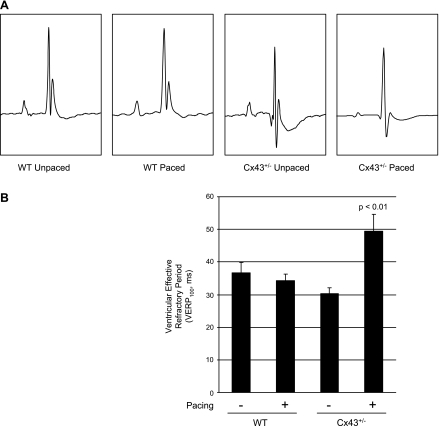
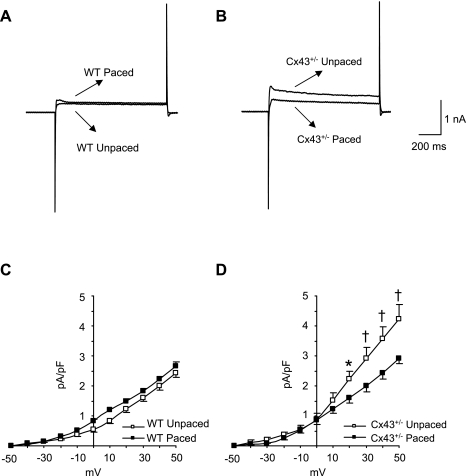
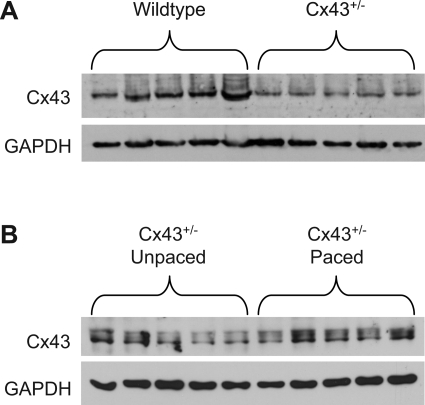
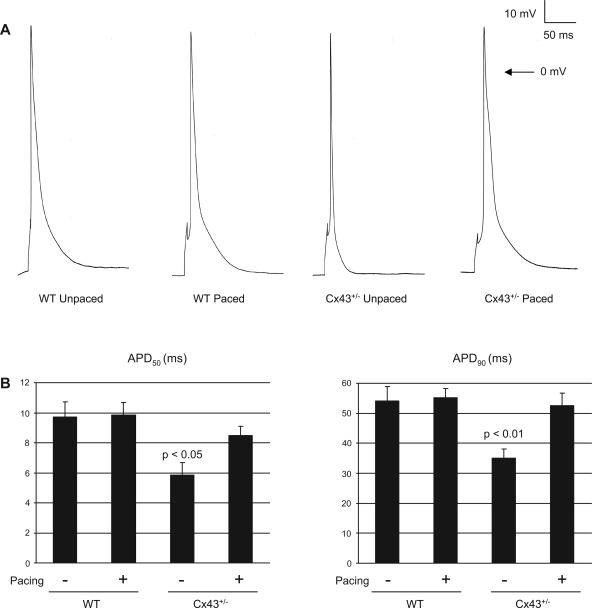
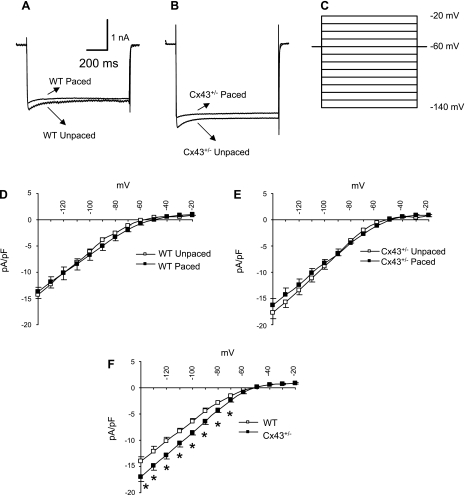
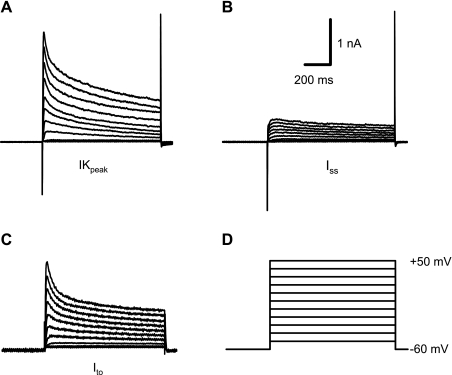
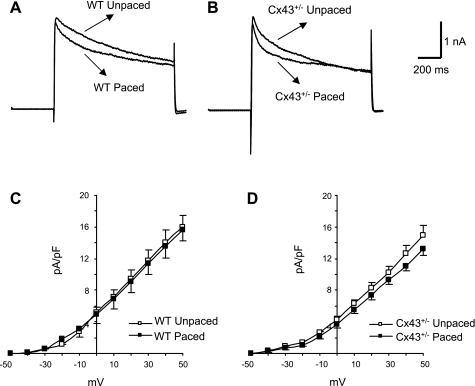
Gap junction redistribution and reduced expression, a phenomenon termed gap junction remodeling (GJR), is often seen in diseased hearts and may predispose toward arrhythmias. We have recently shown that short-term pacing in the mouse is associated with changes in connexin43 (Cx43) expression and localization but not with increased inducibility into sustained arrhythmias. We hypothesized that short-term pacing, if imposed on murine hearts with decreased Cx43 abundance, could serve as a model for evaluating the electrophysiological effects of GJR. We paced wild-type (normal Cx43 abundance) and heterozygous Cx43 knockout (Cx43+/-; 66% mean reduction in Cx43) mice for 6 h at 10-15% above their average sinus rate. We investigated the electrophysiological effects of pacing on the whole animal using programmed electrical stimulation and in isolated ventricular myocytes with patch-clamp studies. Cx43+/- myocytes had significantly shorter action potential durations (APD) and increased steady-state (Iss) and inward rectifier (I(K1)) potassium currents compared with those of wild-type littermate cells. In Cx43+/- hearts, pacing resulted in a significant prolongation of ventricular effective refractory period and APD and significant diminution of Iss compared with unpaced Cx43+/- hearts. However, these changes were not seen in paced wild-type mice. These data suggest that Cx43 abundance plays a critical role in regulating currents involved in myocardial repolarization and their response to pacing. Our study may aid in understanding how dyssynchronous activation of diseased, Cx43-deficient myocardial tissue can lead to electrophysiological changes, which may contribute to the worsened prognosis often associated with pacing in the failing heart.
缝隙连接重新分布和表达减少,即所谓的缝隙连接重塑(GJR)现象,在患病心脏中经常出现,可能易引发心律失常。我们最近发现,小鼠短期起搏与连接蛋白43(Cx43)的表达和定位变化有关,但与持续性心律失常的易感性增加无关。我们推测,如果对Cx43丰度降低的小鼠心脏进行短期起搏,可能会成为评估GJR电生理效应的模型。我们以高于平均窦性心率10 - 15%的频率,对野生型(Cx43丰度正常)和杂合性Cx43基因敲除(Cx43+/-;Cx43平均减少66%)小鼠进行了6小时的起搏。我们使用程控电刺激研究了起搏对整个动物的电生理效应,并通过膜片钳研究对分离的心室肌细胞进行了研究。与野生型同窝小鼠细胞相比,Cx43+/-肌细胞的动作电位时程(APD)显著缩短,稳态(Iss)和内向整流(I(K1))钾电流增加。在Cx43+/-心脏中,与未起搏的Cx43+/-心脏相比,起搏导致心室有效不应期和APD显著延长,Iss显著降低。然而,在起搏的野生型小鼠中未观察到这些变化。这些数据表明,Cx43丰度在调节心肌复极化相关电流及其对起搏的反应中起关键作用。我们的研究可能有助于理解患病的、Cx43缺乏的心肌组织的不同步激活如何导致电生理变化,这可能导致与衰竭心脏起搏相关的预后恶化。