Wang Jingyun, Candy T Rowan, Teel Danielle F W, Jacobs Robert J
Indiana University School of Optometry, Bloomington, IN 47405, USA.
J Opt Soc Am A Opt Image Sci Vis. 2008 Sep;25(9):2263-70. doi: 10.1364/josaa.25.002263.
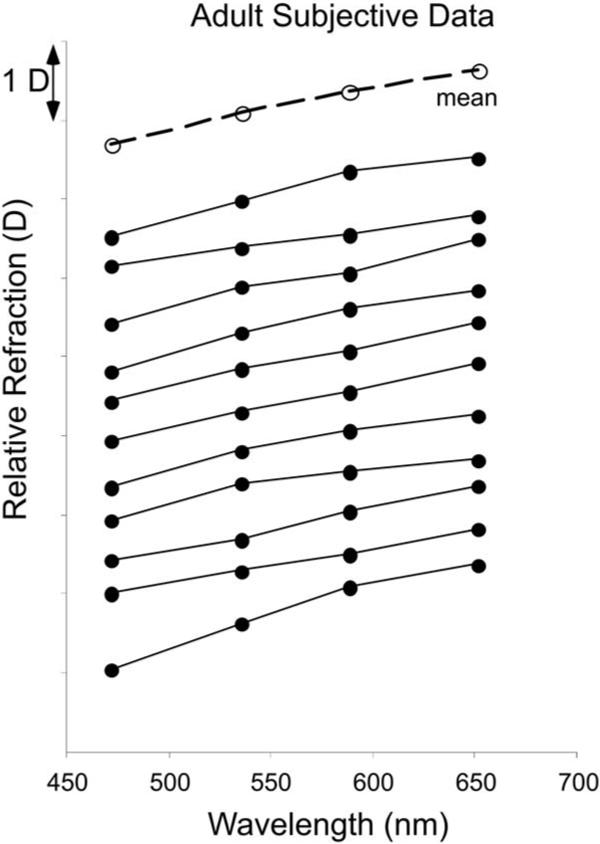
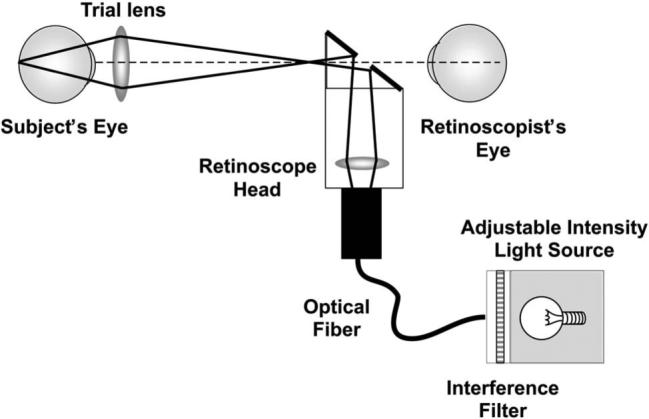
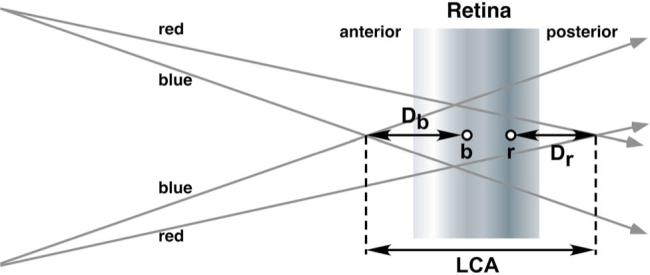
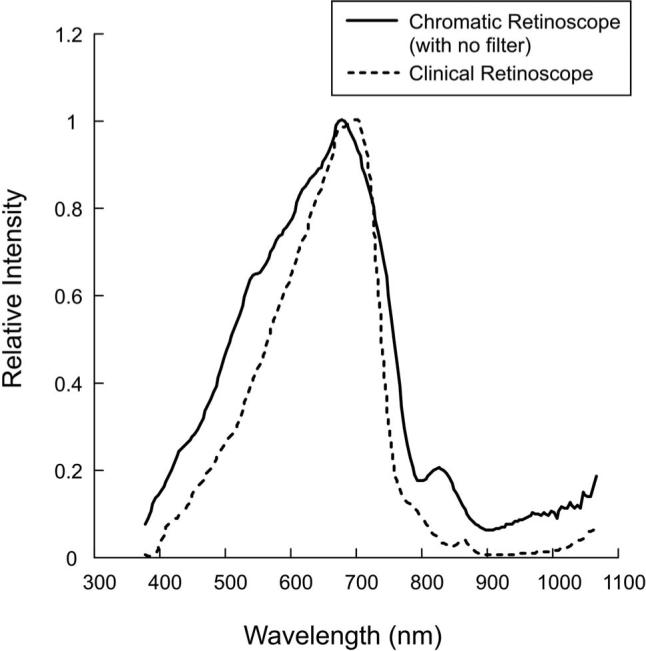
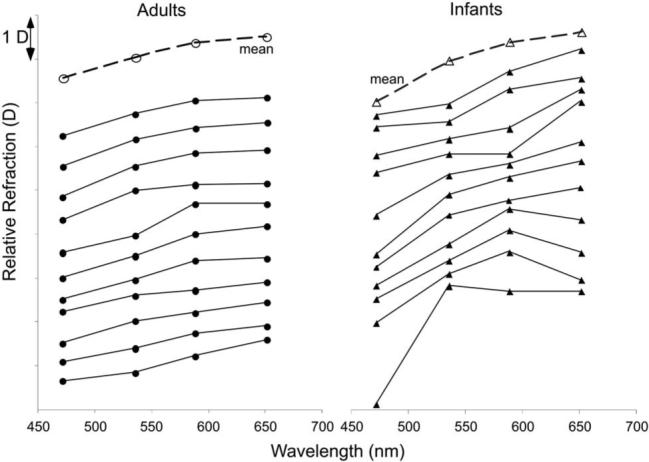
Although the longitudinal chromatic aberration (LCA) of the adult eye has been studied, there are no data collected from the human infant eye. A chromatic retinoscope was used to measure cyclopleged infant and adult refractions with four pseudomonochromatic sources (centered at 472, 538, 589, and 652 nm) and with polychromatic light. The LCA of the infant eyes between 472 and 652 nm was a factor of 1.7 greater than the LCA found in the adult group: infant mean=1.62 D, SD+/- 0.14 D; adult mean=0.96 D, SD+/- 0.17 D. The elevated level of LCA in infant eyes is consistent with the greater optical power of the immature eye and indicates similar chromatic dispersion in infant and adult eyes. The implications for visual performance, defocus detection, and measurement of refraction are discussed.
尽管已经对成人眼睛的纵向色差(LCA)进行了研究,但尚未收集到来自人类婴儿眼睛的数据。使用彩色视网膜镜,通过四个伪单色光源(中心波长分别为472、538、589和652 nm)以及多色光来测量睫状肌麻痹状态下婴儿和成人的屈光情况。婴儿眼睛在472至652 nm之间的纵向色差比成人组大1.7倍:婴儿平均值 = 1.62 D,标准差±0.14 D;成人平均值 = 0.96 D,标准差±0.17 D。婴儿眼睛中纵向色差水平升高与未成熟眼睛更高的屈光力一致,表明婴儿和成人眼睛中的色散情况相似。文中还讨论了这一现象对视觉性能、散焦检测和屈光测量的影响。