Department of Optometry and Vision Science, University of Alabama at Birmingham, Birmingham, AL, USA.
Department of Ophthalmology and Visual Sciences, University of Alabama at Birmingham, Birmingham, AL, USA.
J Vis. 2021 May 3;21(5):11. doi: 10.1167/jov.21.5.11.
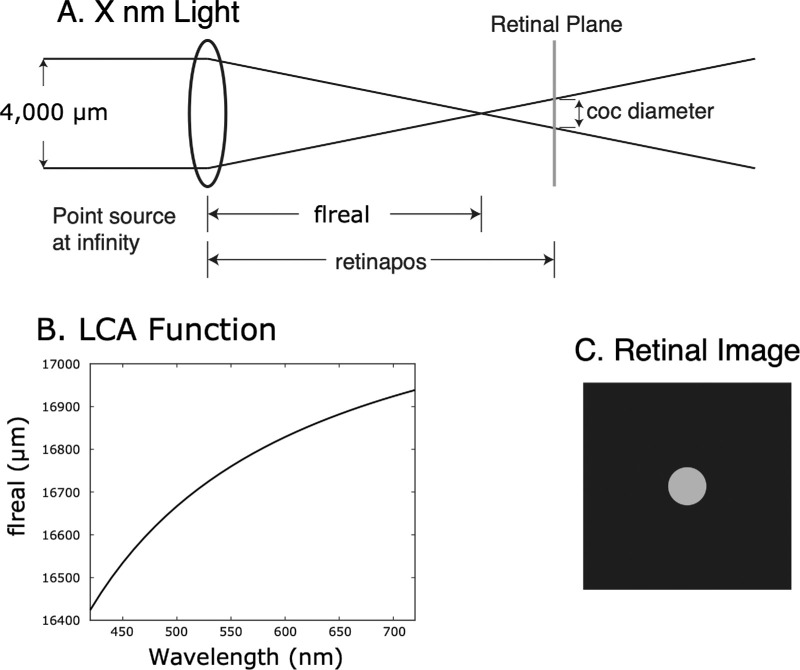
The postnatal growing eye uses visual cues to actively control its own axial elongation to achieve and maintain sharp focus, a process termed emmetropization. The primary visual cue may be the difference in image sharpness as sensed by the arrays of short- and long-wavelength sensitive cone photoreceptors caused by longitudinal chromatic aberration: Shorter wavelengths focus in front of longer wavelengths. However, the sparse distribution of short-wavelength sensitive cones across the retina suggests that they do not have sufficient spatial sampling resolution for this task. Here, we show that the spacing of the short-wavelength sensitive cones in humans is sufficient for them, in conjunction with the longer wavelength cones, to use chromatic signals to detect defocus and guide emmetropization. We hypothesize that the retinal spacing of the short-wavelength sensitive cones in many mammalian species is an evolutionarily ancient adaption that allows the efficient use of chromatic cues in emmetropization.
出生后的眼睛通过视觉线索积极控制自身的轴向伸长,以实现并维持清晰的焦点,这个过程被称为正视化。主要的视觉线索可能是由纵向色差引起的短波长和长波长敏感视锥感受器阵列感知到的图像清晰度差异:较短的波长聚焦在较长的波长之前。然而,短波长敏感视锥在视网膜上的稀疏分布表明,它们没有足够的空间采样分辨率来完成这项任务。在这里,我们表明人类短波长敏感视锥的间距足以使它们与长波长视锥一起利用色觉信号来检测离焦并引导正视化。我们假设,许多哺乳动物物种中短波长敏感视锥的视网膜间距是一种古老的进化适应,它允许在正视化中有效地利用色觉线索。