Gould Fred, Huang Yunxin, Legros Mathieu, Lloyd Alun L
Department of Entomology, North Carolina State University, Raleigh, NC 27695, USA.
Proc Biol Sci. 2008 Dec 22;275(1653):2823-9. doi: 10.1098/rspb.2008.0846.
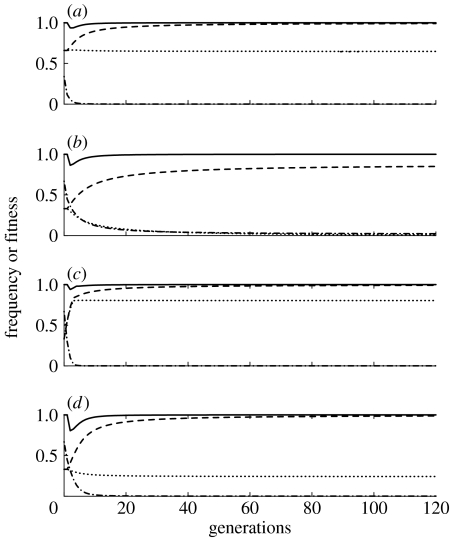
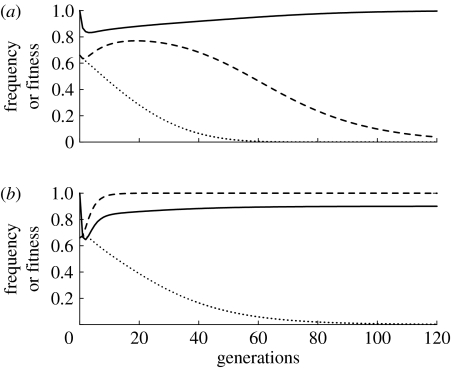
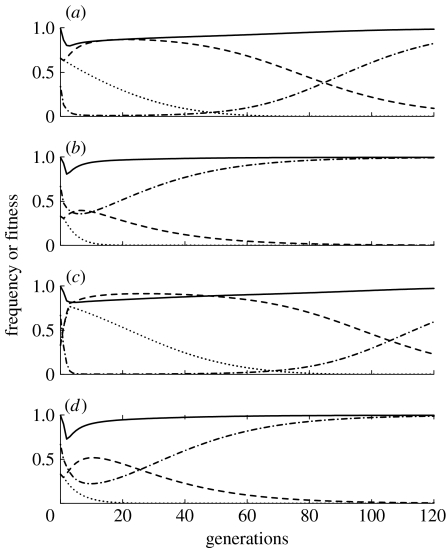
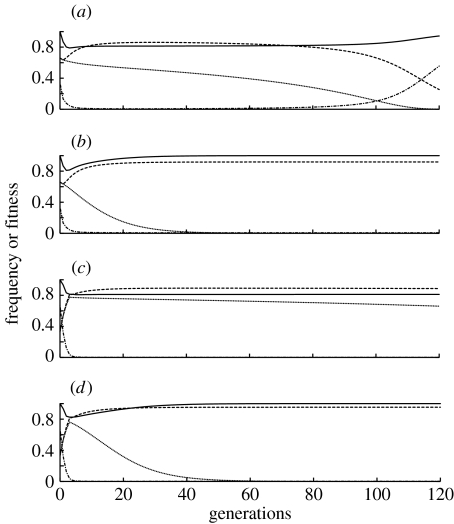
A number of genetic mechanisms have been suggested for driving anti-pathogen genes into natural populations. Each of these mechanisms requires complex genetic engineering, and most are theoretically expected to permanently spread throughout the target species' geographical range. In the near term, risk issues and technical limits of molecular methods could delay the development and use of these mechanisms. We propose a gene-drive mechanism that can be self-limiting over time and space, and is simpler to build. This mechanism involves one gene that codes for toxicity (killer) and a second that confers immunity to the toxic effects (rescue). We use population-genetic models to explore cases with one or two independent insertions of the killer gene and one insertion of the rescue gene. We vary the dominance and penetrance of gene action, as well as the magnitude of fitness costs. Even with the fitness costs of 10 per cent for each gene, the proportion of mosquitoes expected to transmit the pathogen decreases below 5 per cent for over 40 generations after one 2:1 release (engineered:wild) or after four 1:2 releases. Both the killer and rescue genes will be lost from the population over time, if the rescue construct has any associated fitness cost. Molecular approaches for constructing strains are discussed.
人们提出了多种遗传机制,以将抗病原体基因引入自然种群。这些机制中的每一种都需要复杂的基因工程,并且从理论上讲,大多数机制有望在目标物种的地理范围内永久传播。短期内,分子方法的风险问题和技术限制可能会延迟这些机制的开发和应用。我们提出了一种基因驱动机制,该机制在时间和空间上可以自我限制,并且构建起来更简单。这种机制涉及一个编码毒性的基因(杀手基因)和另一个赋予对毒性免疫能力的基因(救援基因)。我们使用群体遗传模型来探索杀手基因有一到两个独立插入以及救援基因有一个插入的情况。我们改变基因作用的显性和外显率,以及适合度代价的大小。即使每个基因的适合度代价为10%,在一次2:1释放(转基因:野生型)或四次1:2释放后,预计传播病原体的蚊子比例在40代以上会降至5%以下。如果救援构建体有任何相关的适合度代价,随着时间的推移,杀手基因和救援基因都将从种群中消失。文中还讨论了构建菌株的分子方法。