O'Riordan Philly, Schwab Uli, Logan Sarah, Cooke Graham, Wilkinson Robert J, Davidson Robert N, Bassett Paul, Wall Robert, Pasvol Geoffrey, Flanagan Katie L
Department of Infection and Tropical Medicine, Lister Unit, Northwick Park Hospital, Harrow, Middlesex, United Kingdom.
PLoS One. 2008 Sep 9;3(9):e3173. doi: 10.1371/journal.pone.0003173.
Multi-drug resistant tuberculosis (MDR-TB) is a major public health concern since diagnosis is often delayed, increasing the risk of spread to the community and health care workers. Treatment is prolonged, and the total cost of treating a single case is high. Diagnosis has traditionally relied upon clinical suspicion, based on risk factors and culture with sensitivity testing, a process that can take weeks or months. Rapid diagnostic molecular techniques have the potential to shorten the time to commencing appropriate therapy, but have not been put to the test under field conditions.
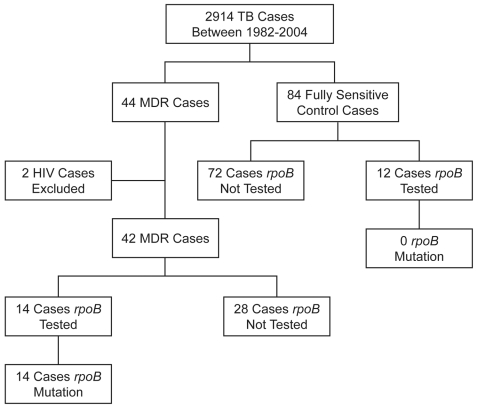
METHODOLOGY/PRINCIPAL FINDINGS: This retrospective case-control study aimed to identify risk factors for MDR-TB, and analyse the impact of testing for rifampicin resistance using RNA polymerase B (rpoB) mutations as a surrogate for MDR-TB. Forty two MDR-TB cases and 84 fully sensitive TB controls were matched by date of diagnosis; and factors including demographics, clinical presentation, microbiology findings, management and outcome were analysed using their medical records. Conventionally recognised risk factors for MDR-TB were absent in almost half (43%) of the cases, and 15% of cases were asymptomatic. A significant number of MDR-TB cases were identified in new entrants to the country. Using rpoB mutation testing, the time to diagnosis of MDR-TB was dramatically shortened by a median of 6 weeks, allowing patients to be commenced on appropriate therapy a median of 51days earlier than those diagnosed by conventional culture and sensitivity testing.
CONCLUSIONS/SIGNIFICANCE: MDR-TB is frequently an unexpected finding, may be asymptomatic, and is particularly prevalent among TB infected new entrants to the country. Molecular resistance testing of all acid fast bacilli positive specimens has the potential to rapidly identify MDR-TB patients and commence them on appropriate therapy significantly earlier than by conventional methods.
耐多药结核病(MDR-TB)是一个重大的公共卫生问题,因为诊断往往延迟,增加了传播给社区和医护人员的风险。治疗时间延长,治疗单个病例的总成本很高。传统上,诊断依赖于基于风险因素的临床怀疑以及进行敏感性测试的培养,这一过程可能需要数周或数月。快速诊断分子技术有可能缩短开始适当治疗的时间,但尚未在现场条件下进行测试。
方法/主要发现:这项回顾性病例对照研究旨在确定耐多药结核病的风险因素,并分析使用RNA聚合酶B(rpoB)突变检测利福平耐药性作为耐多药结核病替代指标的影响。42例耐多药结核病病例和84例完全敏感的结核病对照按诊断日期进行匹配;并使用他们的病历分析包括人口统计学、临床表现、微生物学结果、管理和结局等因素。几乎一半(43%)的病例不存在传统上公认的耐多药结核病风险因素,15%的病例无症状。在该国的新入境者中发现了大量耐多药结核病病例。使用rpoB突变检测,耐多药结核病的诊断时间显著缩短,中位数缩短了6周,使患者比通过传统培养和敏感性测试诊断的患者平均提前51天开始适当治疗。
结论/意义:耐多药结核病常常是一个意外发现,可能无症状,在该国新感染结核病的入境者中尤为普遍。对所有抗酸杆菌阳性标本进行分子耐药性检测有可能快速识别耐多药结核病患者,并比传统方法更早地让他们开始适当治疗。