Chisholm Kimberley, Cook Angus, Bower Carol, Weinstein Philip
Environmental Determinants of Chronic Disease Group, School of Population Health, The University of Western Australia, Crawley, Western Australia, Australia.
Environ Health Perspect. 2008 Sep;116(9):1267-73. doi: 10.1289/ehp.10980.
By international standards, water supplies in Perth, Western Australia, contain high trihalomethane (THM) levels, particularly the brominated forms. Geographic variability in these levels provided an opportunity to examine cross-city spatial relationships between THM exposure and rates of birth defects (BDs).
Our goal was to examine BD rates by exposure to THMs with a highly brominated fraction in metropolitan locations in Perth, Western Australia.
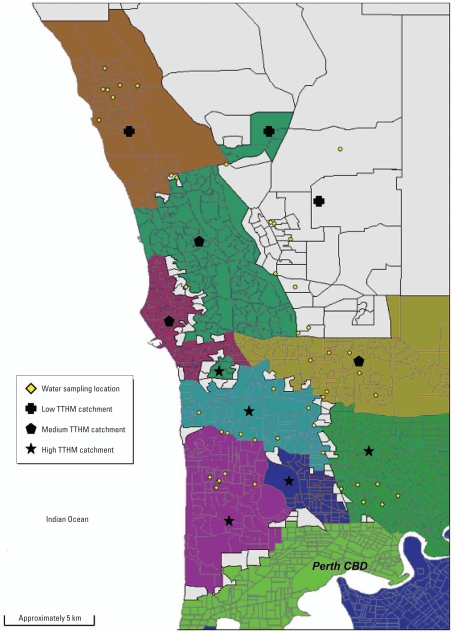
We collected water samples from 47 separate locations and analyzed them for total and individual THM concentrations (micrograms per liter), including separation into brominated forms. We classified collection areas by total THM (TTHM) concentration: low (< 60 microg/L), medium (> 60 to < 130 microg/L), and high (> or = 130 microg/L). We also obtained deidentified registry-based data on total births and BDs (2000-2004 inclusive) from post codes corresponding to water sample collection sites and used binomial logistic regression to compare the frequency of BDs aggregately and separately for the TTHM exposure groups, adjusting for maternal age and socioeconomic status.
Total THMs ranged from 36 to 190 microg/L. A high proportion of the THMs were brominated (on average, 92%). Women living in high-TTHM areas showed an increased risk of any BD [odds ratio (OR) = 1.22; 95% confidence interval (CI), 1.01-1.48] and for the major category of any cardiovascular BD (OR = 1.62; 95% CI, 1.04-2.51), compared with women living in low-TTHM areas.
Brominated forms constituted the significant fraction of THMs in all areas. Small but statistically significant increases in risks of BDs were associated with residence in areas with high THMs.
按照国际标准,澳大利亚西部珀斯的供水系统中三卤甲烷(THM)含量很高,尤其是溴化形式的三卤甲烷。这些含量的地理差异为研究THM暴露与出生缺陷(BD)发生率之间的跨城市空间关系提供了契机。
我们的目标是在澳大利亚西部珀斯的大都市地区,研究暴露于高溴化组分的THM下的BD发生率。
我们从47个不同地点采集了水样,并分析了总THM浓度和各THM浓度(微克/升),包括将其分离为溴化形式。我们根据总THM(TTHM)浓度对采集区域进行分类:低(<60微克/升)、中(>60至<130微克/升)和高(≥130微克/升)。我们还从与水样采集地点对应的邮政编码中获取了基于登记处的去识别化数据,包括总出生数和BD数(涵盖2000年至2004年),并使用二项逻辑回归来比较TTHM暴露组中BD的总体频率和分别频率,同时对产妇年龄和社会经济地位进行了调整。
总THM浓度范围为36至190微克/升。大部分THM为溴化形式(平均为92%)。与生活在低TTHM地区的女性相比,生活在高TTHM地区的女性出现任何BD的风险增加[比值比(OR)=1.22;95%置信区间(CI),1.01 - 1.48],以及任何心血管BD的主要类别(OR = 1.62;95% CI,1.04 - 2.51)。
在所有地区,溴化形式占THM的很大一部分。BD风险虽有小幅增加,但具有统计学意义,这与居住在THM含量高的地区有关。