Kumar Hari R, Zhong Xiaoling, Hoelz Derek J, Rescorla Frederick J, Hickey Robert J, Malkas Linda H, Sandoval John A
Section of Pediatric Surgery, Indiana University School of Medicine and Riley Children's Hospital, 545 N. Barnhill Dr. EH202, Indianapolis, IN 46202, USA.
Pediatr Surg Int. 2008 Nov;24(11):1229-34. doi: 10.1007/s00383-008-2245-2. Epub 2008 Sep 17.
Solid tumors, such as neuroblastoma (NB), are associated with a heterogeneous cell environment. Multicellular tumor spheroid (MCTS) cultures have been shown to better mimic growth characteristics of in vivo solid tumors. Because tumor spheroid growth patterns may be quite different from standard two-dimensional culture systems, we sought to compare the protein expression profiles of two- and three-dimensional in vitro NB cultures, i.e., monolayers and MCTS.
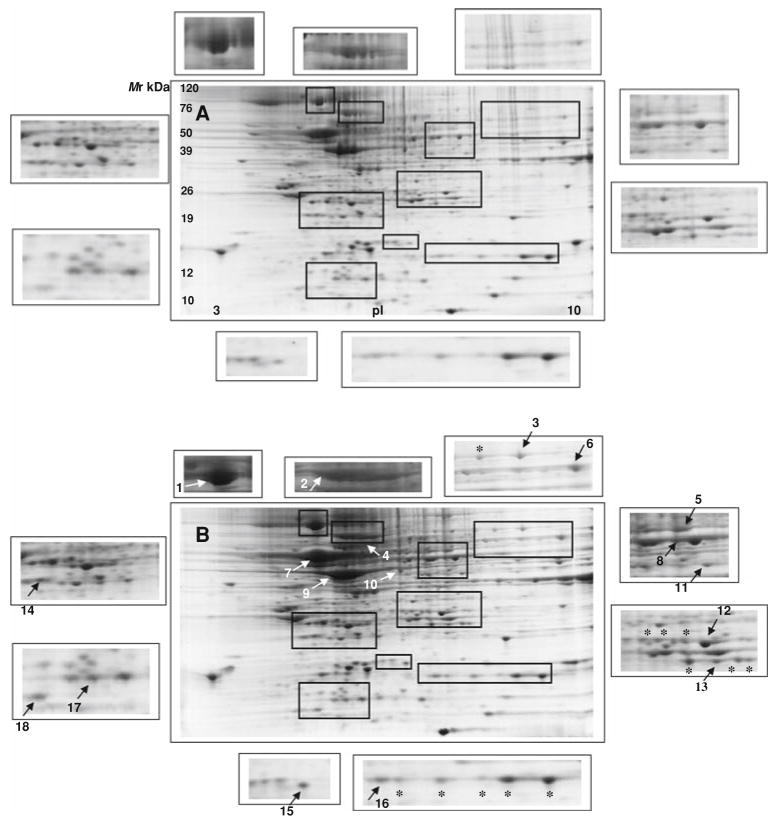
Human NB cells were grown as both monolayers and spheres. Nuclear and cytosolic proteins were analyzed for differentially secreted proteins by two-dimensional polyacrylamide gel electrophoresis (2-D PAGE) and selected polypeptides were identified by mass spectrometry (LC-MS/MS).
Several metabolic (transketolase, triosephosphate isomerase, pyruvate kinase M1/M2, alpha enolase, and phosphoglycerate mutase-1), cell stress response (heat shock proteins (HSP) 90, 70, and 60; antioxidant, thioredoxin), cell structure (septin 2, adenyl cyclase-associated protein-1), tubulin beta-2 chain, actin, translationally controlled tumor protein and cofilin), signal transduction (peptidyl prolyl cis/trans isomerase A), biosynthetic (phosphoserine aminotransferase) and transport (cellular retinoic acid binding protein 1) polypeptides were overexpressed in spheroids. Several protein groups were differentially expressed between NB monolayers and spheroids.
The altered proteins among NB spheroids may represent an important link between monolayer cell cultures and in vivo experiments and thus a more ideal in vitro culture system for determining the precise three-dimensional microenvironment of NB.
实体瘤,如神经母细胞瘤(NB),与异质性细胞环境相关。多细胞肿瘤球体(MCTS)培养已被证明能更好地模拟体内实体瘤的生长特征。由于肿瘤球体的生长模式可能与标准二维培养系统有很大不同,我们试图比较二维和三维体外NB培养物(即单层细胞和MCTS)的蛋白质表达谱。
人NB细胞分别培养成单层细胞和球体。通过二维聚丙烯酰胺凝胶电泳(2-D PAGE)分析核蛋白和胞质蛋白中差异分泌的蛋白质,并通过质谱(LC-MS/MS)鉴定选定的多肽。
几种代谢相关(转酮醇酶、磷酸丙糖异构酶、丙酮酸激酶M1/M2、α-烯醇化酶和磷酸甘油酸变位酶-1)、细胞应激反应相关(热休克蛋白(HSP)90、70和60;抗氧化剂、硫氧还蛋白)、细胞结构相关(septin 2、腺苷酸环化酶相关蛋白-1)、微管蛋白β-2链、肌动蛋白、翻译控制肿瘤蛋白和丝切蛋白)、信号转导相关(肽基脯氨酰顺/反异构酶A)、生物合成相关(磷酸丝氨酸转氨酶)和转运相关(细胞视黄酸结合蛋白1)的多肽在球体中过表达。NB单层细胞和球体之间有几种蛋白质组差异表达。
NB球体中改变的蛋白质可能代表单层细胞培养和体内实验之间的重要联系,因此是用于确定NB精确三维微环境的更理想体外培养系统。