Hoofnagle Andrew N, Becker Jessica O, Wener Mark H, Heinecke Jay W
Department of Laboratory Medicine, University of Washington, Seattle, WA 98195, USA.
Clin Chem. 2008 Nov;54(11):1796-804. doi: 10.1373/clinchem.2008.109652. Epub 2008 Sep 18.
Quantification of serum tumor markers plays an important role in determining whether patients treated for cancer require further therapy. Whereas large-scale proteomic efforts aim to identify novel tumor markers to facilitate early detection, optimization of methods for quantifying known tumor markers offers another approach to improving management of malignancies. For example, immunoassays used in clinical practice to measure established tumor markers suffer from potential interference from endogenous immunoglobulins and imperfect concordance across platforms-problems that also plague many other immunoassays. To address these important limitations, this study used peptide immunoaffinity enrichment in concert with liquid chromatography-tandem mass spectrometry (LC-MS/MS) to quantify thyroglobulin, a well-characterized tumor marker.
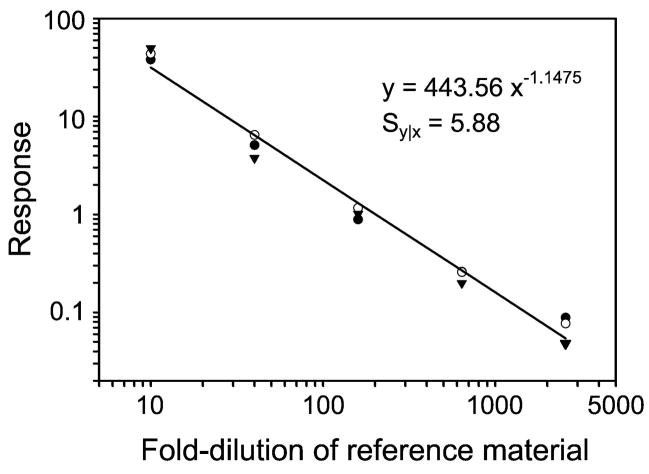
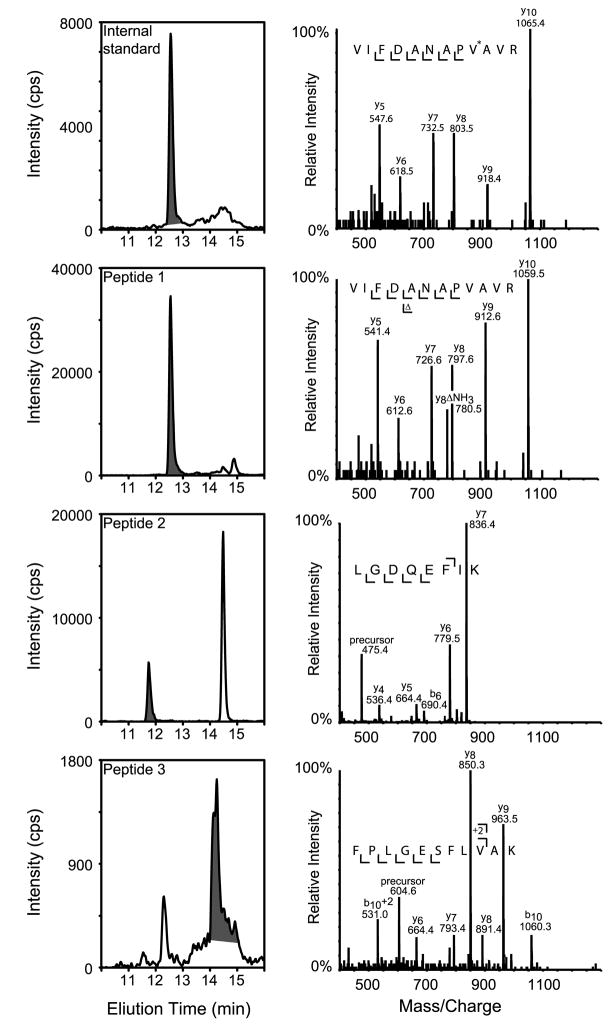
We identified 3 peptides in tryptic digests of thyroglobulin that were detected at low concentrations by tandem mass spectrometry, raised polyclonal antibodies to those peptides, and used the antibodies to extract the 3 corresponding peptides from tryptic digests of human serum. We quantified each endogenous peptide using LC-MS/MS and multiple reaction monitoring with external calibrators.
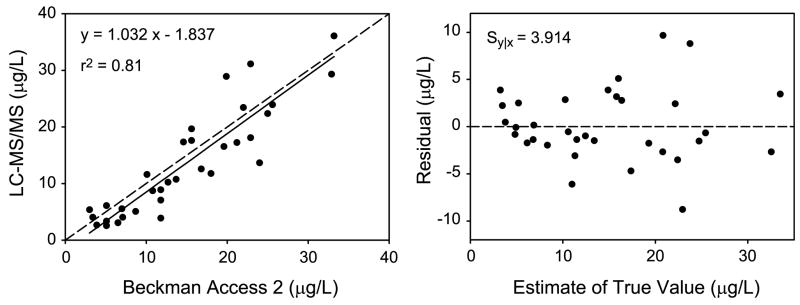
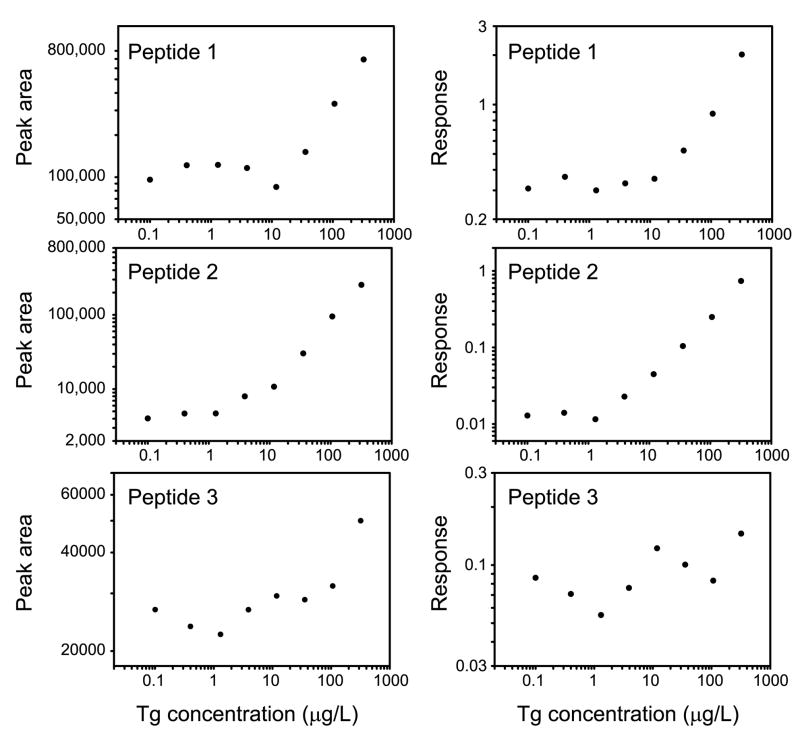
The detection limit for endogenous thyroglobulin in serum was 2.6 microg/L (4 pmol/L). Direct comparison with immunoassay revealed good correlation (r(2) = 0.81).
Immunoaffinity peptide enrichment-tandem mass spectrometry can detect tryptic peptides of thyroglobulin at picomolar concentrations while also digesting the endogenous immunoglobulins that can potentially interfere with traditional immunoassays. Our observations suggest a general analytical strategy for using immunoaffinity isolation together with tandem mass spectrometry to quantify tumor antigens and other low-abundance proteins in human serum.
血清肿瘤标志物的定量分析在确定癌症治疗患者是否需要进一步治疗方面发挥着重要作用。大规模蛋白质组学研究旨在识别新型肿瘤标志物以促进早期检测,而优化已知肿瘤标志物的定量方法则为改善恶性肿瘤的管理提供了另一种途径。例如,临床实践中用于测量已确立的肿瘤标志物的免疫测定法受到内源性免疫球蛋白的潜在干扰以及不同平台间不一致性的影响——这些问题也困扰着许多其他免疫测定法。为了解决这些重要局限性,本研究将肽免疫亲和富集与液相色谱 - 串联质谱法(LC-MS/MS)相结合,对甲状腺球蛋白(一种特征明确的肿瘤标志物)进行定量分析。
我们在甲状腺球蛋白的胰蛋白酶消化物中鉴定出3种肽段,这些肽段通过串联质谱法在低浓度下被检测到,针对这些肽段制备多克隆抗体,并使用这些抗体从人血清的胰蛋白酶消化物中提取3种相应的肽段。我们使用LC-MS/MS和外部校准物的多反应监测对每种内源性肽段进行定量分析。
血清中内源性甲状腺球蛋白的检测限为2.6微克/升(4皮摩尔/升)。与免疫测定法的直接比较显示出良好的相关性(r² = 0.81)。
免疫亲和肽富集 - 串联质谱法能够以皮摩尔浓度检测甲状腺球蛋白的胰蛋白酶肽段,同时还能消化可能干扰传统免疫测定法的内源性免疫球蛋白。我们的观察结果表明了一种通用的分析策略,即使用免疫亲和分离结合串联质谱法来定量分析人血清中的肿瘤抗原和其他低丰度蛋白质。