Department of Biochemistry, University of Washington, Seattle, WA, USA.
Institute for Protein Design, University of Washington, Seattle, WA, USA.
Nature. 2024 Feb;626(7998):435-442. doi: 10.1038/s41586-023-06953-1. Epub 2023 Dec 18.
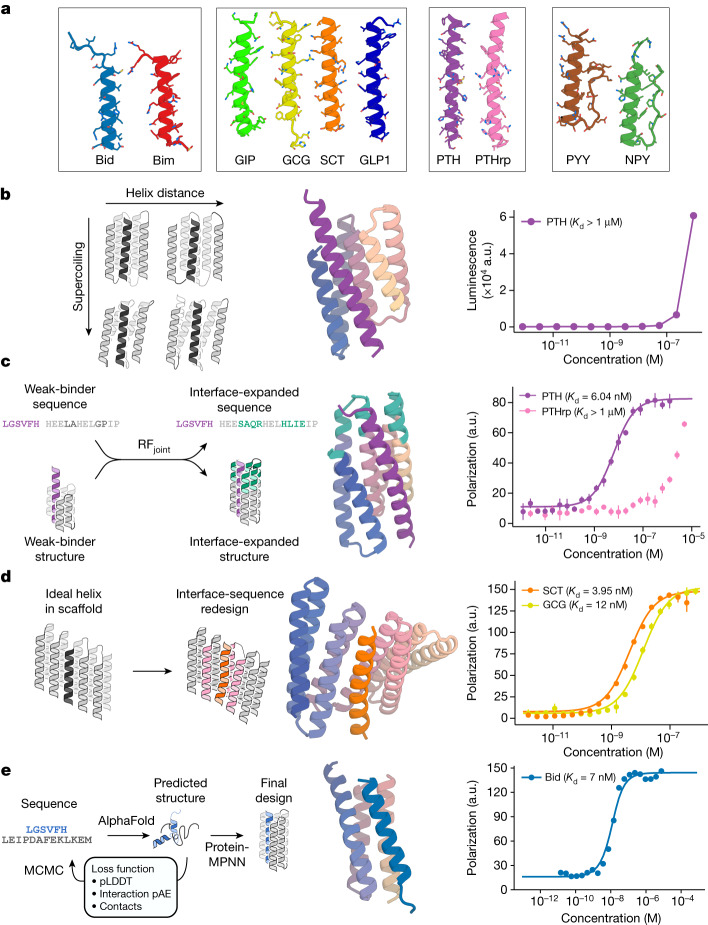
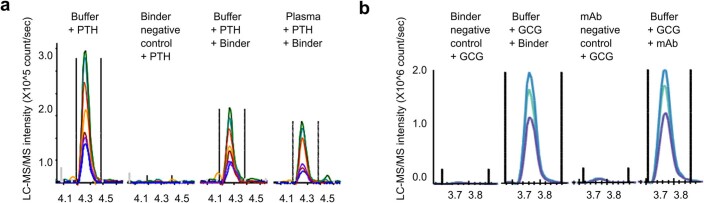
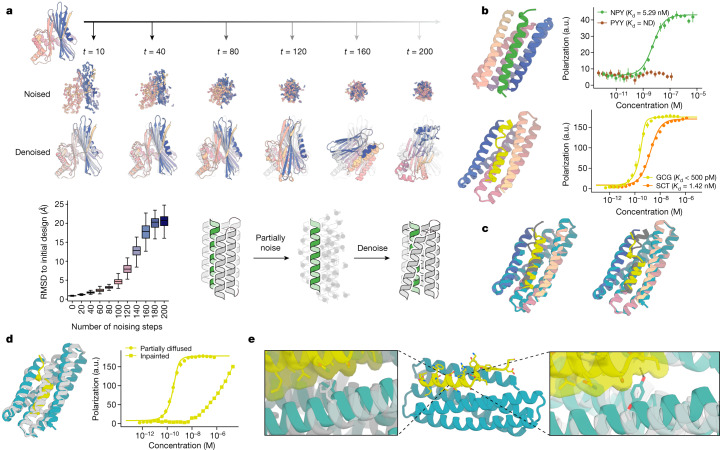
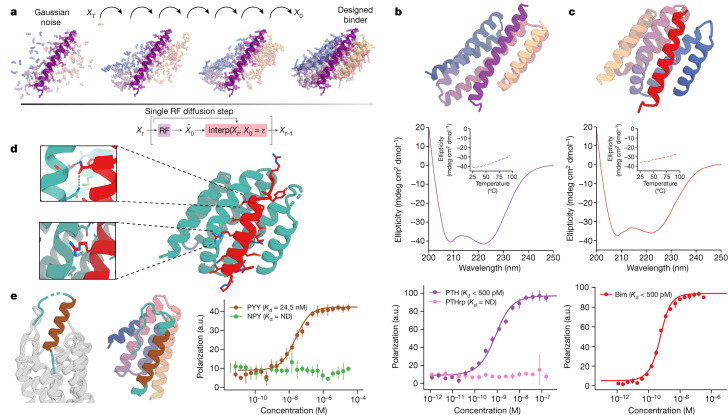
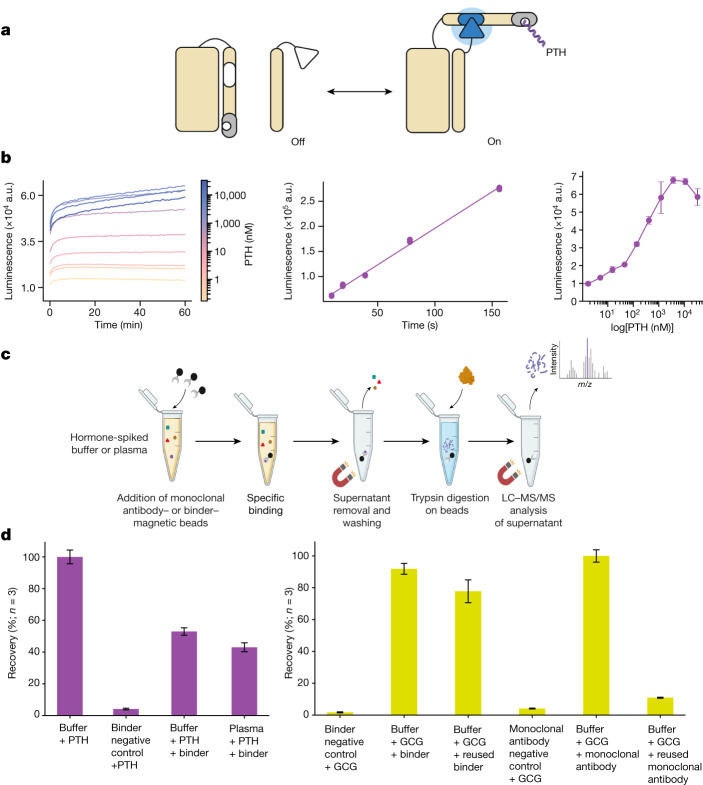
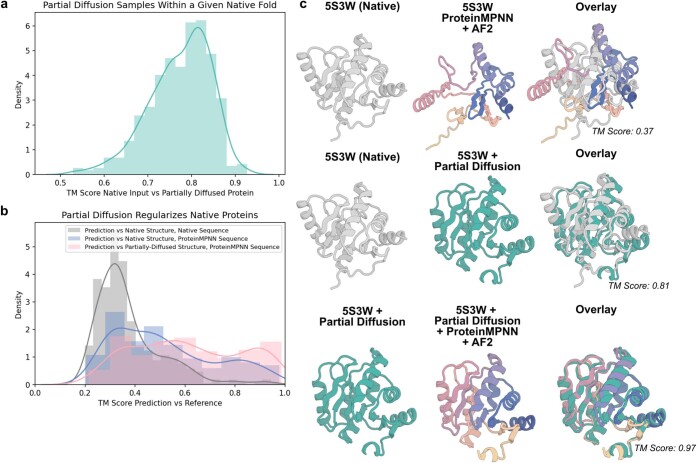
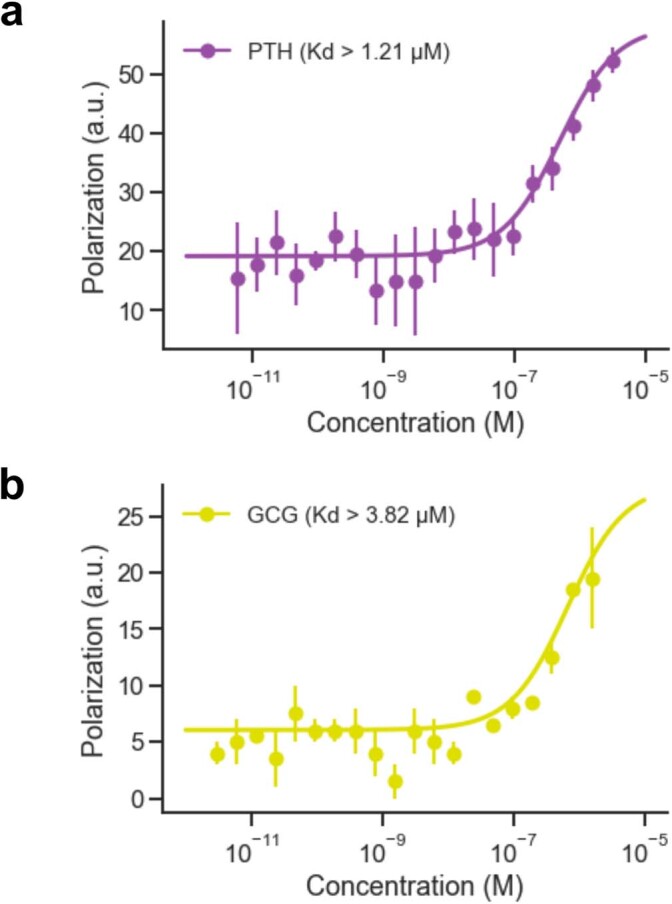
Many peptide hormones form an α-helix on binding their receptors, and sensitive methods for their detection could contribute to better clinical management of disease. De novo protein design can now generate binders with high affinity and specificity to structured proteins. However, the design of interactions between proteins and short peptides with helical propensity is an unmet challenge. Here we describe parametric generation and deep learning-based methods for designing proteins to address this challenge. We show that by extending RFdiffusion to enable binder design to flexible targets, and to refining input structure models by successive noising and denoising (partial diffusion), picomolar-affinity binders can be generated to helical peptide targets by either refining designs generated with other methods, or completely de novo starting from random noise distributions without any subsequent experimental optimization. The RFdiffusion designs enable the enrichment and subsequent detection of parathyroid hormone and glucagon by mass spectrometry, and the construction of bioluminescence-based protein biosensors. The ability to design binders to conformationally variable targets, and to optimize by partial diffusion both natural and designed proteins, should be broadly useful.
许多肽激素在与受体结合时形成α-螺旋,因此能够灵敏地检测这些激素的方法可能有助于更好地管理疾病。从头设计蛋白质现在可以生成对结构蛋白具有高亲和力和特异性的结合物。然而,设计具有螺旋倾向的蛋白质与短肽之间的相互作用仍然是一个尚未解决的挑战。在这里,我们描述了基于参数生成和深度学习的方法,用于设计蛋白质来解决这一挑战。我们表明,通过扩展 RFdiffusion 以实现对柔性靶标的结合物设计,并通过连续的加噪和去噪(部分扩散)来细化输入结构模型,我们可以生成对螺旋肽靶标具有皮摩尔亲和力的结合物,方法是要么通过对其他方法生成的设计进行细化,要么完全从头开始从随机噪声分布开始,而无需任何后续的实验优化。RFdiffusion 设计可通过质谱法富集和随后检测甲状旁腺激素和胰高血糖素,并构建基于生物发光的蛋白质生物传感器。设计与构象变化靶标结合物的能力,以及通过部分扩散对天然和设计蛋白质进行优化的能力,应该具有广泛的用途。