Burdon Kathryn P, Sharma Shiwani, Hewitt Alex W, McMellon Amy E, Wang Jie Jin, Mackey David A, Mitchell Paul, Craig Jamie E
Department of Ophthalmology, Flinders University, Adelaide, Australia.
Mol Vis. 2008 Sep 22;14:1727-36.
Pseudoexfoliation syndrome is a major risk factor for the development of glaucoma. Following recent reports of a strong association of coding variants in the lysyl oxidase-like 1 (LOXL1) gene with this syndrome but low penetrance and variable disease frequency between different populations, we aimed to identify additional genetic factors contributing to the disease. The clusterin (CLU) gene has been proposed as a candidate because of the presence of clusterin protein in pseudoexfoliation deposits, its varied levels in aqueous humor of cases compared to controls, and the role of the protein as a molecular chaperone. We investigated the association of genetic variants across CLU in pseudoexfoliation syndrome and analyzed molecular characteristics of the encoded protein in ocular tissues.
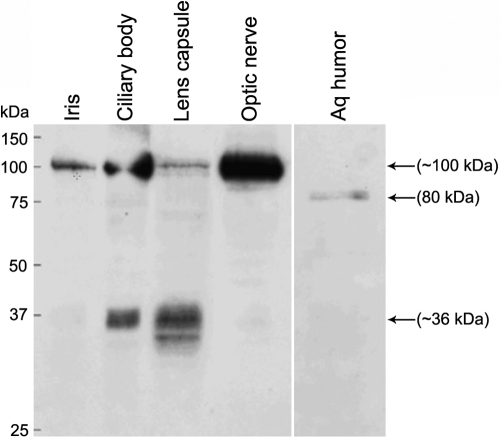
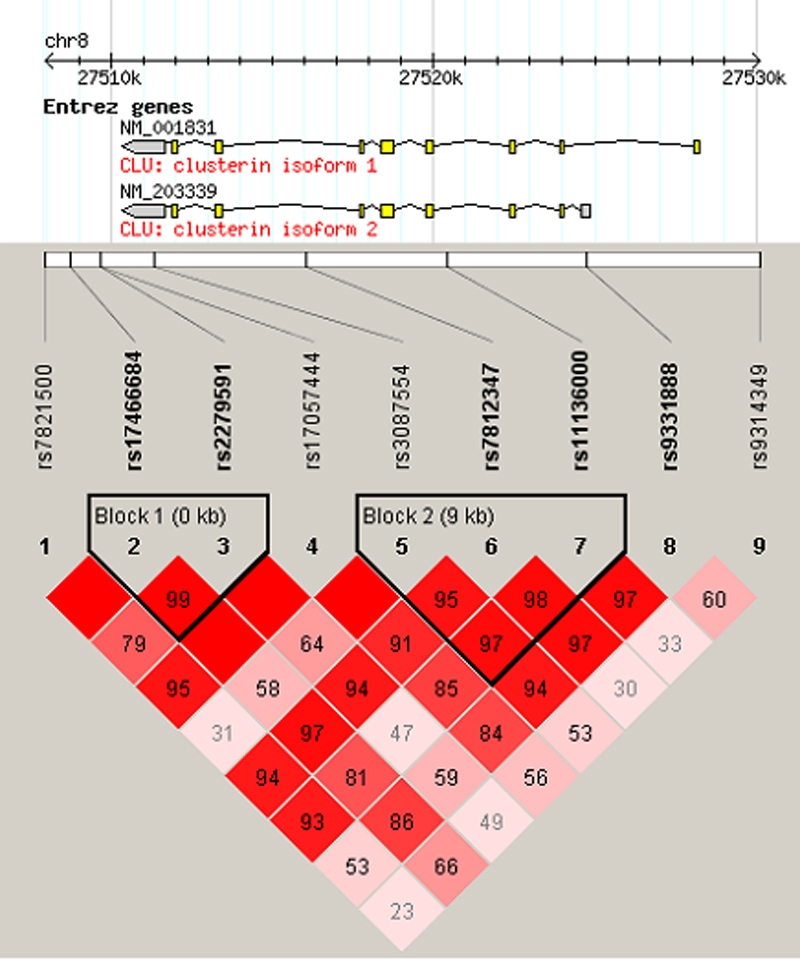
The expression of clusterin in relevant ocular tissues was assessed using western blotting. Nine tag single nucleotide polymorphisms (SNPs) across CLU were genotyped in 86 cases of pseudoexfoliation syndrome and 2422 controls from the Australian Blue Mountains Eye Study cohort. Each SNP and haplotype was assessed for association with the syndrome.
Clusterin was identified in normal human iris, the ciliary body, lens capsule, optic nerve, and aqueous humor. Post-translational modification gives rise to a 100 kDa precursor protein in ocular tissues, larger than that reported in non-ocular tissues. One CLU SNP (rs3087554) was nominally associated with pseudoexfoliation syndrome at the genotypic level (p=0.044), although not when the age of controls was restricted to those over 73 years. Only age and the LOXL1 diplotype were significant factors in the logistic regression. One haplotype of all nine CLU SNPs was also associated (p=0.005), but the significance decreased slightly with the use of the age-restricted controls (p=0.011).
Clusterin is present in ocular anterior segment tissues involved in pseudoexfoliation syndrome. Although one haplotype may contribute in a minor way to genetic risk of pseudoexfoliation syndrome, common variation in this gene is not a major contributor to the risk of pseudoexfoliation syndrome.
假性剥脱综合征是青光眼发生的主要危险因素。近期有报道称赖氨酰氧化酶样1(LOXL1)基因的编码变异与该综合征有很强的关联,但不同人群中该基因的外显率较低且疾病频率存在差异,我们旨在确定导致该疾病的其他遗传因素。由于假性剥脱沉积物中存在簇集素蛋白、与对照组相比病例房水中其水平不同以及该蛋白作为分子伴侣的作用,簇集素(CLU)基因被提出作为候选基因。我们研究了假性剥脱综合征中CLU基因变异的关联性,并分析了眼组织中编码蛋白的分子特征。
使用蛋白质印迹法评估簇集素在相关眼组织中的表达。对来自澳大利亚蓝山眼研究队列的86例假性剥脱综合征病例和2422名对照进行CLU基因上9个标签单核苷酸多态性(SNP)的基因分型。评估每个SNP和单倍型与该综合征的关联性。
在正常人的虹膜、睫状体、晶状体囊、视神经和房水中发现了簇集素。翻译后修饰在眼组织中产生一种100 kDa的前体蛋白,比非眼组织中报道的要大。一个CLU SNP(rs3087554)在基因型水平上与假性剥脱综合征名义上相关(p = 0.044),尽管当对照组年龄限制在73岁以上时不相关。在逻辑回归中,只有年龄和LOXL1双倍型是显著因素。所有9个CLU SNP的一个单倍型也相关(p = 0.005),但使用年龄限制的对照组时显著性略有下降(p = 0.011)。
簇集素存在于参与假性剥脱综合征的眼前段组织中。虽然一个单倍型可能对假性剥脱综合征的遗传风险有轻微影响,但该基因中的常见变异不是假性剥脱综合征风险的主要因素。