Department of Basic Research, Kitasato Institute, Tokyo 108-8642, Japan.
J Clin Biochem Nutr. 2008 Sep;43(2):75-81. doi: 10.3164/jcbn.2008049.
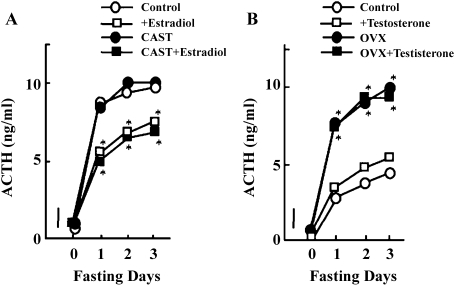
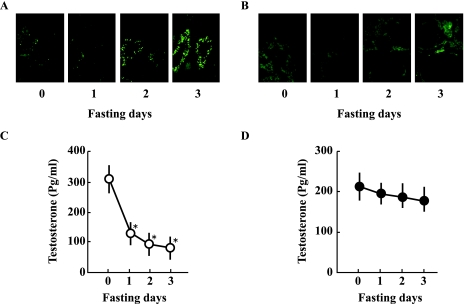
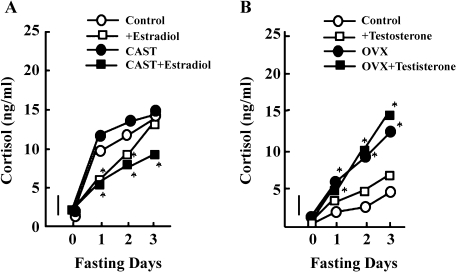
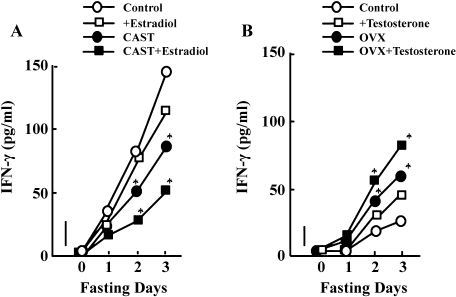
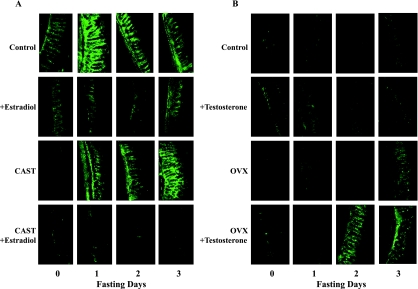
The immunological properties and hormonal metabolism in rodents are affected by physical and psychological stress more strongly in males than in females. To elucidate the mechanism and physiological significance of the sex difference in the susceptibility of animal to stresses, changes in the immunological system in plasma and intestine and hormonal status in plasma were compared among 8-week-old male and female ICR mice before and after fasting. During the fasting of animals, the expression of immunoglobulin A in intestinal mucosa, and cortisol, interleukin-10 and interferon-gamma in plasma increased. These changes occurred more apparently in males than in females. Under identical conditions, the plasma levels of testosterone decreased markedly with concomitant occurrence of apoptosis in the testis, while the plasma levels of estradiol decreased calmly, and no appreciable apoptosis occurred in the ovary. These results indicate that testosterone enhances the stress-induced modulation of the immune system by some mechanism that was antagonized by estradiol.
雄性动物比雌性动物更容易受到生理和心理压力的影响,从而改变其免疫特性和激素代谢。为了阐明动物对压力的敏感性存在性别差异的机制和生理意义,本研究比较了 8 周龄雄性和雌性 ICR 小鼠在禁食前后血浆和肠道中的免疫系统变化以及血浆中的激素状态。在动物禁食期间,肠道黏膜中的免疫球蛋白 A 以及血浆中的皮质醇、白细胞介素-10 和干扰素-γ的表达增加。这些变化在雄性动物中比在雌性动物中更为明显。在相同条件下,睾丸中的细胞凋亡伴随着血浆中睾酮水平显著下降,而血浆中雌二醇水平则平静下降,卵巢中没有明显的细胞凋亡发生。这些结果表明,睾酮通过某种机制增强了应激诱导的免疫系统调节,而这种机制被雌二醇拮抗。