Lopez Vanessa M, Decatur Christina L, Stamer W Daniel, Lynch Ronald M, McKay Brian S
Department of Ophthalmology and Vision Science, The University of Arizona, Tucson, Arizona, USA.
PLoS Biol. 2008 Sep 30;6(9):e236. doi: 10.1371/journal.pbio.0060236.
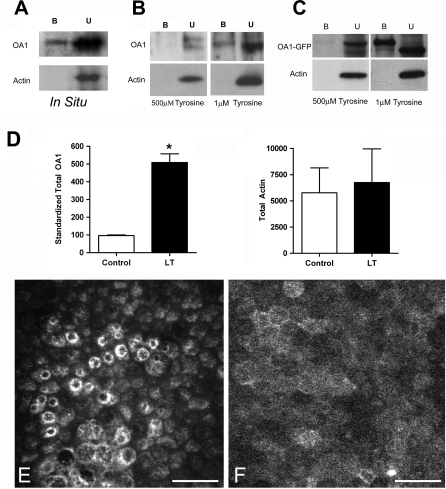
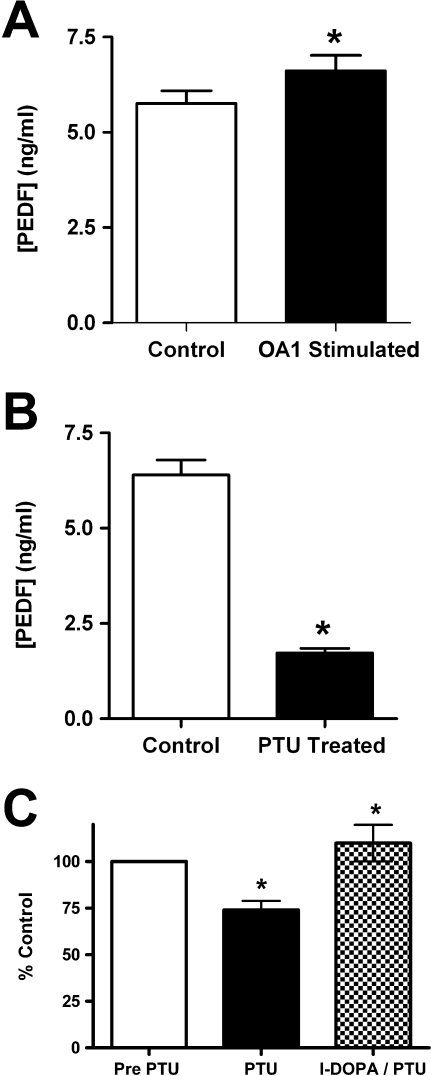
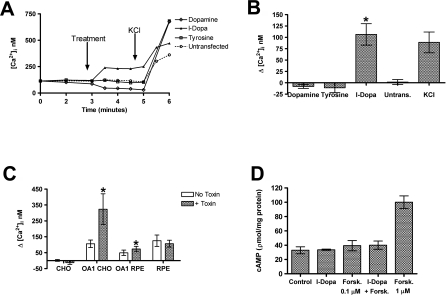
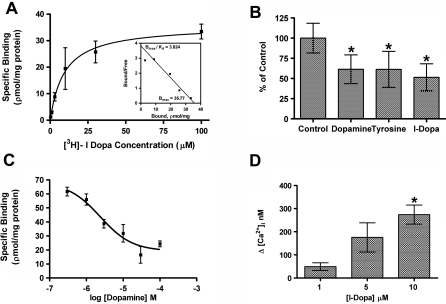
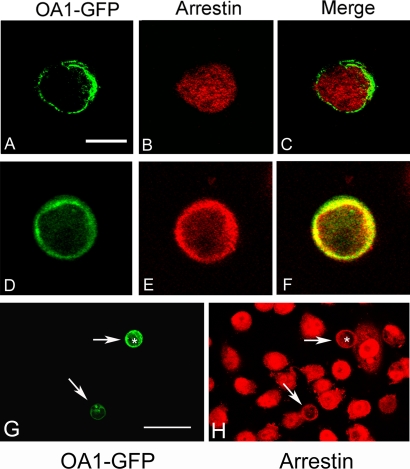
Albinism is a genetic defect characterized by a loss of pigmentation. The neurosensory retina, which is not pigmented, exhibits pathologic changes secondary to the loss of pigmentation in the retina pigment epithelium (RPE). How the loss of pigmentation in the RPE causes developmental defects in the adjacent neurosensory retina has not been determined, but offers a unique opportunity to investigate the interactions between these two important tissues. One of the genes that causes albinism encodes for an orphan GPCR (OA1) expressed only in pigmented cells, including the RPE. We investigated the function and signaling of OA1 in RPE and transfected cell lines. Our results indicate that OA1 is a selective L-DOPA receptor, with no measurable second messenger activity from two closely related compounds, tyrosine and dopamine. Radiolabeled ligand binding confirmed that OA1 exhibited a single, saturable binding site for L-DOPA. Dopamine competed with L-DOPA for the single OA1 binding site, suggesting it could function as an OA1 antagonist. OA1 response to L-DOPA was defined by several common measures of G-protein coupled receptor (GPCR) activation, including influx of intracellular calcium and recruitment of beta-arrestin. Further, inhibition of tyrosinase, the enzyme that makes L-DOPA, resulted in decreased PEDF secretion by RPE. Further, stimulation of OA1 in RPE with L-DOPA resulted in increased PEDF secretion. Taken together, our results illustrate an autocrine loop between OA1 and tyrosinase linked through L-DOPA, and this loop includes the secretion of at least one very potent retinal neurotrophic factor. OA1 is a selective L-DOPA receptor whose downstream effects govern spatial patterning of the developing retina. Our results suggest that the retinal consequences of albinism caused by changes in melanin synthetic machinery may be treated by L-DOPA supplementation.
白化病是一种以色素沉着缺失为特征的基因缺陷。未色素沉着的神经感觉视网膜会出现继发于视网膜色素上皮(RPE)色素沉着缺失的病理变化。RPE中色素沉着的缺失如何导致相邻神经感觉视网膜的发育缺陷尚未明确,但这为研究这两个重要组织之间的相互作用提供了独特的机会。导致白化病的基因之一编码一种仅在色素细胞(包括RPE)中表达的孤儿GPCR(OA1)。我们研究了OA1在RPE和转染细胞系中的功能及信号传导。我们的结果表明,OA1是一种选择性L - 多巴受体,对于两种密切相关的化合物酪氨酸和多巴胺没有可测量的第二信使活性。放射性标记配体结合证实OA1对L - 多巴表现出单一的、可饱和的结合位点。多巴胺与L - 多巴竞争单一的OA1结合位点,表明它可作为OA1拮抗剂发挥作用。OA1对L - 多巴的反应通过几种G蛋白偶联受体(GPCR)激活的常见指标来定义,包括细胞内钙流入和β - 抑制蛋白的募集。此外,抑制生成L - 多巴的酪氨酸酶会导致RPE分泌色素上皮衍生因子(PEDF)减少。此外,用L - 多巴刺激RPE中的OA1会导致PEDF分泌增加。综上所述,我们的结果说明了通过L - 多巴连接的OA1和酪氨酸酶之间的自分泌环,并且这个环包括至少一种非常有效的视网膜神经营养因子的分泌。OA1是一种选择性L - 多巴受体,其下游效应控制发育中视网膜的空间模式。我们的结果表明,由黑色素合成机制变化引起的白化病的视网膜后果可能通过补充L - 多巴来治疗。