Mao Huirong, Guo Yuanmei, Yang Guangcheng, Yang Bin, Ren Jun, Liu Sanfeng, Ai Huashui, Ma Junwu, Brenig Bertram, Huang Lusheng
Key Laboratory for Animal Biotechnology of Jiangxi Province and the Ministry of Agriculture of China, Jiangxi Agricultural University, Nanchang 330045, PR China.
BMC Genet. 2008 Oct 8;9:63. doi: 10.1186/1471-2156-9-63.
Limb bone lengths and bone mineral density (BMD) have been used to assess the bone growth and the risk of bone fractures in pigs, respectively. It has been suggested that limb bone lengths and BMD are under genetic control. However, the knowledge about the genetic basis of the limb bone lengths and mineralisatinon is limited in pigs. The aim of this study was to identify quantitative trait loci (QTL) affecting limb bone lengths and BMD of the distal femur in a White Duroc x Erhualian resource population.
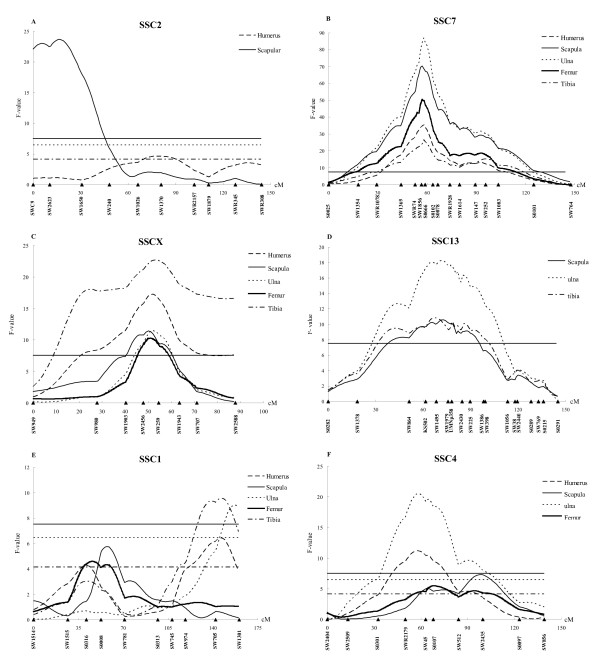
Limb bone lengths and femoral bone mineral density (fBMD) were measured in a total of 1021 and 116 F2 animals, respectively. There were strong positive correlations among the lengths of limb bones and medium positive correlations between the lengths of limb bones and fBMD. A whole-genome scan involving 183 microsatellite markers across the pig genome revealed 35 QTL for the limb bone lengths and 2 for femoral BMD. The most significant QTL for the lengths of five limb bones were mapped on two chromosomes affecting all 5 limb bones traits. One was detected around 57 cM on pig chromosome (SSC) 7 with the largest F-value of more than 26 and 95% confidence intervals of less than 5 cM, providing a crucial start point to identify the causal genes for these traits. The Erhualian alleles were associated with longer limb bones. The other was located on SSCX with a peak at 50-53 cM, whereas alleles from the White Duroc breed increased the bone length. Many QTL identified are homologous to the human genomic regions containing QTL for bone-related traits and a list of interesting candidate genes.
This study detected the QTL for the lengths of scapula, ulna, humerus and tibia and fBMD in the pig for the first time. Moreover, several new QTL for the pig femoral length were found. As correlated traits, QTL for the lengths of five limb bones were mainly located in the same genomic regions. The most promising QTL for the lengths of five limb bones on SSC7 merits further investigation.
肢骨长度和骨矿物质密度(BMD)已分别用于评估猪的骨骼生长和骨折风险。有人提出肢骨长度和BMD受遗传控制。然而,关于猪肢骨长度和矿化的遗传基础的知识有限。本研究的目的是在大白杜洛克×二花脸资源群体中鉴定影响股骨远端肢骨长度和BMD的数量性状基因座(QTL)。
分别在总共1021只和116只F2动物中测量了肢骨长度和股骨骨矿物质密度(fBMD)。肢骨长度之间存在强正相关,肢骨长度与fBMD之间存在中等正相关。涉及猪基因组中183个微卫星标记的全基因组扫描揭示了35个肢骨长度的QTL和2个股骨BMD的QTL。五个肢骨长度的最显著QTL定位在两条染色体上,影响所有5个肢骨性状。一个在猪7号染色体(SSC)约57 cM处检测到,最大F值超过26,95%置信区间小于5 cM, 为鉴定这些性状的因果基因提供了关键起点。二花脸等位基因与较长的肢骨相关。另一个位于SSCX上,峰值在50 - 53 cM处,而来自大白杜洛克品种的等位基因增加了骨长度。鉴定出的许多QTL与包含骨相关性状QTL的人类基因组区域同源,并列出了一系列有趣的候选基因。
本研究首次在猪中检测到肩胛骨、尺骨、肱骨和胫骨长度以及fBMD的QTL。此外,还发现了几个新的猪股骨长度QTL。作为相关性状,五个肢骨长度的QTL主要位于相同的基因组区域。SSC7上五个肢骨长度最有希望的QTL值得进一步研究。