McDougall Stuart J, Peters James H, LaBrant Lia, Wang Xin, Koop Dennis R, Andresen Michael C
Department of Physiology & Pharmacology, Oregon Health & Science University, Portland, OR, USA.
PLoS One. 2008 Oct 8;3(10):e3372. doi: 10.1371/journal.pone.0003372.
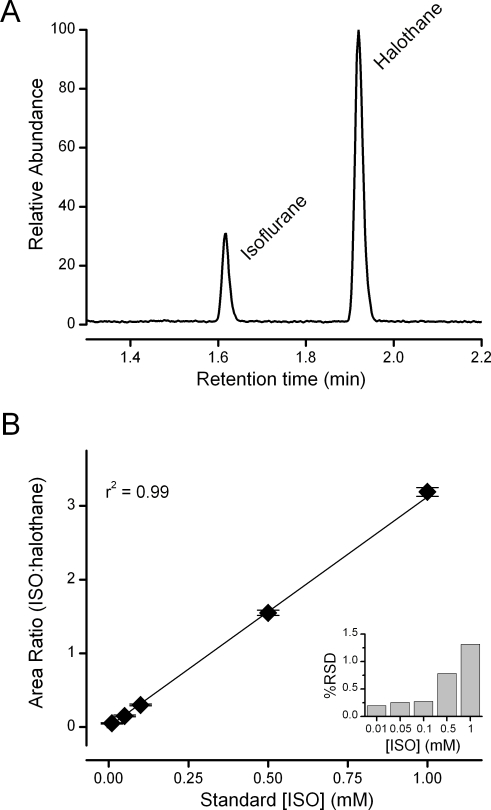
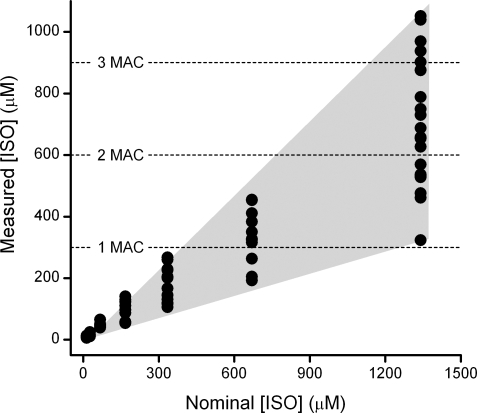
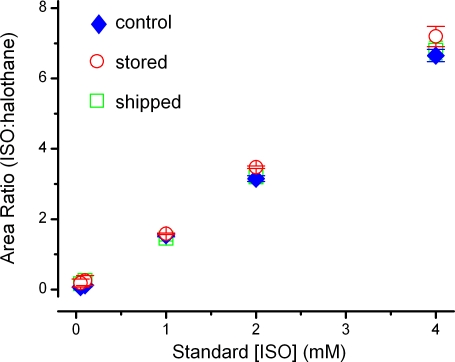
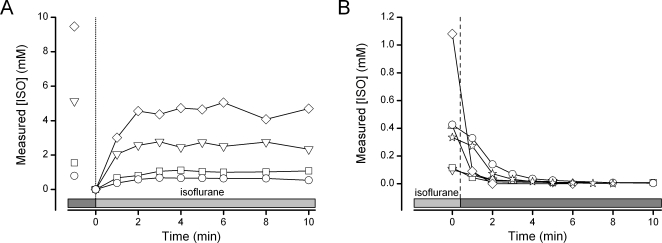
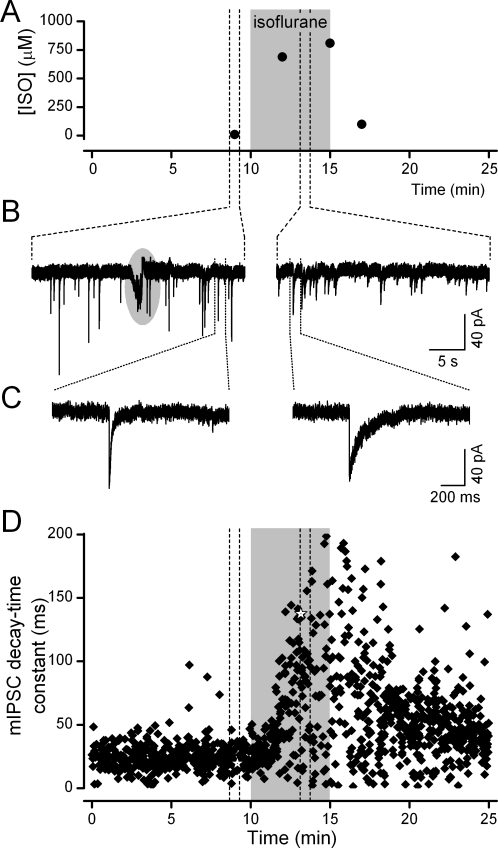
The volatile anesthetic isoflurane poses a number of experimental challenges in the laboratory. Due to its rapid evaporation, the open conditions of most in vitro electrophysiological recording systems make the determination of actual isoflurane concentrations a challenge. Since the absolute anesthetic concentration in solution is directly related to efficacy, concentration measurements are important to allow comparisons between laboratory and clinical studies. In this study we quantify the sources of isoflurane loss during experimentation and describe a method for the measurement of isoflurane concentrations using gas chromatography and mass spectrometry simultaneous to in vitro electrophysiological measurements. Serial samples of perfused bath solution allowed correlation of isoflurane concentrations with ongoing biological effects. Saturated physiological solutions contained 13.4 +/- 0.2 mM isoflurane and were diluted to desired "nominal" concentrations for experiments. The perfusion system established stable isoflurane concentrations within the bath by 2 minutes. However, bath isoflurane concentrations varied substantially and unpredictably between experiments. The magnitudes of such discrepancies in isoflurane concentrations spanned clinically important levels. Our studies suggest that, despite countermeasures, solution handling significantly impacted the isoflurane content in the tissue bath. The magnitude of these discrepancies appears to necessitate systematic direct measurement of bath isoflurane concentrations during most in vitro conditions.
挥发性麻醉剂异氟烷在实验室中带来了许多实验挑战。由于其快速蒸发,大多数体外电生理记录系统的开放条件使得确定实际的异氟烷浓度成为一项挑战。由于溶液中的绝对麻醉剂浓度与疗效直接相关,浓度测量对于在实验室研究和临床研究之间进行比较非常重要。在本研究中,我们量化了实验过程中异氟烷损失的来源,并描述了一种在进行体外电生理测量的同时使用气相色谱和质谱法测量异氟烷浓度的方法。灌注浴液的系列样本使异氟烷浓度与持续的生物学效应相关联。饱和生理溶液含有13.4±0.2 mM的异氟烷,并被稀释至所需的“标称”浓度用于实验。灌注系统在2分钟内使浴室内的异氟烷浓度稳定下来。然而,不同实验之间浴室内的异氟烷浓度变化很大且不可预测。异氟烷浓度的这种差异幅度跨越了临床上重要的水平。我们的研究表明,尽管采取了对策,但溶液处理仍对组织浴中的异氟烷含量产生了显著影响。这些差异的幅度似乎使得在大多数体外条件下有必要系统地直接测量浴室内的异氟烷浓度。