Siniscalchi Marcello, Quaranta Angelo, Rogers Lesley J
Department of Animal Production, University of Bari, Bari, Italy.
PLoS One. 2008;3(10):e3349. doi: 10.1371/journal.pone.0003349. Epub 2008 Oct 9.
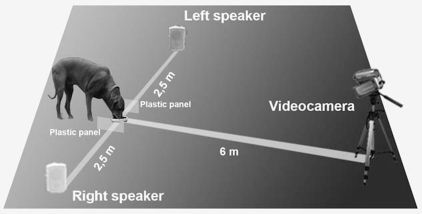
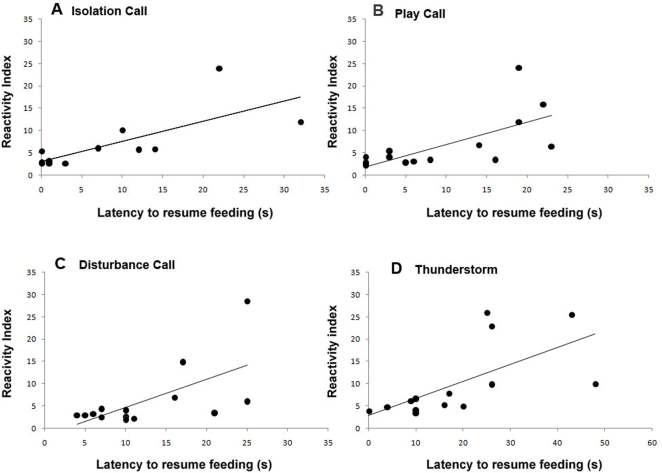
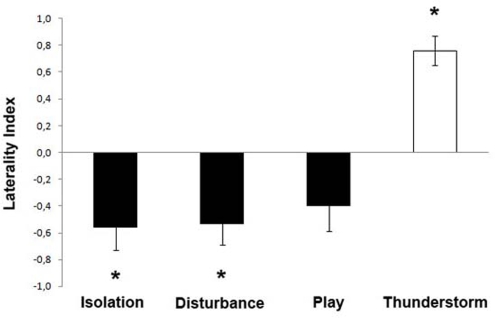
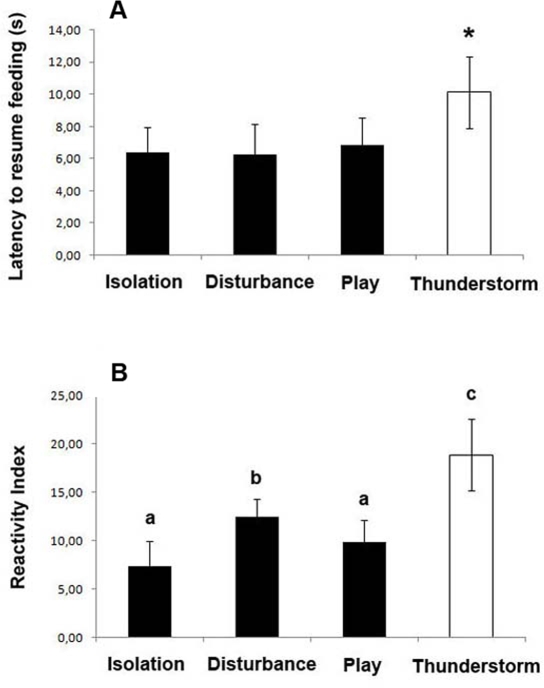
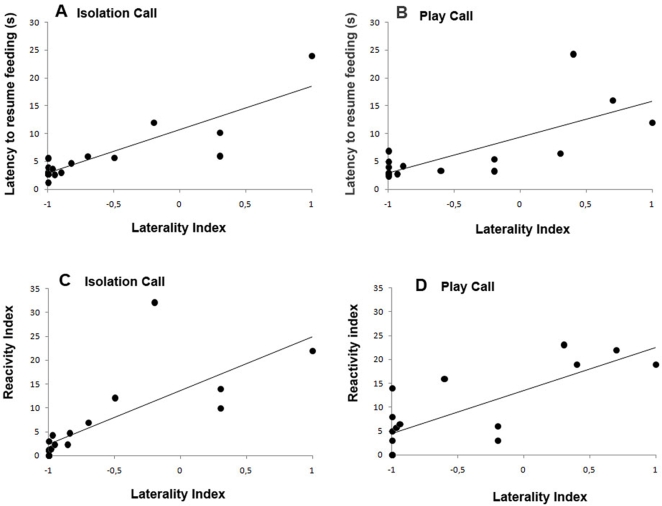
Considerable experimental evidence shows that functional cerebral asymmetries are widespread in animals. Activity of the right cerebral hemisphere has been associated with responses to novel stimuli and the expression of intense emotions, such as aggression, escape behaviour and fear. The left hemisphere uses learned patterns and responds to familiar stimuli. Although such lateralization has been studied mainly for visual responses, there is evidence in primates that auditory perception is lateralized and that vocal communication depends on differential processing by the hemispheres. The aim of the present work was to investigate whether dogs use different hemispheres to process different acoustic stimuli by presenting them with playbacks of a thunderstorm and their species-typical vocalizations. The results revealed that dogs usually process their species-typical vocalizations using the left hemisphere and the thunderstorm sounds using the right hemisphere. Nevertheless, conspecific vocalizations are not always processed by the left hemisphere, since the right hemisphere is used for processing vocalizations when they elicit intense emotion, including fear. These findings suggest that the specialisation of the left hemisphere for intraspecific communication is more ancient that previously thought, and so is specialisation of the right hemisphere for intense emotions.
大量实验证据表明,功能性脑不对称在动物中广泛存在。右半球的活动与对新刺激的反应以及强烈情绪的表达有关,如攻击、逃避行为和恐惧。左半球则利用习得模式并对熟悉的刺激做出反应。尽管这种脑侧化主要针对视觉反应进行了研究,但在灵长类动物中有证据表明听觉感知也存在脑侧化,并且发声交流依赖于半球的差异处理。本研究的目的是通过向狗播放雷暴声音及其物种典型发声,来探究狗是否使用不同的半球处理不同的声学刺激。结果显示,狗通常使用左半球处理其物种典型发声,使用右半球处理雷暴声音。然而,同种发声并不总是由左半球处理,因为当发声引发包括恐惧在内的强烈情绪时,右半球会用于处理发声。这些发现表明,左半球在种内交流方面的特化比之前认为的更为古老,右半球在处理强烈情绪方面的特化也是如此。