Lund Søren Søgaard, Tarnow Lise, Astrup Anne Sofie, Hovind Peter, Jacobsen Peter Karl, Alibegovic Amra Ciric, Parving Ida, Pietraszek Lotte, Frandsen Merete, Rossing Peter, Parving Hans-Henrik, Vaag Allan Arthur
Steno Diabetes Center, Gentofte, Denmark.
PLoS One. 2008;3(10):e3363. doi: 10.1371/journal.pone.0003363. Epub 2008 Oct 9.
Despite intensive insulin treatment, many patients with type-1 diabetes (T1DM) have longstanding inadequate glycaemic control. Metformin is an oral hypoglycaemic agent that improves insulin action in patients with type-2 diabetes. We investigated the effect of a one-year treatment with metformin versus placebo in patients with T1DM and persistent poor glycaemic control.
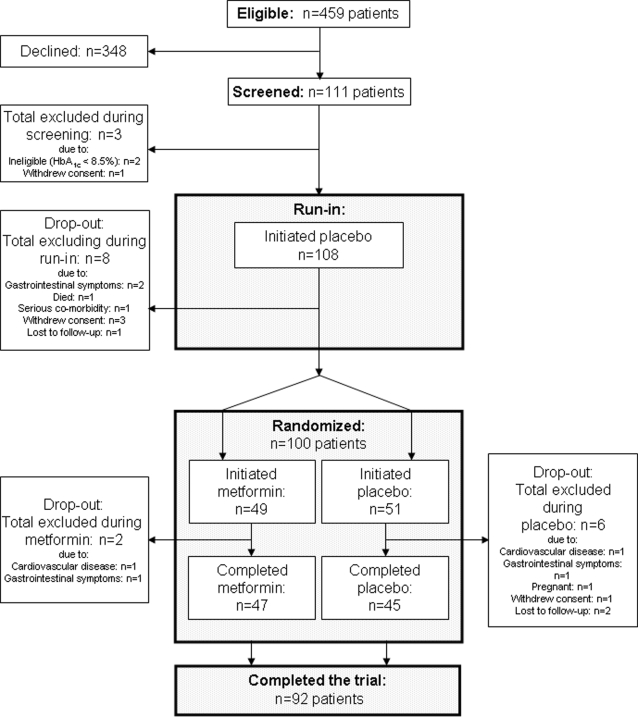
METHODOLOGY/PRINCIPAL FINDINGS: One hundred patients with T1DM, preserved hypoglycaemic awareness and HaemoglobinA(1c) (HbA(1c)) > or = 8.5% during the year before enrolment entered a one-month run-in on placebo treatment. Thereafter, patients were randomized (baseline) to treatment with either metformin (1 g twice daily) or placebo for 12 months (double-masked). Patients continued ongoing insulin therapy and their usual outpatient clinical care. The primary outcome measure was change in HbA(1c) after one year of treatment. At enrolment, mean (standard deviation) HbA(1c) was 9.48% (0.99) for the metformin group (n = 49) and 9.60% (0.86) for the placebo group (n = 51). Mean (95% confidence interval) baseline-adjusted differences after 12 months with metformin (n = 48) versus placebo (n = 50) were: HbA(1c), 0.13% (-0.19; 0.44), p = 0.422; Total daily insulin dose, -5.7 U/day (-8.6; -2.9), p<0.001; body weight, -1.74 kg (-3.32; -0.17), p = 0.030. Minor and overall major hypoglycaemia was not significantly different between treatments. Treatments were well tolerated.
CONCLUSIONS/SIGNIFICANCE: In patients with poorly controlled T1DM, adjunct metformin therapy did not provide any improvement of glycaemic control after one year. Nevertheless, adjunct metformin treatment was associated with sustained reductions of insulin dose and body weight. Further investigations into the potential cardiovascular-protective effects of metformin therapy in patients with T1DM are warranted.
ClinicalTrials.gov NCT00118937.
尽管进行了强化胰岛素治疗,但许多1型糖尿病(T1DM)患者长期血糖控制不佳。二甲双胍是一种口服降糖药,可改善2型糖尿病患者的胰岛素作用。我们研究了二甲双胍与安慰剂治疗1年对T1DM且血糖持续控制不佳患者的影响。
方法/主要发现:100例T1DM患者,在入组前一年血糖自我监测功能保留且糖化血红蛋白(HbA1c)≥8.5%,先接受为期1个月的安慰剂导入治疗。此后,患者被随机(基线)分为二甲双胍(每日2次,每次1g)治疗组或安慰剂治疗组,为期12个月(双盲)。患者继续进行现有的胰岛素治疗及常规门诊临床护理。主要结局指标为治疗1年后HbA1c的变化。入组时,二甲双胍组(n = 49)的平均(标准差)HbA1c为9.48%(0.99),安慰剂组(n = 51)为9.60%(0.86)。二甲双胍组(n = 48)与安慰剂组(n = 50)治疗12个月后,平均(95%置信区间)经基线调整的差异为:HbA1c,0.13%(-0.19;0.44),p = 0.422;每日胰岛素总剂量,-5.7 U/天(-8.6;-2.9),p<0.001;体重,-1.74 kg(-3.32;-0.17),p = 0.030。治疗组间轻度及总体严重低血糖无显著差异。治疗耐受性良好。
结论/意义:在血糖控制不佳的T1DM患者中,辅助二甲双胍治疗1年后并未改善血糖控制。然而,辅助二甲双胍治疗可使胰岛素剂量和体重持续降低。有必要进一步研究二甲双胍治疗对T1DM患者潜在的心血管保护作用。
ClinicalTrials.gov NCT00118937。