Qin Wenyi, Zhu Weizhu, Hewett John E, Rottinghaus George, Chen Yin-Chieh, Flynn John T, Kliethermes Beth, Mannello Ferdinando, Sauter Edward R
Department of Surgery, University of North Dakota, Grand Forks, ND, USA.
BMC Cancer. 2008 Oct 15;8:298. doi: 10.1186/1471-2407-8-298.
While increased urokinase-type plasminogen activator (uPA) expression in breast cancer tissue is directly associated with poor prognosis, recent evidence suggests that uPA overexpression may suppress tumor growth and prolong survival. Celecoxib has been shown to have antiangiogenic and antiproliferative properties. We sought to determine if uPA, PA inhibitor (PAI)-1 and prostaglandin (PG)E2 expression in nipple aspirate fluid (NAF) and uPA and PGE2 expression in plasma were altered by celecoxib dose and concentration in women at increased breast cancer risk.
NAF and plasma samples were collected in women at increased breast cancer risk before and 2 weeks after taking celecoxib 200 or 400 mg twice daily (bid). uPA, PAI-1 and PGE2 were measured before and after intervention.
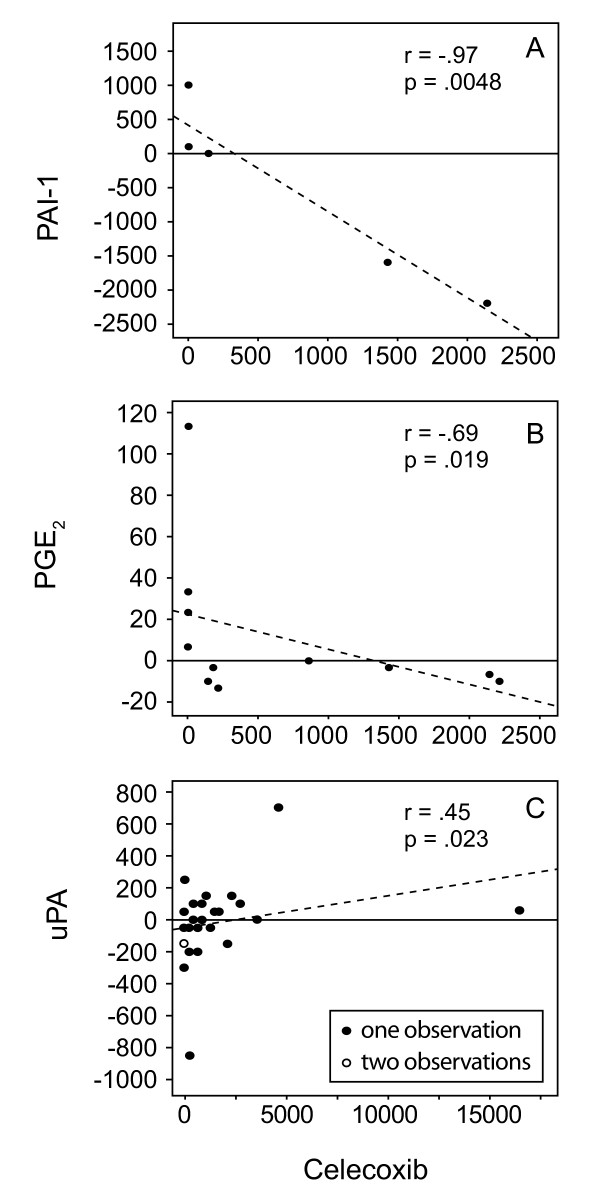
Celecoxib concentrations trended higher in women taking 400 mg (median 1025.0 ng/mL) compared to 200 mg bid (median 227.3 ng/mL), and in post- (534.6 ng/mL) compared to premenopausal (227.3 ng/mL) women. In postmenopausal women treated with the higher (400 mg bid) celecoxib dose, uPA concentrations increased, while PAI-1 and PGE2 decreased. In women taking the higher dose, both PAI-1 (r = -.97, p = .0048) and PGE2 (r = -.69, p = .019) in NAF and uPA in plasma (r = .45, p = .023) were correlated with celecoxib concentrations.
Celecoxib concentrations after treatment correlate inversely with the change in PAI-1 and PGE2 in the breast and directly with the change in uPA in the circulation. uPA upregulation, in concert with PAI-1 and PGE2 downregulation, may have a cancer preventive effect.
虽然乳腺癌组织中尿激酶型纤溶酶原激活剂(uPA)表达增加与预后不良直接相关,但最近的证据表明,uPA过表达可能会抑制肿瘤生长并延长生存期。塞来昔布已被证明具有抗血管生成和抗增殖特性。我们试图确定,在乳腺癌风险增加的女性中,塞来昔布的剂量和浓度是否会改变乳头抽吸液(NAF)中的uPA、PA抑制剂(PAI)-1和前列腺素(PG)E2表达以及血浆中的uPA和PGE2表达。
在乳腺癌风险增加的女性中,于每日两次服用200或400毫克塞来昔布(bid)之前及之后2周采集NAF和血浆样本。在干预前后测量uPA、PAI-1和PGE2。
与每日两次服用200毫克(中位数227.3纳克/毫升)相比,服用400毫克的女性塞来昔布浓度呈上升趋势(中位数1025.0纳克/毫升),且绝经后女性(534.6纳克/毫升)高于绝经前女性(227.3纳克/毫升)。在接受较高剂量(每日两次400毫克)塞来昔布治疗的绝经后女性中,uPA浓度升高,而PAI-1和PGE2降低。在服用较高剂量的女性中,NAF中的PAI-1(r = -0.97,p = 0.0048)和PGE2(r = -0.69,p = 0.019)以及血浆中的uPA(r = 0.45,p = 0.023)均与塞来昔布浓度相关。
治疗后的塞来昔布浓度与乳腺中PAI-1和PGE2的变化呈负相关,与循环中uPA的变化呈正相关。uPA上调,与PAI-1和PGE2下调协同作用,可能具有癌症预防作用。