Yuferov Vadim, Ji Fei, Nielsen David A, Levran Orna, Ho Ann, Morgello Susan, Shi Ruijin, Ott Jurg, Kreek Mary Jeanne
Laboratory of the Biology of Addictive Diseases, The Rockefeller University, New York, NY 10065, USA.
Neuropsychopharmacology. 2009 Apr;34(5):1185-97. doi: 10.1038/npp.2008.187. Epub 2008 Oct 15.
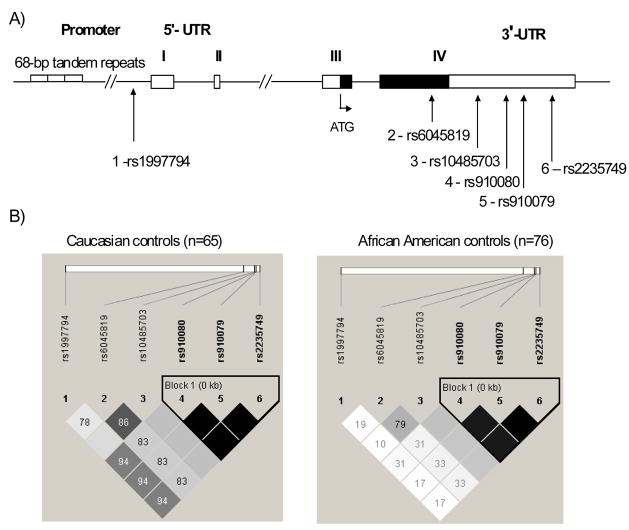
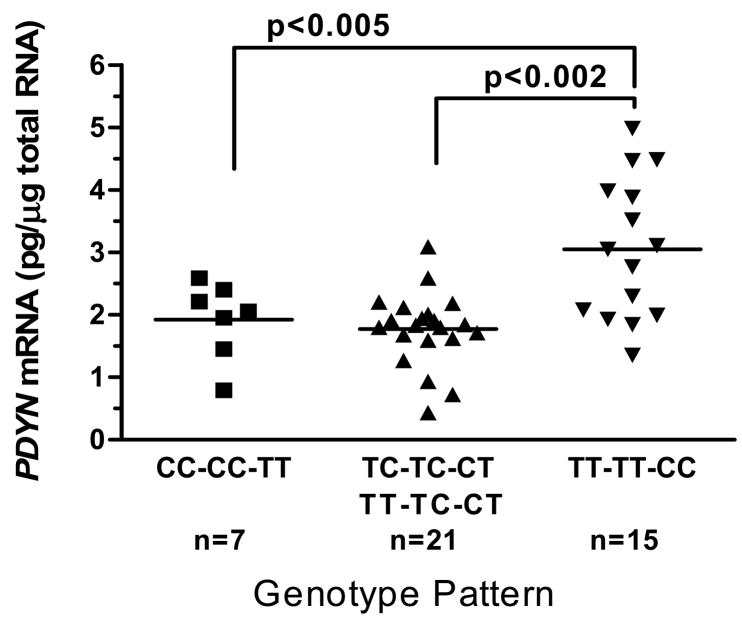
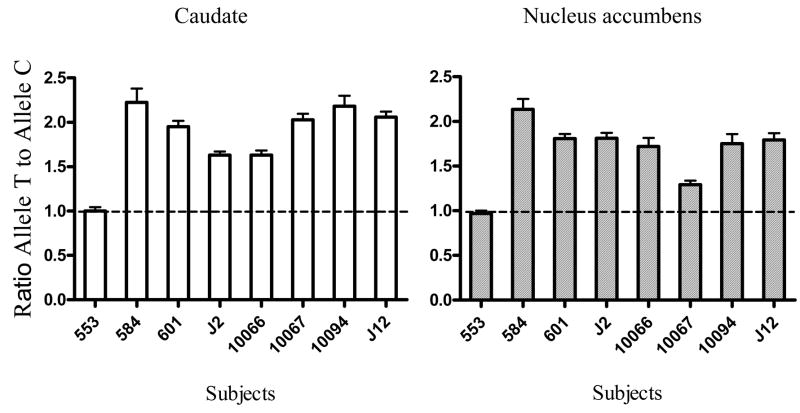
Dynorphin peptides and the kappa-opioid receptor are important in the rewarding properties of cocaine, heroin, and alcohol. We tested polymorphisms of the prodynorphin gene (PDYN) for association with cocaine dependence and cocaine/alcohol codependence. We genotyped six single nucleotide polymorphisms (SNPs), located in the promoter region, exon 4 coding, and 3' untranslated region, in 106 Caucasians and 204 African Americans who were cocaine dependent, cocaine/alcohol codependent, or controls. In Caucasians, we found point-wise significant associations of 3'UTR SNPs (rs910080, rs910079, and rs2235749) with cocaine dependence and cocaine/alcohol codependence. These SNPs are in high linkage disequilibrium, comprising a haplotype block. The haplotype CCT was significantly experiment-wise associated with cocaine dependence and with combined cocaine dependence and cocaine/alcohol codependence (false discovery rate, q=0.04 and 0.03, respectively). We investigated allele-specific gene expression of PDYN, using SNP rs910079 as a reporter, in postmortem human brains from eight heterozygous subjects, using SNaPshot assay. There was significantly lower expression for C allele (rs910079), with ratios ranging from 0.48 to 0.78, indicating lower expression of the CCT haplotype of PDYN in both the caudate and nucleus accumbens. Analysis of total PDYN expression in 43 postmortem brains also showed significantly lower levels of preprodynorphin mRNA in subjects having the risk CCT haplotype. This study provides evidence that a 3'UTR PDYN haplotype, implicated in vulnerability to develop cocaine addiction and/or cocaine/alcohol codependence, is related to lower mRNA expression of the PDYN gene in human dorsal and ventral striatum.
强啡肽肽和κ-阿片受体在可卡因、海洛因和酒精的奖赏特性中起重要作用。我们测试了前强啡肽基因(PDYN)的多态性与可卡因依赖以及可卡因/酒精共依赖的关联性。我们对106名白种人和204名非裔美国人进行了基因分型,这些人分别为可卡因依赖者、可卡因/酒精共依赖者或对照,检测了位于启动子区域、外显子4编码区和3'非翻译区的六个单核苷酸多态性(SNP)。在白种人中,我们发现3'非翻译区SNP(rs910080、rs910079和rs2235749)与可卡因依赖以及可卡因/酒精共依赖存在逐点显著关联。这些SNP处于高度连锁不平衡状态,构成一个单倍型块。单倍型CCT在实验水平上与可卡因依赖以及合并的可卡因依赖和可卡因/酒精共依赖显著相关(错误发现率,q分别为0.04和0.03)。我们使用SNaPshot分析,以SNP rs910079作为报告基因,在八名杂合子受试者的死后人类大脑中研究了PDYN的等位基因特异性基因表达。C等位基因(rs910079)的表达显著降低,比率范围为0.48至0.78,表明在尾状核和伏隔核中PDYN的CCT单倍型表达较低。对43个死后大脑中总PDYN表达的分析也显示,具有风险CCT单倍型的受试者中前强啡肽原mRNA水平显著较低。这项研究提供了证据,表明一个与可卡因成瘾和/或可卡因/酒精共依赖易感性相关的3'非翻译区PDYN单倍型,与人类背侧和腹侧纹状体中PDYN基因较低的mRNA表达有关。