Chavanas Stéphane, Adoue Véronique, Méchin Marie-Claire, Ying Shibo, Dong Sijun, Duplan Hélène, Charveron Marie, Takahara Hidenari, Serre Guy, Simon Michel
UMR 5165, CNRS-Toulouse III University, CHU Purpan, Toulouse, France.
PLoS One. 2008;3(10):e3408. doi: 10.1371/journal.pone.0003408. Epub 2008 Oct 16.
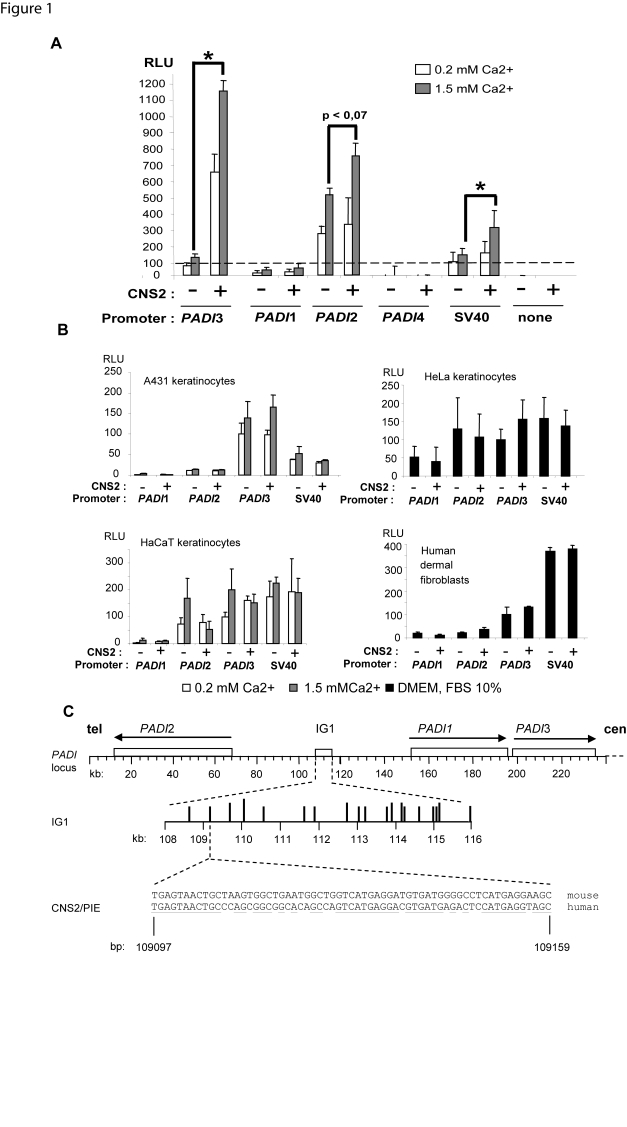
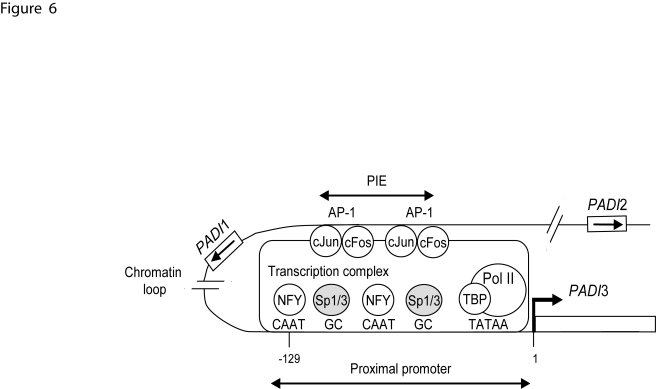
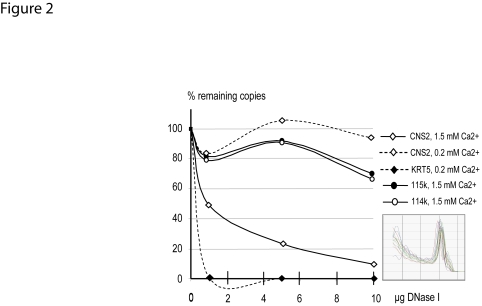
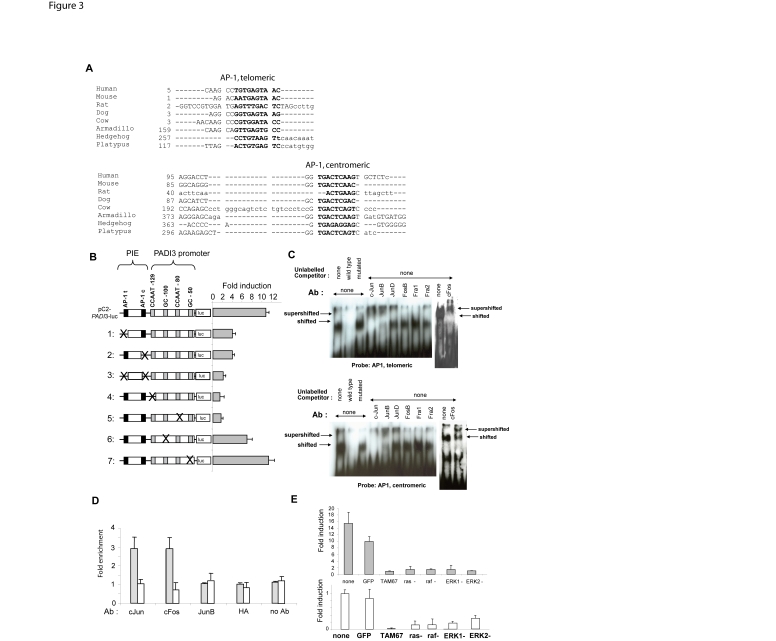
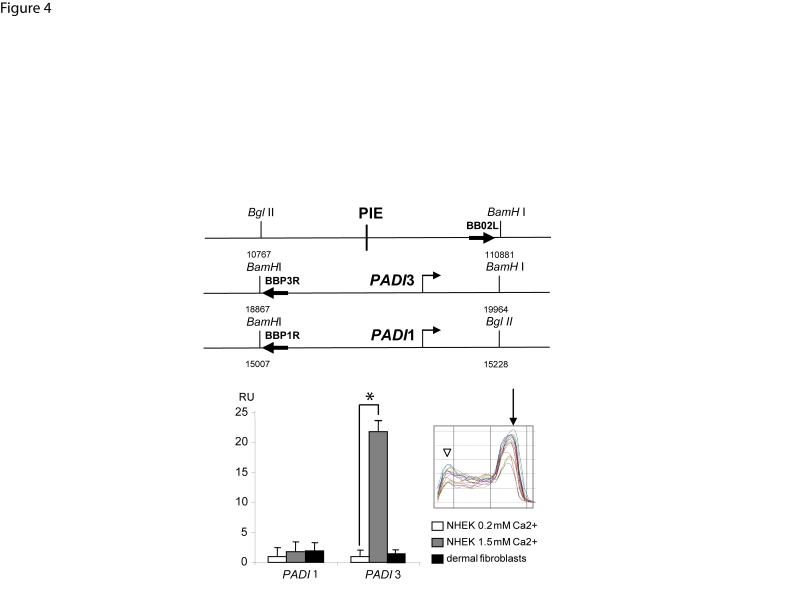
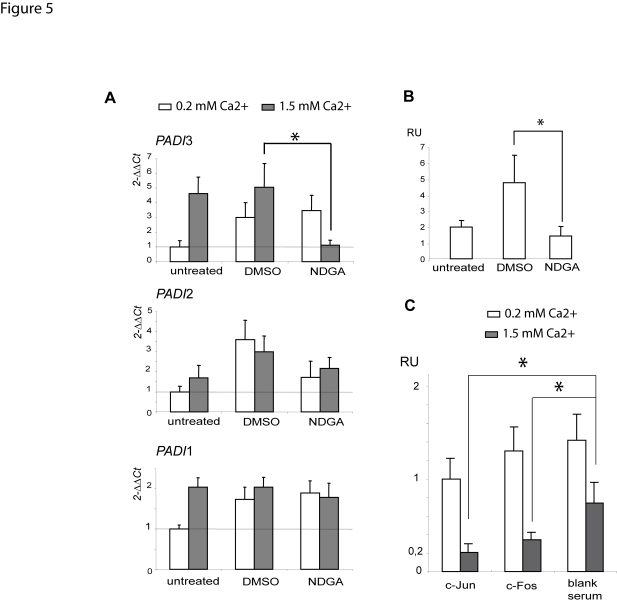
Transcription control at a distance is a critical mechanism, particularly for contiguous genes. The peptidylarginine deiminases (PADs) catalyse the conversion of protein-bound arginine into citrulline (deimination), a critical reaction in the pathophysiology of multiple sclerosis, Alzheimer's disease and rheumatoid arthritis, and in the metabolism of the major epidermal barrier protein filaggrin, a strong predisposing factor for atopic dermatitis. PADs are encoded by 5 clustered PADI genes (1p35-6). Unclear are the mechanisms controlling the expression of the gene PADI3 encoding the PAD3 isoform, a strong candidate for the deimination of filaggrin in the terminally differentiating epidermal keratinocyte. We describe the first PAD Intergenic Enhancer (PIE), an evolutionary conserved non coding segment located 86-kb from the PADI3 promoter. PIE is a strong enhancer of the PADI3 promoter in Ca2+-differentiated epidermal keratinocytes, and requires bound AP-1 factors, namely c-Jun and c-Fos. As compared to proliferative keratinocytes, calcium stimulation specifically associates with increased local DNase I hypersensitivity around PIE, and increased physical proximity of PIE and PADI3 as assessed by Chromosome Conformation Capture. The specific AP-1 inhibitor nordihydroguaiaretic acid suppresses the calcium-induced increase of PADI3 mRNA levels in keratinocytes. Our findings pave the way to the exploration of deimination control during tumorigenesis and wound healing, two conditions for which AP-1 factors are critical, and disclose that long-range transcription control has a role in the regulation of the gene PADI3. Since invalidation of distant regulators causes a variety of human diseases, PIE results to be a plausible candidate in association studies on deimination-related disorders or atopic disease.
远距离转录调控是一种关键机制,对于相邻基因尤为重要。肽基精氨酸脱亚氨酶(PADs)催化蛋白质结合的精氨酸转化为瓜氨酸(脱亚氨基作用),这是多发性硬化症、阿尔茨海默病和类风湿关节炎病理生理学中的关键反应,也是主要表皮屏障蛋白丝聚合蛋白代谢中的关键反应,而丝聚合蛋白是特应性皮炎的一个重要易感因素。PADs由5个成簇的PADI基因(1p35 - 6)编码。目前尚不清楚控制编码PAD3同工型的PADI3基因表达的机制,PAD3同工型是终末分化的表皮角质形成细胞中丝聚合蛋白脱亚氨基作用的一个有力候选因素。我们描述了首个PAD基因间增强子(PIE),这是一个位于距PADI3启动子86 kb处的进化保守非编码片段。PIE是Ca2 + 分化的表皮角质形成细胞中PADI3启动子的强增强子,并且需要结合的AP - 1因子,即c - Jun和c - Fos。与增殖性角质形成细胞相比,钙刺激与PIE周围局部DNase I超敏反应增加以及通过染色体构象捕获评估的PIE与PADI3的物理距离增加特异性相关。特异性AP - 1抑制剂去甲二氢愈创木酸抑制角质形成细胞中钙诱导的PADI3 mRNA水平升高。我们的研究结果为探索肿瘤发生和伤口愈合过程中的脱亚氨基作用控制铺平了道路,这两种情况中AP - 1因子至关重要,并且揭示了远距离转录调控在PADI3基因调控中的作用。由于远距离调节因子的失活会导致多种人类疾病,PIE成为脱亚氨基作用相关疾病或特应性疾病关联研究中一个合理的候选因素。