Wordsworth Sarah, Buchanan James, Regan Regina, Davison Val, Smith Kim, Dyer Sara, Campbell Carolyn, Blair Edward, Maher Eddy, Taylor Jenny, Knight Samantha J L
Health Economics Research Centre, Department of Public Health, University of Oxford, Old Road Campus, Headington, Oxford, OX3 7LF, UK,
Genomic Med. 2007;1(1-2):35-45. doi: 10.1007/s11568-007-9005-6. Epub 2007 Jun 5.
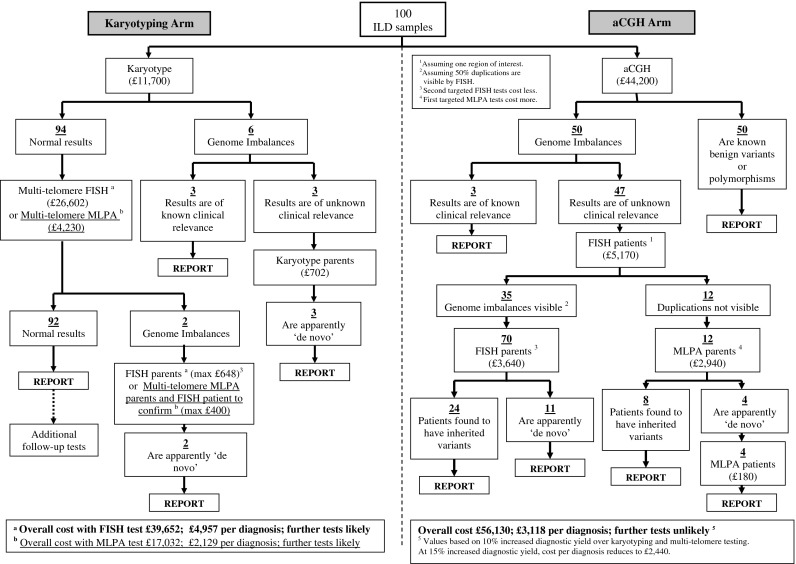
Array based comparative genomic hybridisation (aCGH) is a powerful technique for detecting clinically relevant genome imbalance and can offer 40 to > 1000 times the resolution of karyotyping. Indeed, idiopathic learning disability (ILD) studies suggest that a genome-wide aCGH approach makes 10-15% more diagnoses involving genome imbalance than karyotyping. Despite this, aCGH has yet to be implemented as a routine NHS service. One significant obstacle is the perception that the technology is prohibitively expensive for most standard NHS clinical cytogenetics laboratories. To address this, we investigated the cost-effectiveness of aCGH versus standard cytogenetic analysis for diagnosing idiopathic learning disability (ILD) in the NHS. Cost data from four participating genetics centres were collected and analysed. In a single test comparison, the average cost of aCGH was pound442 and the average cost of karyotyping was pound117 with array costs contributing most to the cost difference. This difference was not a key barrier when the context of follow up diagnostic tests was considered. Indeed, in a hypothetical cohort of 100 ILD children, aCGH was found to cost less per diagnosis ( pound3,118) than a karyotyping and multi-telomere FISH approach ( pound4,957). We conclude that testing for genomic imbalances in ILD using microarray technology is likely to be cost-effective because long-term savings can be made regardless of a positive (diagnosis) or negative result. Earlier diagnoses save costs of additional diagnostic tests. Negative results are cost-effective in minimising follow-up test choice. The use of aCGH in routine clinical practice warrants serious consideration by healthcare providers.
基于芯片的比较基因组杂交技术(aCGH)是检测临床相关基因组失衡的一项强大技术,其分辨率比核型分析高40至1000倍以上。实际上,针对特发性学习障碍(ILD)的研究表明,全基因组aCGH方法比核型分析多诊断出10% - 15%涉及基因组失衡的病例。尽管如此,aCGH尚未作为英国国家医疗服务体系(NHS)的常规服务实施。一个重大障碍是人们认为该技术对大多数标准的NHS临床细胞遗传学实验室来说成本过高。为解决这一问题,我们调查了在NHS中使用aCGH与标准细胞遗传学分析诊断特发性学习障碍(ILD)的成本效益。收集并分析了四个参与研究的遗传学中心的成本数据。在单次检测比较中,aCGH的平均成本为442英镑,核型分析的平均成本为117英镑,芯片成本对成本差异的影响最大。当考虑后续诊断检测的背景时,这一差异并非关键障碍。事实上,在一个假设的100名ILD儿童队列中,发现aCGH每例诊断成本(3118英镑)低于核型分析和多端粒荧光原位杂交(FISH)方法(4957英镑)。我们得出结论,使用微阵列技术检测ILD中的基因组失衡可能具有成本效益,因为无论结果是阳性(诊断)还是阴性,都能实现长期成本节约。早期诊断可节省额外诊断检测的成本。阴性结果在最小化后续检测选择方面具有成本效益。医疗服务提供者应认真考虑在常规临床实践中使用aCGH。