Yu Huifeng, Tudor Daniela, Alfsen Annette, Labrosse Beatrice, Clavel François, Bomsel Morgane
Departement de Biologie Cellulaire, (Cell Biology Department), Institut Cochin, Université Paris Descartes, CNRS (UMR 8104), 22 rue Mechain, 75014 Paris, France.
Retrovirology. 2008 Oct 16;5:93. doi: 10.1186/1742-4690-5-93.
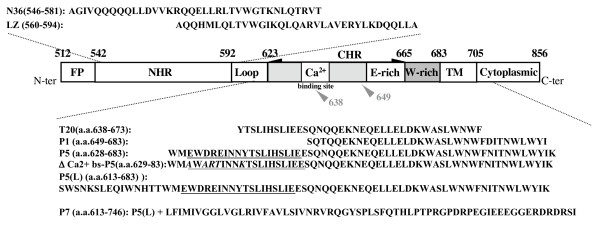
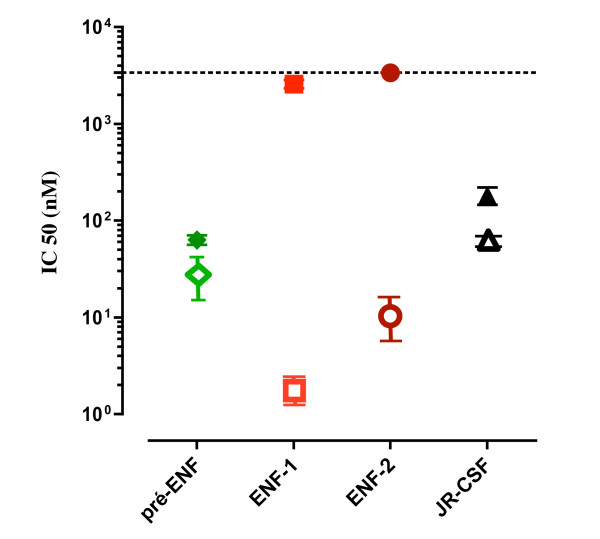
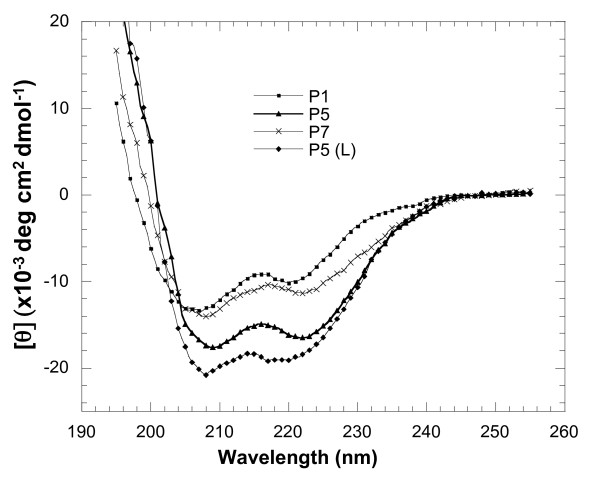
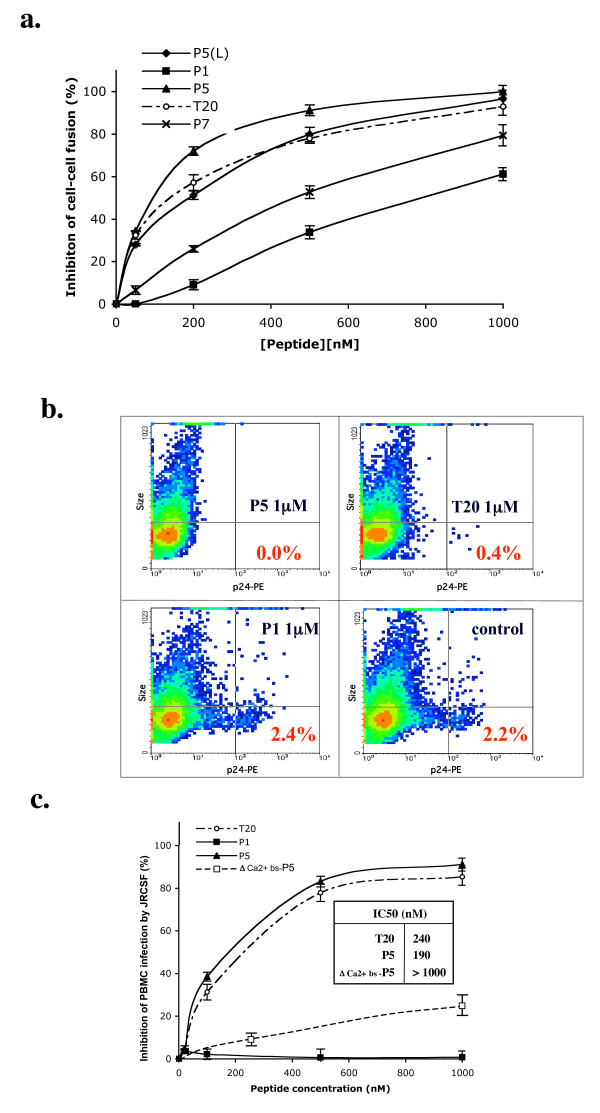
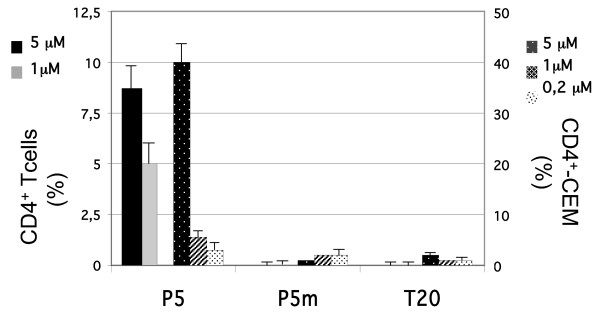
The membrane proximal region (MPR) of the transmembrane subunit, gp41, of the HIV envelope glycoprotein plays a critical role in HIV-1 infection of CD4+ target cells and CD4-independent mucosal entry. It contains continuous epitopes recognized by neutralizing IgG antibodies 2F5, 4E10 and Z13, and is therefore considered to be a promising target for vaccine design. Moreover, some MPR-derived peptides, such as T20 (enfuvirtide), are in clinical use as HIV-1 inhibitors. We have shown that an extended MPR peptide, P5, harbouring the lectin-like domain of gp41 and a calcium-binding site, is implicated in the interaction of HIV with its mucosal receptor. We now investigate the potential antiviral activities of P5 and other such long MPR-derived peptides. Structural studies of gp41 MPR-derived peptides using circular dichroism showed that the peptides P5 (a.a.628-683), P1 (a.a.648-683), P5L (a.a.613-683) and P7 (a.a.613-746) displayed a well-defined alpha-helical structure. Peptides P5 inhibited HIV-1 envelope mediated cell-cell fusion and infection of peripheral blood mononuclear cells by both X4- and R5-tropic HIV-1 strains, whereas peptides P5 mutated in the calcium binding site or P1 lacked antiviral activity, when P5L blocked cell fusion in contrast to P7. Strikingly, P5 inhibited CD4-dependent infection by T20-resistant R5-tropic HIV-1 variants. Cell-cell fusion studies indicated that the anti-HIV-1 activity of P5, unlike T20, could not be abrogated in the presence of the N-terminal leucine zipper domain (LZ). These results suggested that P5 could serve as a potent fusion inhibitor.
HIV包膜糖蛋白跨膜亚基gp41的膜近端区域(MPR)在HIV-1感染CD4+靶细胞和不依赖CD4的黏膜进入过程中起关键作用。它包含可被中和性IgG抗体2F5、4E10和Z13识别的连续表位,因此被认为是疫苗设计的一个有前景的靶点。此外,一些源自MPR的肽,如T20(恩夫韦肽),在临床上用作HIV-1抑制剂。我们已经表明,一种扩展的MPR肽P5,含有gp41的凝集素样结构域和一个钙结合位点,与HIV与其黏膜受体的相互作用有关。我们现在研究P5和其他此类源自MPR的长肽的潜在抗病毒活性。使用圆二色性对源自gp41 MPR的肽进行的结构研究表明,肽P5(氨基酸628 - 683)、P1(氨基酸648 - 683)、P5L(氨基酸613 - 683)和P7(氨基酸613 - 746)呈现出明确的α-螺旋结构。肽P5抑制HIV-1包膜介导的细胞-细胞融合以及X4和R5嗜性HIV-1毒株对外周血单核细胞的感染,而在钙结合位点发生突变的肽P5或P1缺乏抗病毒活性,与P7相反,P5L可阻断细胞融合。引人注目的是,P5抑制T20耐药的R5嗜性HIV-1变体的CD4依赖性感染。细胞-细胞融合研究表明,与T20不同,P5的抗HIV-1活性在存在N端亮氨酸拉链结构域(LZ)的情况下不会被消除。这些结果表明P5可作为一种有效的融合抑制剂。