Habibi Golareh, Leung Samuel, Law Jennifer H, Gelmon Karen, Masoudi Hamid, Turbin Dmitry, Pollak Michael, Nielsen Torsten O, Huntsman David, Dunn Sandra E
Laboratory for Oncogenomic Research, Departments of Pediatrics and Experimental Medicine, Child and Family Research Institute, University of British Columbia, Vancouver, Canada.
Breast Cancer Res. 2008;10(5):R86. doi: 10.1186/bcr2156. Epub 2008 Oct 16.
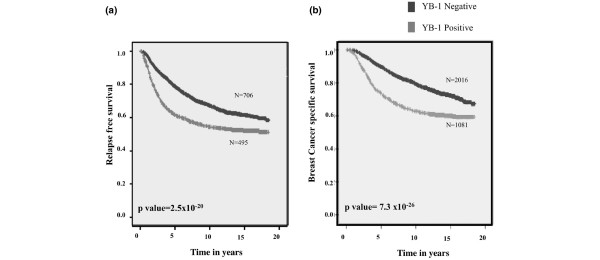
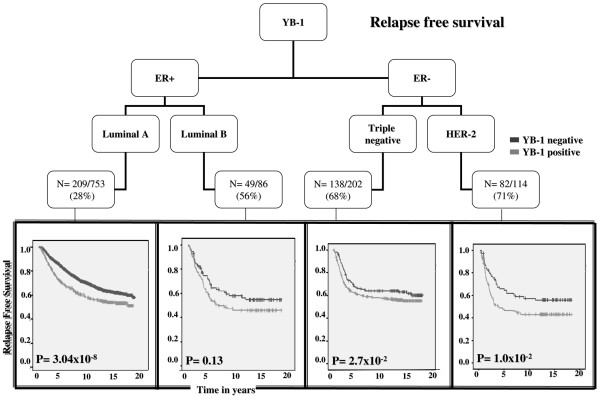
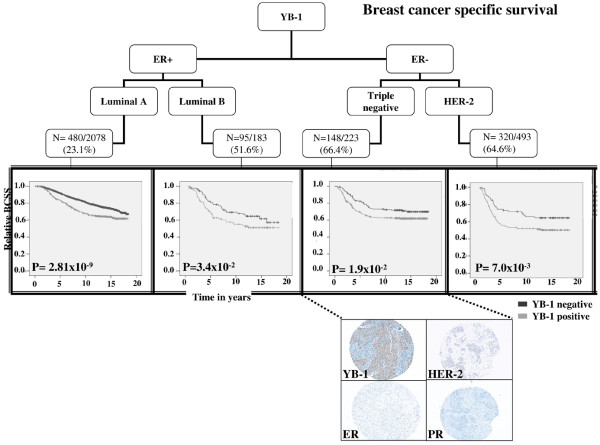
Gene expression analysis is used to subtype breast cancers such that the most aggressive tumors are identified, but translating this into clinical practice can be cumbersome. Our goal is to develop a universal biomarker that distinguishes patients at high risk across all breast cancer subtypes. We previously reported that Y-box binding protein-1 (YB-1), a transcription/translation factor, was a marker of poor prognosis in a cohort of 490 patients with breast cancer, but the study was not large enough to subtype the cancers. We therefore investigated whether YB-1 identifies patients at risk for either reduced relapse free survival or decreased r breast cancer specific survival (BCSS) across all tumor subtypes by evaluating 4,049 cases.
Tumor tissue microarrays, representing 4,049 cases of invasive breast cancers with 20 years of follow up, were subtyped by the expression profiles of estrogen receptor, progesterone receptor, or HER-2. We then addressed whether YB-1 expression identified patients at higher risk for relapse and/or lower BCSS.
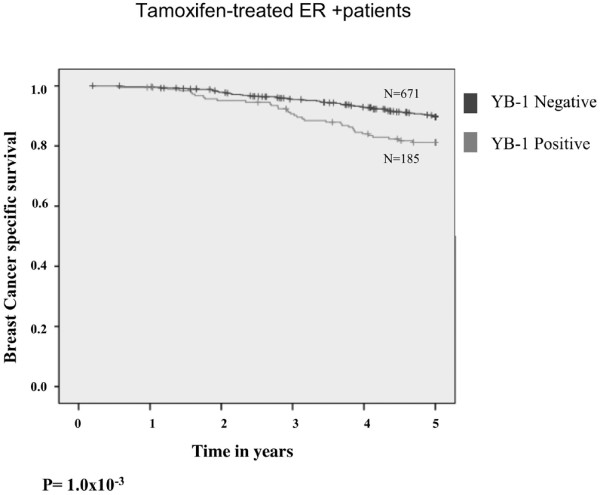
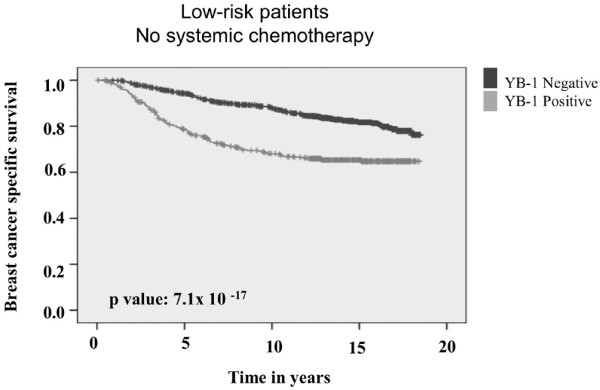
We found YB-1 to be a highly predictive biomarker of relapse (P < 2.5 x 10(-20)) and poor survival (P < 7.3 x 10(-26)) in the entire cohort and across all breast cancer subtypes. Patients with node-positive or node-negative cancer were more likely to die from the disease if YB-1 was expressed. This was further substantiated using a Cox regression model, which revealed that it was significantly associated with relapse and poor survival in a subtype independent manner (relapse patients, hazard ratio = 1.28, P < 8 x 10(-3); all patients, hazard ratio = 1.45, P < 6.7 x 10(-7)). Moreover, YB-1 was superior to estrogen receptor and HER-2 as a prognostic marker for relapse and survival. For a subset of patients who were originally considered low risk and were therefore not given chemotherapy, YB-1 was indicative of poor survival (P < 7.1 x 10 (-17)). Likewise, YB-1 was predictive of decreased BCSS in tamoxifen-treated patients (P = 0.001); in this setting a Cox regression model once again demonstrated it to be an independent biomarker indicating poor survival (hazard ratio = 1.70, P = 0.022).
Expression of YB-1 universally identifies patients at high risk across all breast cancer subtypes and in situations where more aggressive treatment may be needed. We therefore propose that YB-1 may re-define high-risk breast cancer and thereby create opportunities for individualized therapy.
基因表达分析用于对乳腺癌进行亚型分类,从而识别出最具侵袭性的肿瘤,但将其转化为临床实践可能会很麻烦。我们的目标是开发一种通用生物标志物,以区分所有乳腺癌亚型中处于高风险的患者。我们之前报道过,Y盒结合蛋白1(YB-1)作为一种转录/翻译因子,在490例乳腺癌患者队列中是预后不良的标志物,但该研究规模不足以对癌症进行亚型分类。因此,我们通过评估4049例病例,研究YB-1是否能识别出所有肿瘤亚型中无复发生存期缩短或乳腺癌特异性生存期(BCSS)降低风险的患者。
代表4049例浸润性乳腺癌且有20年随访数据的肿瘤组织微阵列,通过雌激素受体、孕激素受体或HER-2的表达谱进行亚型分类。然后我们探讨YB-1表达是否能识别出复发风险更高和/或BCSS更低的患者。
我们发现YB-1在整个队列以及所有乳腺癌亚型中都是复发(P < 2.5×10⁻²⁰)和生存不良(P < 7.3×10⁻²⁶)的高度预测性生物标志物。如果表达YB-1,无论有无淋巴结转移的癌症患者死于该疾病的可能性都更高。使用Cox回归模型进一步证实了这一点,该模型显示它与复发和生存不良以亚型独立的方式显著相关(复发患者,风险比 = 1.28,P < 8×10⁻³;所有患者,风险比 = 1.45,P < 6.7×10⁻⁷)。此外,作为复发和生存的预后标志物,YB-1优于雌激素受体和HER-2。对于一部分最初被认为是低风险因此未接受化疗的患者,YB-1表明其生存不良(P < 7.1×10⁻¹⁷)。同样,YB-1可预测他莫昔芬治疗患者的BCSS降低(P = 0.001);在这种情况下,Cox回归模型再次证明它是一个表明生存不良的独立生物标志物(风险比 = 1.70,P = 0.022)。
YB-1的表达普遍能识别出所有乳腺癌亚型中处于高风险以及可能需要更积极治疗的患者。因此,我们建议YB-1可能会重新定义高风险乳腺癌,从而为个体化治疗创造机会。