Campbell Esther J, Tesson Mathias, Doogan Flora, Mohammed Zahra M A, Mallon Elizabeth, Edwards Joanne
Department of Surgery, Queen Elizabeth University Hospital, Glasgow G51 4TF, UK.
Institute of Cancer Sciences, University of Glasgow, Wolfson Wohl Translational Cancer Research Centre, Garscube Estate, Glasgow G61 1HQ, UK.
Br J Cancer. 2016 Oct 11;115(8):967-973. doi: 10.1038/bjc.2016.206. Epub 2016 Sep 22.
The functional role of progesterone receptor (PR) signalling was previously unclear and PR testing in breast cancer is controversial. Recent defining work has highlighted the functional crosstalk that exists between the oestrogen receptor (ER) and PR. The purpose of this retrospective cohort study was to compare the prognostic value of the combined ER and PR score with either ER or PR alone.
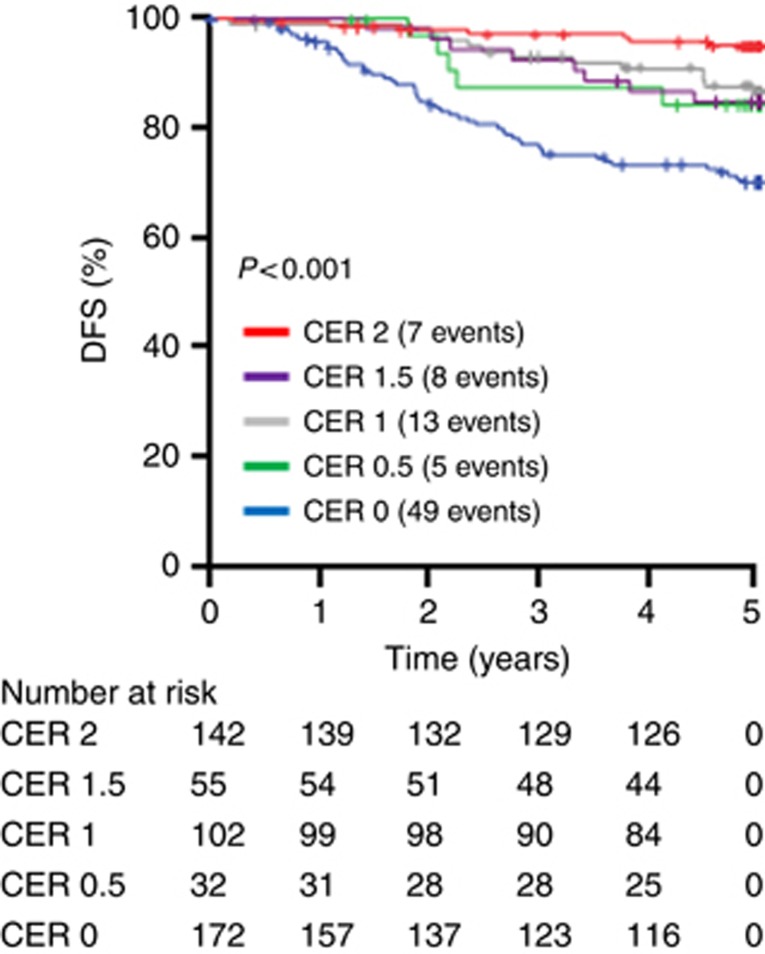
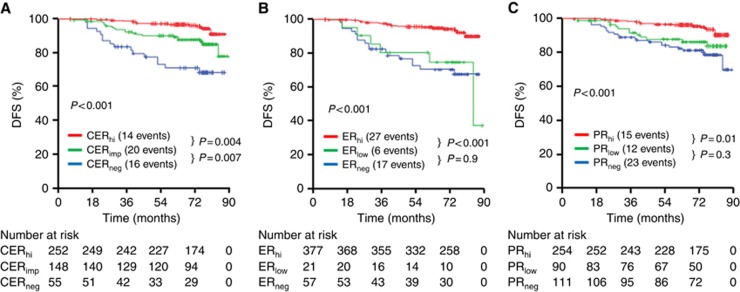
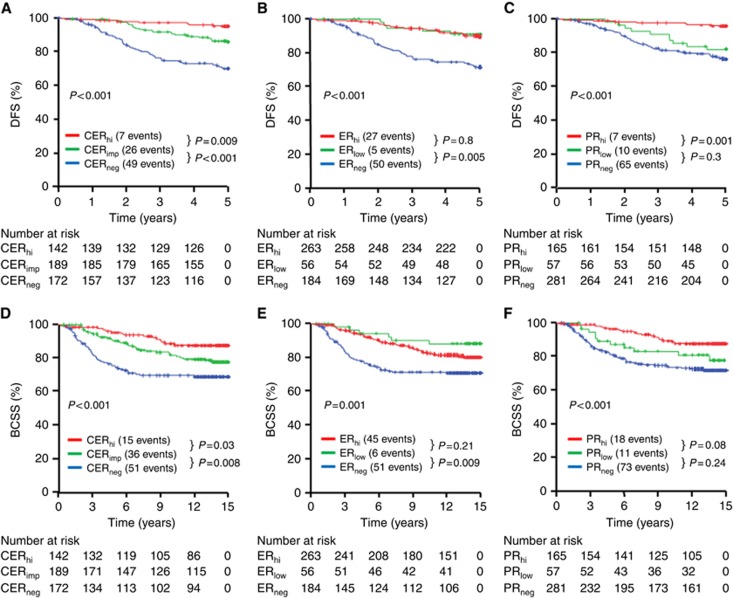
Tumour Allred ER and PR scores were reclassified as negative, low and high. The combined endocrine receptor (CER) was calculated as the average of the reclassified ER and PR scores, resulting in three groups: CER negative, impaired and high. Cox proportional hazards models were used to estimate disease-free survival (DFS) and breast cancer-specific survival (BCSS).
The CER was a more powerful predictor of 5-year DFS and BCSS than either ER or PR alone. In multivariate analysis that included ER, PR and CER, only CER remained an independent prognostic variable for 5-year DFS (hazard ratio (HR) 0.393; CI: 0.283-0.548, P=0.00001) and BCSS (HR 0.553; CI: 0.423-0.722; P=2.506 × 10). In ER-positive (ER+) patients impaired CER was an independent marker of poor outcome for 5-year DFS (HR 2.469; CI: 1.049-5.810; P=0.038) and BCSS (HR 1.946; CI: 1.054-3.596; P=0.033) in multivariate analysis that included grade, lymph node, tumour size, HER2 status and PR status. The results were validated in a separate cohort of patients.
Combined endocrine receptor is a more powerful discriminator of patient outcome than either ER or PR alone. Economical and simple, it can identify risk in ER+ early breast cancer and potentially be used for adjuvant cytotoxic chemotherapy decision-making.
孕激素受体(PR)信号传导的功能作用此前尚不清楚,且乳腺癌中的PR检测存在争议。最近的关键研究突出了雌激素受体(ER)与PR之间存在的功能相互作用。这项回顾性队列研究的目的是比较ER和PR联合评分与单独的ER或PR的预后价值。
将肿瘤的奥尔雷德ER和PR评分重新分类为阴性、低和高。联合内分泌受体(CER)计算为重新分类后的ER和PR评分的平均值,从而得出三组:CER阴性、受损和高。使用Cox比例风险模型来估计无病生存期(DFS)和乳腺癌特异性生存期(BCSS)。
CER对5年DFS和BCSS的预测能力比单独的ER或PR更强。在包括ER、PR和CER的多变量分析中,只有CER仍然是5年DFS(风险比(HR)0.393;CI:0.283 - 0.548,P = 0.00001)和BCSS(HR 0.553;CI:0.423 - 0.722;P = 2.506×10)的独立预后变量。在包括分级、淋巴结、肿瘤大小、HER2状态和PR状态的多变量分析中,在ER阳性(ER +)患者中,受损的CER是5年DFS(HR 2.469;CI:1.049 - 5.810;P = 0.038)和BCSS(HR 1.946;CI:1.054 - 3.596;P = 0.033)不良结局的独立标志物。结果在另一组患者中得到验证。
联合内分泌受体对患者结局的区分能力比单独的ER或PR更强。经济且简单,它可以识别ER +早期乳腺癌的风险,并有可能用于辅助细胞毒性化疗的决策。