Group of Stable Isotopes and of Energy Metabolism, German Institute of Human Nutrition in Potsdam-Rehbruecke (DIfE), Arthur-Scheunert-Allee 114-116, 14558 Nuthetal, Germany.
Nutr Metab (Lond). 2008 Oct 17;5:25. doi: 10.1186/1743-7075-5-25.
Macronutrient composition of diets can influence energy balance in humans. We tested the hypothesis whether low protein content in single meals may induce lower values of energy expenditure (EE) and fat oxidation (FO) as compared to adequate protein content.
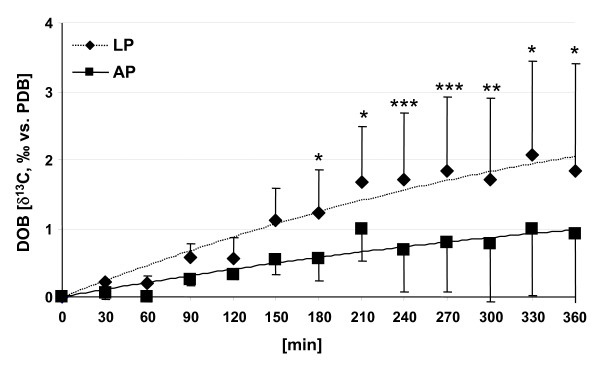
Indirect calorimetry was combined with a breath test using naturally 13C-enriched corn oil to differentiate between postprandial exogenous and endogenous FO. Young women ingested single meals containing either 3.9% (low protein, LP) or 11.4% (adequate protein, AP) of total energy (~3100 kJ) as protein.
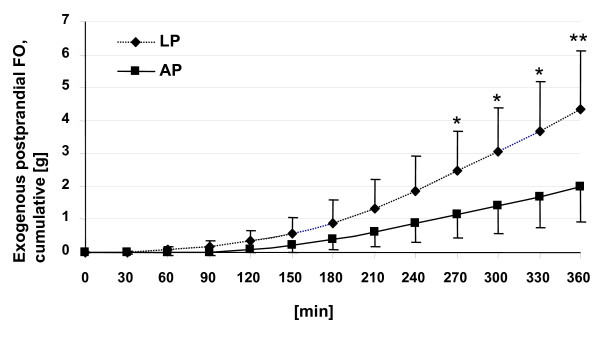
Postprandial EE was 160 kJ/6 h lower (p < 0.01) after LP meals and diet induced thermogenesis (DIT) increased less (p < 0.001) as compared to AP meals. Total postprandial FO was not significantly different between meals (~17 g/6 h). However, exogenous postprandial FO was significantly (p < 0.01) higher (4.28 +/- 1.57 g/6 h) after exposure to LP meals as compared to AP meals (1.87 +/- 1.00 g/6 h). Less than 10% of ingested fat (50 g) was oxidized in the postprandial phase. The overall postprandial fat balance was approximately + 33 g.
Breath tests using naturally 13C-labeled corn oil mirror exogenous FO. Low protein meals resulted in reduced postprandial EE and increased exogenous FO as compared to adequate protein meals without differences in total FO.
饮食中的宏量营养素组成会影响人体的能量平衡。我们检验了这样一个假设,即与摄入充足蛋白质相比,单餐中低蛋白质含量可能会导致能量消耗(EE)和脂肪氧化(FO)值降低。
间接测热法与使用天然 13C 标记玉米油的呼吸测试相结合,以区分餐后外源性和内源性 FO。年轻女性摄入含有总能量 3.9%(低蛋白,LP)或 11.4%(充足蛋白,AP)蛋白质的单餐。
LP 餐后 6 小时的 EE 比 AP 餐后低 160 kJ(p < 0.01),而饮食诱导的产热(DIT)增加较少(p < 0.001)。餐后总 FO 无显著差异(约 17 g/6 h)。然而,与 AP 餐相比,LP 餐对外源性餐后 FO 的影响更大(4.28 +/- 1.57 g/6 h)(p < 0.01)。在餐后阶段,只有不到 10%的摄入脂肪(50 g)被氧化。总的餐后脂肪平衡约为+ 33 g。
使用天然 13C 标记玉米油的呼吸测试反映了外源性 FO。与摄入充足蛋白质的餐相比,低蛋白餐会导致餐后 EE 降低和外源性 FO 增加,而总 FO 没有差异。