Yamamoto Takaharu G, Watanabe Sonoko, Essex Anthony, Kitagawa Risa
Department of Molecular Pharmacology, St. Jude Children's Research Hospital, Memphis, TN 38105, USA.
J Cell Biol. 2008 Oct 20;183(2):187-94. doi: 10.1083/jcb.200805185.
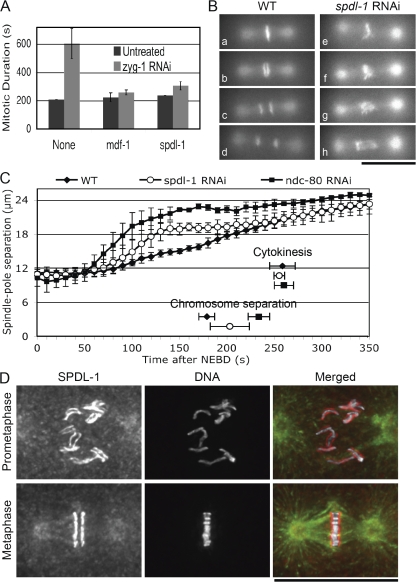
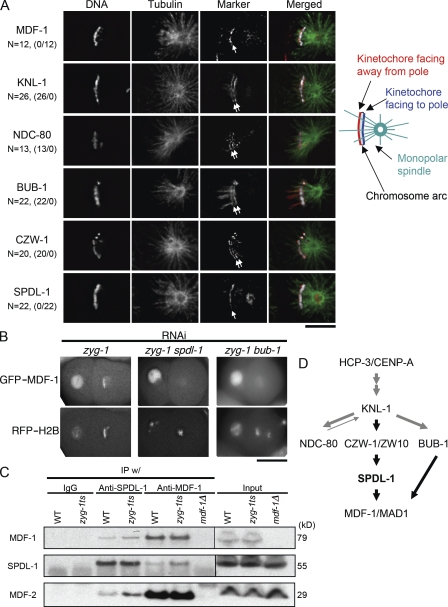
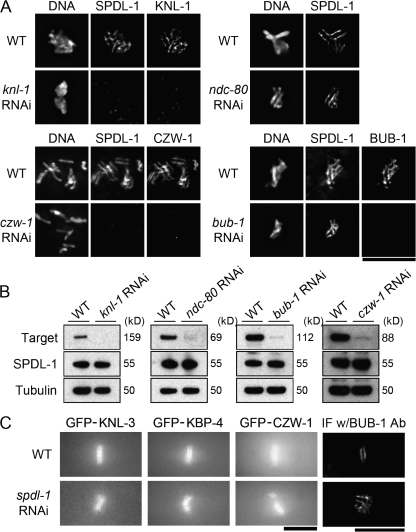
The spindle assembly checkpoint (SAC) ensures faithful chromosome segregation by delaying anaphase onset until all sister kinetochores are attached to bipolar spindles. An RNA interference screen for synthetic genetic interactors with a conserved SAC gene, san-1/MAD3, identified spdl-1, a Caenorhabditis elegans homologue of Spindly. SPDL-1 protein localizes to the kinetochore from prometaphase to metaphase, and this depends on KNL-1, a highly conserved kinetochore protein, and CZW-1/ZW10, a component of the ROD-ZW10-ZWILCH complex. In two-cell-stage embryos harboring abnormal monopolar spindles, SPDL-1 is required to induce the SAC-dependent mitotic delay and localizes the SAC protein MDF-1/MAD1 to the kinetochore facing away from the spindle pole. In addition, SPDL-1 coimmunoprecipitates with MDF-1/MAD1 in vivo. These results suggest that SPDL-1 functions in a kinetochore receptor of MDF-1/MAD1 to induce SAC function.
纺锤体组装检查点(SAC)通过延迟后期开始,直到所有姐妹动粒都附着到双极纺锤体上,来确保染色体的忠实分离。一项针对与保守的SAC基因san-1/MAD3的合成遗传相互作用因子的RNA干扰筛选,鉴定出了spdl-1,它是线虫中Spindly的同源物。SPDL-1蛋白从前中期到中期定位于动粒,这依赖于高度保守的动粒蛋白KNL-1以及ROD-ZW10-ZWILCH复合体的组成部分CZW-1/ZW10。在具有异常单极纺锤体的二细胞期胚胎中,SPDL-1是诱导SAC依赖性有丝分裂延迟所必需的,并且将SAC蛋白MDF-1/MAD1定位于远离纺锤体极的动粒上。此外,SPDL-1在体内与MDF-1/MAD1进行共免疫沉淀。这些结果表明,SPDL-1在MDF-1/MAD1的动粒受体中发挥作用,以诱导SAC功能。