Department of Preventive Medicine, University of Colorado Denver, Denver, Colorado, USA.
Diabetes Care. 2009 Jan;32(1):175-80. doi: 10.2337/dc08-1442. Epub 2008 Oct 22.
To compare cardiovascular disease (CVD) risk factors among recently diagnosed youth with type 2 diabetes and nondiabetic youth and investigate whether demographic, behavioral, or metabolic factors might account for observed differences.
Data from 106 type 2 diabetic and 189 nondiabetic multiethnic youth, aged 10-22 years, were analyzed. Prevalence of CVD risk factors were age and race/ethnicity adjusted using direct standardization. Multiple linear regression models were sequentially adjusted for demographic, behavioral (dietary saturated fat intake and physical activity), and metabolic (body adiposity and glycemia) factors to explore possible mechanisms associated with differences in CVD risk factors between the case and control groups.
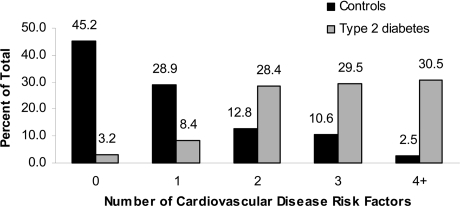
Compared with control subjects, youth with type 2 diabetes had a higher prevalence of elevated blood pressure, obesity, large waist circumference, low HDL cholesterol, high triglycerides, and high albumin-to-creatinine ratio (P < 0.05 for each risk factor). Type 2 diabetic youth also had higher levels of apolipoprotein B, fibrinogen, interleukin (IL)-6, C-reactive protein, and leptin; lower adiponectin levels; and denser LDL particles (P < 0.05 for each risk factor). Adjustment for BMI, waist circumference, and A1C substantially attenuated differences in the CVD risk factors between the case/control groups, except for fibrinogen and IL-6, which remained significantly higher in type 2 diabetic youth.
Compared with control youth, type 2 diabetic youth have a less favorable CVD risk factor profile. Adiposity and glycemia are important contributors to differences in CVD risk profiles among type 2 diabetic and control youth. Inflammatory and prothrombotic factors may also play an important role.
比较新近诊断为 2 型糖尿病的青年与非糖尿病青年的心血管疾病(CVD)危险因素,并探讨是否存在人口统计学、行为或代谢因素可解释这些差异。
分析了 106 例 2 型糖尿病和 189 例非糖尿病的多民族青年(年龄 10-22 岁)的数据。采用直接标化法,根据年龄和种族/民族调整 CVD 危险因素的患病率。采用逐步多线性回归模型,依次调整人口统计学、行为(饮食饱和脂肪摄入量和体力活动)和代谢(身体肥胖和血糖)因素,以探索与病例组和对照组 CVD 危险因素差异相关的可能机制。
与对照组相比,2 型糖尿病青年的高血压、肥胖、大腰围、低 HDL 胆固醇、高甘油三酯和高白蛋白/肌酐比值的发生率更高(每种危险因素的 P 值均<0.05)。2 型糖尿病青年的载脂蛋白 B、纤维蛋白原、白细胞介素(IL)-6、C 反应蛋白和瘦素水平更高,脂联素水平更低,LDL 颗粒密度更高(每种危险因素的 P 值均<0.05)。调整 BMI、腰围和 A1C 后,病例/对照组间 CVD 危险因素的差异明显减弱,但纤维蛋白原和 IL-6 除外,2 型糖尿病青年的这两种因子仍显著升高。
与对照组青年相比,2 型糖尿病青年的 CVD 危险因素谱更差。肥胖和血糖是导致 2 型糖尿病和对照组青年 CVD 风险谱差异的重要因素。炎症和促血栓形成因子可能也发挥了重要作用。