Chen Faye H, Tuan Rocky S
Cartilage Biology and Orthopaedics Branch, National Institute of Arthritis, and Musculoskeletal and Skin Diseases, National Institutes of Health, 50 South Dr, Bethesda, MD 20892, USA.
Arthritis Res Ther. 2008;10(5):223. doi: 10.1186/ar2514. Epub 2008 Oct 10.
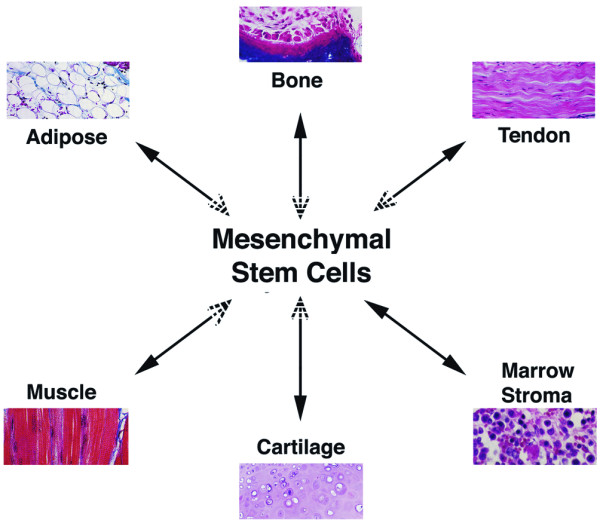
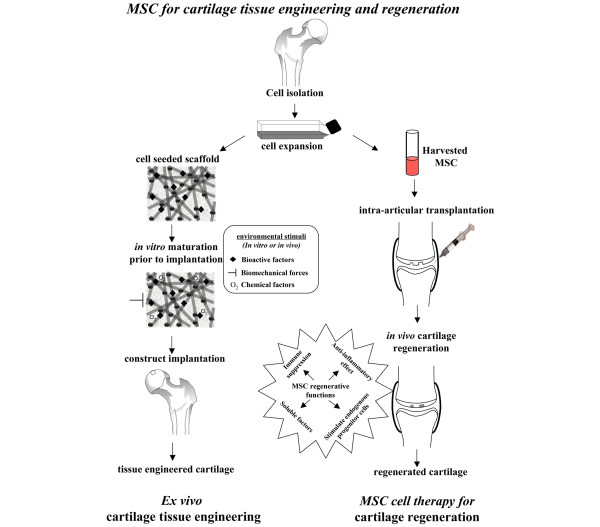
Mesenchymal stem cells (MSCs), the nonhematopoietic progenitor cells found in various adult tissues, are characterized by their ease of isolation and their rapid growth in vitro while maintaining their differentiation potential, allowing for extensive culture expansion to obtain large quantities suitable for therapeutic use. These properties make MSCs an ideal candidate cell type as building blocks for tissue engineering efforts to regenerate replacement tissues and repair damaged structures as encountered in various arthritic conditions. Osteoarthritis (OA) is the most common arthritic condition and, like rheumatoid arthritis (RA), presents an inflammatory environment with immunological involvement and this has been an enduring obstacle that can potentially limit the use of cartilage tissue engineering. Recent advances in our understanding of the functions of MSCs have shown that MSCs also possess potent immunosuppression and anti-inflammation effects. In addition, through secretion of various soluble factors, MSCs can influence the local tissue environment and exert protective effects with an end result of effectively stimulating regeneration in situ. This function of MSCs can be exploited for their therapeutic application in degenerative joint diseases such as RA and OA. This review surveys the advances made in the past decade which have led to our current understanding of stem cell biology as relevant to diseases of the joint. The potential involvement of MSCs in the pathophysiology of degenerative joint diseases will also be discussed. Specifically, we will explore the potential of MSC-based cell therapy of OA and RA by means of functional replacement of damaged cartilage via tissue engineering as well as their anti-inflammatory and immunosuppressive activities.
间充质干细胞(MSCs)是存在于多种成体组织中的非造血祖细胞,其特点是易于分离,在体外能快速生长,同时保持分化潜能,可进行大量培养扩增以获得适合治疗用途的大量细胞。这些特性使MSCs成为一种理想的候选细胞类型,作为组织工程的构建单元,用于再生替代组织和修复各种关节炎病症中出现的受损结构。骨关节炎(OA)是最常见的关节炎病症,与类风湿关节炎(RA)一样,呈现出伴有免疫参与的炎症环境,这一直是一个潜在限制软骨组织工程应用的持久障碍。我们对MSCs功能的最新认识进展表明,MSCs还具有强大的免疫抑制和抗炎作用。此外,通过分泌各种可溶性因子,MSCs可以影响局部组织环境并发挥保护作用,最终有效地刺激原位再生。MSCs的这一功能可用于其在RA和OA等退行性关节疾病中的治疗应用。本综述概述了过去十年所取得的进展,这些进展使我们目前对与关节疾病相关的干细胞生物学有了认识。还将讨论MSCs在退行性关节疾病病理生理学中的潜在作用。具体而言,我们将探讨基于MSCs的细胞疗法通过组织工程功能性替代受损软骨以及其抗炎和免疫抑制活性来治疗OA和RA的潜力。