Kardia Sharon L R, Kelly Reagan J, Keddache Mehdi A, Aronow Bruce J, Grabowski Gregory A, Hahn Harvey S, Case Karen L, Wagoner Lynne E, Dorn Gerald W, Liggett Stephen B
Department of Epidemiology, School of Public Health, University of Michigan, 109 Observatory St,, Ann Arbor, MI 48109-2029, USA.
BMC Med Genet. 2008 Oct 23;9:93. doi: 10.1186/1471-2350-9-93.
Persistent stimulation of cardiac beta1-adrenergic receptors by endogenous norepinephrine promotes heart failure progression. Polymorphisms of this gene are known to alter receptor function or expression, as are polymorphisms of the alpha 2C-adrenergic receptor, which regulates norepinephrine release from cardiac presynaptic nerves. The purpose of this study was to investigate possible synergistic effects of polymorphisms of these two intronless genes (ADRB1 and ADRA2C, respectively) on the risk of death/transplant in heart failure patients.
Sixteen sequence variations in ADRA2C and 17 sequence variations in ADRB1 were genotyped in a longitudinal study of 655 white heart failure patients. Eleven sequence variations in each gene were polymorphic in the heart failure cohort. Cox proportional hazards modeling was used to identify polymorphisms and potential intra- or intergenic interactions that influenced risk of death or cardiac transplant. A leave-one-out cross-validation method was utilized for internal validation.
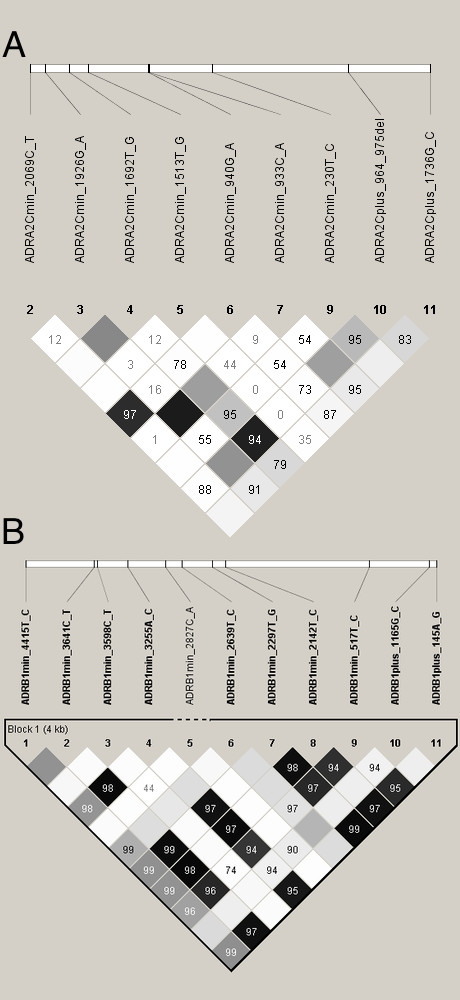
Three polymorphisms in ADRA2C and five polymorphisms in ADRB1 were involved in eight cross-validated epistatic interactions identifying several two-locus genotype classes with significant relative risks ranging from 3.02 to 9.23. There was no evidence of intragenic epistasis. Combining high risk genotype classes across epistatic pairs to take into account linkage disequilibrium, the relative risk of death or transplant was 3.35 (1.82, 6.18) relative to all other genotype classes.
Multiple polymorphisms act synergistically between the ADRA2C and ADRB1 genes to increase risk of death or cardiac transplant in heart failure patients.
内源性去甲肾上腺素对心脏β1-肾上腺素能受体的持续刺激会促进心力衰竭的进展。已知该基因的多态性会改变受体功能或表达,α2C-肾上腺素能受体的多态性也会如此,该受体调节心脏突触前神经去甲肾上腺素的释放。本研究的目的是调查这两个无内含子基因(分别为ADRB1和ADRA2C)的多态性对心力衰竭患者死亡/移植风险可能存在的协同作用。
在一项对655名白人心力衰竭患者的纵向研究中,对ADRA2C的16个序列变异和ADRB1的17个序列变异进行了基因分型。每个基因中的11个序列变异在心力衰竭队列中具有多态性。采用Cox比例风险模型来识别影响死亡或心脏移植风险的多态性以及潜在的基因内或基因间相互作用。采用留一法交叉验证方法进行内部验证。
ADRA2C中的三个多态性和ADRB1中的五个多态性参与了八次交叉验证的上位性相互作用,确定了几个两位点基因型类别,其相对风险显著,范围为3.02至9.23。没有基因内上位性的证据。考虑到连锁不平衡,将上位性对中的高风险基因型类别合并,死亡或移植的相对风险相对于所有其他基因型类别为3.35(1.82,6.18)。
ADRA2C和ADRB1基因之间的多个多态性协同作用,增加了心力衰竭患者死亡或心脏移植的风险。