Chong Trevor T-J, Cunnington Ross, Williams Mark A, Kanwisher Nancy, Mattingley Jason B
St Vincent's Hospital Melbourne, Fitzroy, Victoria 3065, Australia.
Curr Biol. 2008 Oct 28;18(20):1576-80. doi: 10.1016/j.cub.2008.08.068.
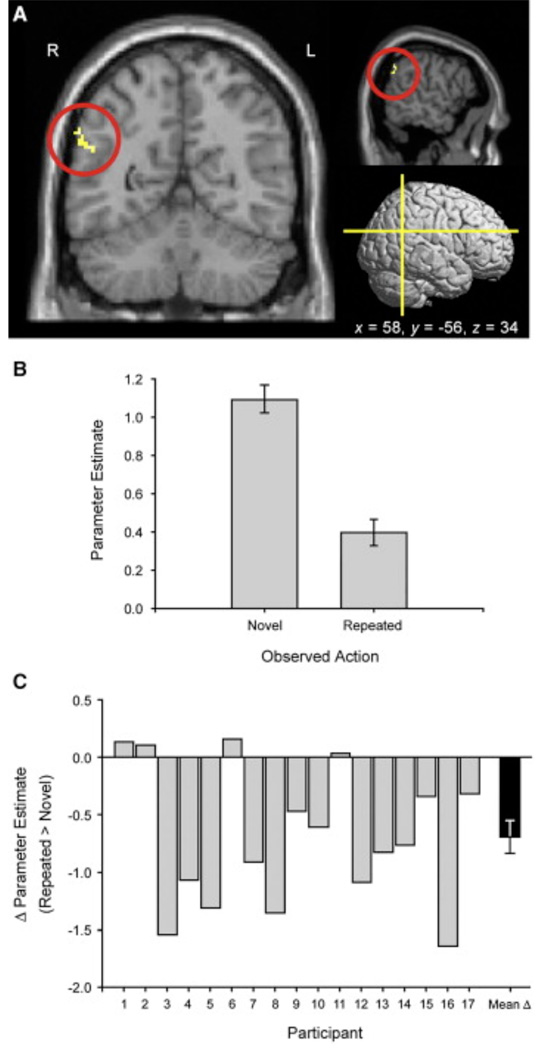
Mirror neurons, as originally described in the macaque, have two defining properties [1, 2]: They respond specifically to a particular action (e.g., bringing an object to the mouth), and they produce their action-specific responses independent of whether the monkey executes the action or passively observes a conspecific performing the same action. In humans, action observation and action execution engage a network of frontal, parietal, and temporal areas. However, it is unclear whether these responses reflect the activity of a single population that represents both observed and executed actions in a common neural code or the activity of distinct but overlapping populations of exclusively perceptual and motor neurons [3]. Here, we used fMRI adaptation to show that the right inferior parietal lobe (IPL) responds independently to specific actions regardless of whether they are observed or executed. Specifically, responses in the right IPL were attenuated when participants observed a recently executed action relative to one that had not previously been performed. This adaptation across action and perception demonstrates that the right IPL responds selectively to the motoric and perceptual representations of actions and is the first evidence for a neural response in humans that shows both defining properties of mirror neurons.
镜像神经元最初是在猕猴中发现的,具有两个决定性特征[1,2]:它们对特定动作(如将物体送到嘴边)有特异性反应,并且无论猴子是执行该动作还是被动观察同种个体执行相同动作,它们都会产生特定于该动作的反应。在人类中,动作观察和动作执行涉及额叶、顶叶和颞叶区域组成的神经网络。然而,尚不清楚这些反应是反映了一个单一神经元群体的活动,该群体以共同的神经编码来表征观察到的和执行的动作,还是反映了分别专门负责感知和运动的不同但重叠的神经元群体的活动[3]。在此,我们利用功能磁共振成像适应技术表明,右侧顶下小叶(IPL)对特定动作有独立反应,而不管这些动作是被观察到还是被执行。具体而言,当参与者观察到一个最近执行过的动作相对于一个之前未执行过的动作时,右侧顶下小叶的反应会减弱。这种跨动作和感知的适应表明,右侧顶下小叶对动作的运动和感知表征有选择性反应,这是人类神经反应中显示出镜像神经元两个决定性特征的首个证据。