Pomel Sebastien, Luk Flora C Y, Beckers Con J M
Department of Cell & Developmental Biology, University of North Carolina, Chapel Hill, North Carolina, USA.
PLoS Pathog. 2008 Oct;4(10):e1000188. doi: 10.1371/journal.ppat.1000188. Epub 2008 Oct 24.
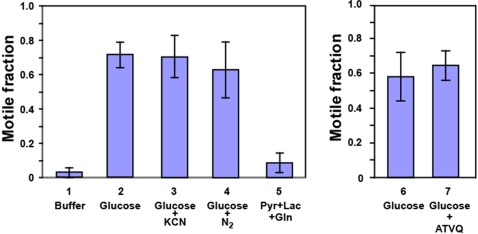
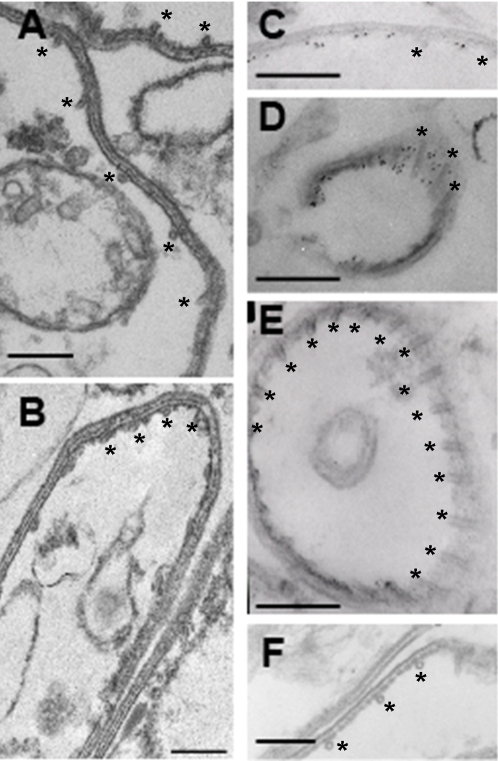
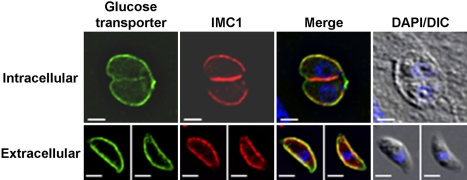
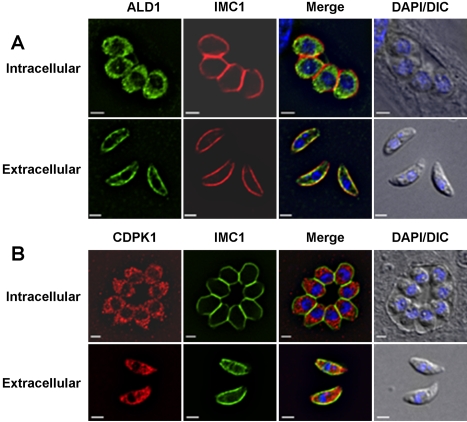
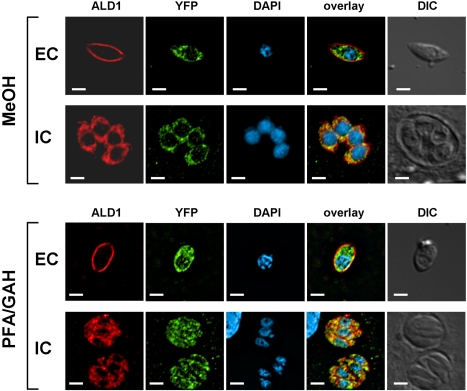
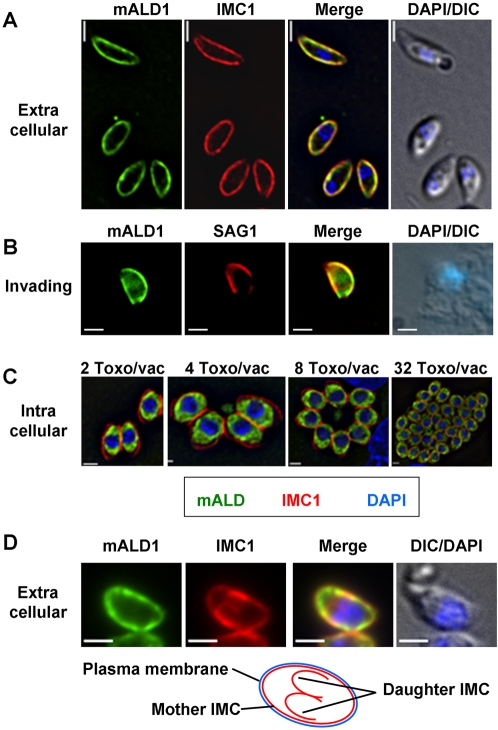
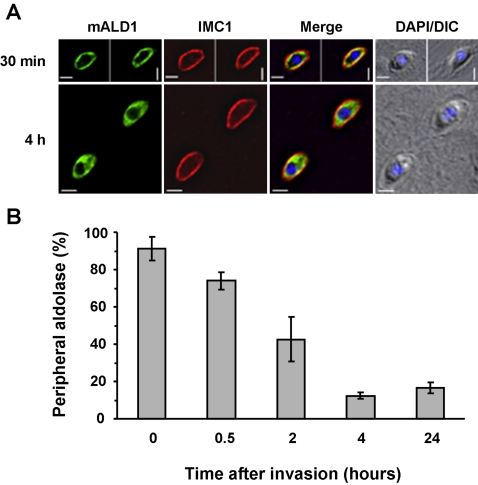
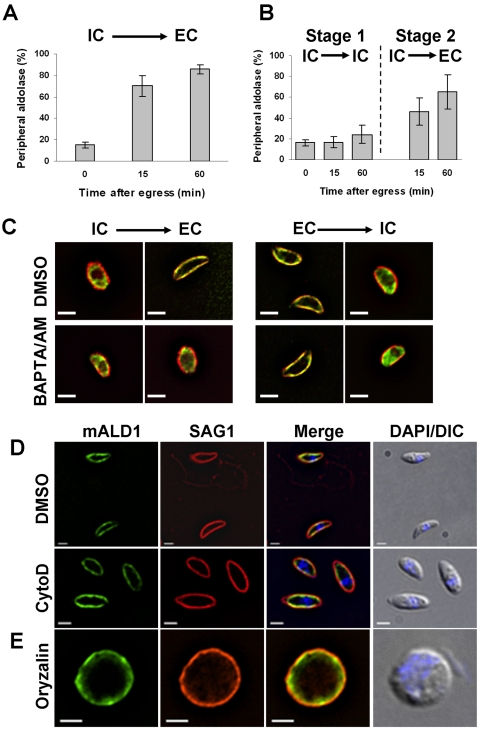
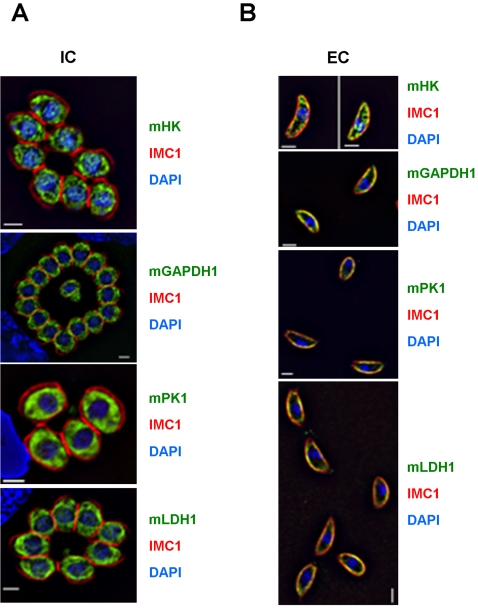
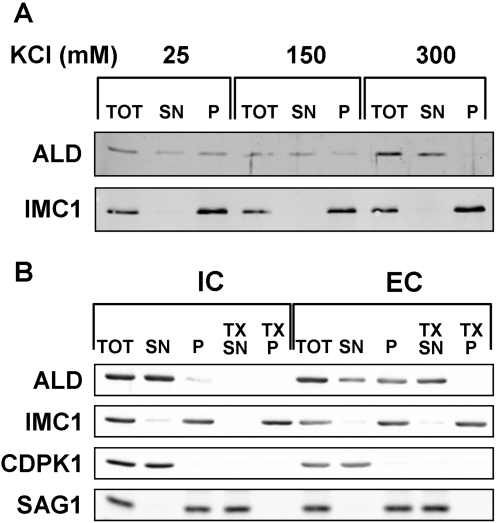
Apicomplexan parasites are dependent on an F-actin and myosin-based motility system for their invasion into and escape from animal host cells, as well as for their general motility. In Toxoplasma gondii and Plasmodium species, the actin filaments and myosin motor required for this process are located in a narrow space between the parasite plasma membrane and the underlying inner membrane complex, a set of flattened cisternae that covers most the cytoplasmic face of the plasma membrane. Here we show that the energy required for Toxoplasma motility is derived mostly, if not entirely, from glycolysis and lactic acid production. We also demonstrate that the glycolytic enzymes of Toxoplasma tachyzoites undergo a striking relocation from the parasites' cytoplasm to their pellicles upon Toxoplasma egress from host cells. Specifically, it appears that the glycolytic enzymes are translocated to the cytoplasmic face of the inner membrane complex as well as to the space between the plasma membrane and inner membrane complex. The glycolytic enzymes remain pellicle-associated during extended incubations of parasites in the extracellular milieu and do not revert to a cytoplasmic location until well after parasites have completed invasion of new host cells. Translocation of glycolytic enzymes to and from the Toxoplasma pellicle appears to occur in response to changes in extracellular [K(+)] experienced during egress and invasion, a signal that requires changes of Ca(2+) in the parasite during egress. Enzyme translocation is, however, not dependent on either F-actin or intact microtubules. Our observations indicate that Toxoplasma gondii is capable of relocating its main source of energy between its cytoplasm and pellicle in response to exit from or entry into host cells. We propose that this ability allows Toxoplasma to optimize ATP delivery to those cellular processes that are most critical for survival outside host cells and those required for growth and replication of intracellular parasites.
顶复门寄生虫侵入动物宿主细胞、从宿主细胞逸出以及进行一般运动都依赖于基于F-肌动蛋白和肌球蛋白的运动系统。在弓形虫和疟原虫物种中,这一过程所需的肌动蛋白丝和肌球蛋白马达位于寄生虫质膜与下方内膜复合体之间的狭窄空间内,内膜复合体是一组扁平的潴泡,覆盖了质膜大部分的胞质面。在此我们表明,弓形虫运动所需的能量大部分(如果不是全部的话)来自糖酵解和乳酸生成。我们还证明,速殖子弓形虫的糖酵解酶在从宿主细胞逸出时会从寄生虫的细胞质显著重新定位到其表膜。具体而言,糖酵解酶似乎被转运到内膜复合体的胞质面以及质膜与内膜复合体之间的空间。在寄生虫于细胞外环境中长时间孵育期间,糖酵解酶仍与表膜相关联,直到寄生虫完成对新宿主细胞的入侵很久之后才恢复到细胞质位置。糖酵解酶往返于弓形虫表膜的转运似乎是对逸出和入侵期间细胞外[K⁺]变化的响应,这一信号在逸出过程中需要寄生虫内[Ca²⁺]c的变化。然而,酶的转运不依赖于F-肌动蛋白或完整的微管。我们的观察结果表明,弓形虫能够根据从宿主细胞逸出或进入宿主细胞的情况,在其细胞质和表膜之间重新定位其主要能量来源。我们提出,这种能力使弓形虫能够优化ATP向那些对宿主细胞外生存最为关键以及对细胞内寄生虫生长和复制所需的细胞过程的输送。